






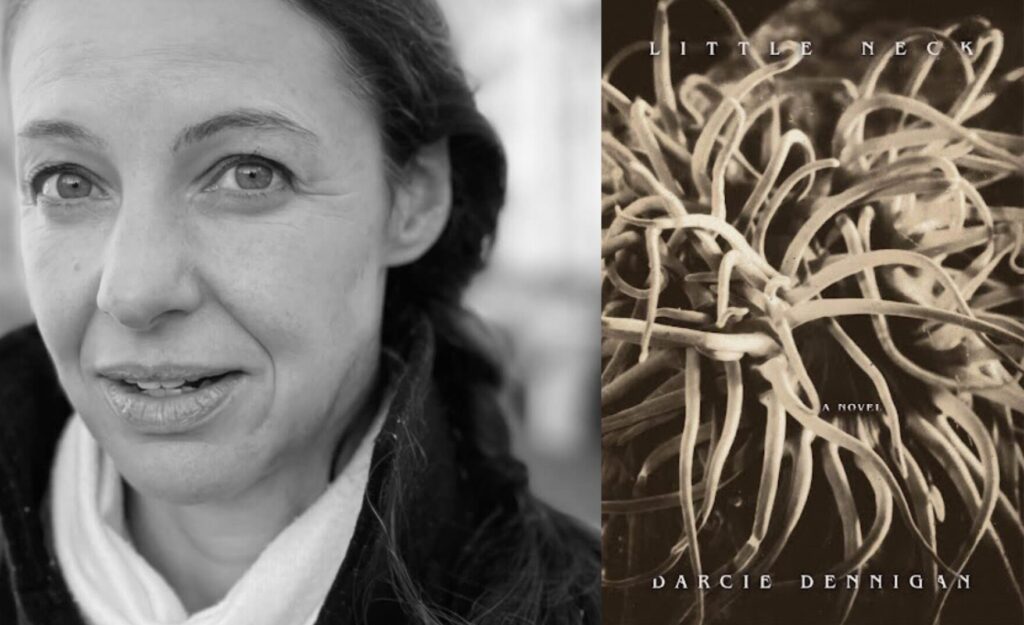
Little Neck by Providence’s Darcie Dennigan is the book that Gertrude Stein would have written, if only she’d had a side hustle in death. Told in spooky retrospect by a knowing teen who works at a gravestone-cutting shop, the novel begins with a four-sentence revelation about herself, her boss, Rosmarge, and a memorial in which they share an obscure interest. “Now that I am Marguerite Concrete,” she declares mysteriously, “I know it is Rosmarge who chose the epitaph. Now go. It is a thing that Rosmarge would say and it is the way she would say it. Now go.”
Questions about what people say and how they say it, and of what can be known and said in the first place, are at the center of this short novel. Not surprisingly, things are not at all what they seem at the start. To begin, the narrator’s name is not actually Marguerite Concrete, though her opening statement is so ambiguous you’d be forgiven for thinking so. Located in a town called Little Neck, Marguerite Concrete is actually a company run by two sisters, Rosmarge and Rita, who make headstones and carve epitaphs on them. The sisters write the epitaphs as well, specializing in strangely haunting phrases like Now go.
Some time earlier, the narrator turned up injured at the offices of Marguerite Concrete. Before that, she seems to have been abandoned as an infant at a cemetery called Rose Head. While the identities of her parents are unknown to her, everyone else seems to know who they are—or were. As the novel opens, its young narrator can no longer turn a blind eye to the lying adults who have until recently controlled her life.
Ambiguity is one of Dennigan’s great tools. She befogs her characters and their circumstances so fully that readers must stay on their toes. It helps that Little Neck is a largely silent place, charged with past crimes and long-held secrets—all this mystery prompts curiosity and interest. As the narrator comes to understand more about her parents and the circumstances of her birth, she relates these clues piecemeal, inviting the reader along for what becomes a truly alarming ride.

Last month, at a packed launch held at Riffraff Bookstore + Bar in Olneyville, Dennigan advised those present to “let the words flow over them” as she read from Little Neck. It was good advice. The effect was fairly electric, as might be expected from Dennigan, who is not only a prose writer but also a poet. While all writers of fiction ask readers to suspend their disbelief, to throttle the skepticism that ordinarily colors any thoughtful encounter with words on a page, Dennigan requires (and repays) a special effort to listen, to make space for ambiguity. To make sense of her, you have to follow her voice all the way to the end—of her sentences and chapters, of the volume in your hand.
In addition to drawing from poetry, Dennigan has a playwright’s sense of scene. Reminiscent of a play staged in a black-box theater, Little Neck relies on a spare handful of settings and characters. Stone, glass, and knives predominate in this grim and hard-edged world. Notably, the fingers of the narrator’s dominant hand, the one that cuts stone, are always closing around a blade. Naturally blood is everywhere too, flooding wounds that don’t heal. These wounds, both real and symbolic, produce floods of language as well as blood. While the world of the novel is sparsely furnished, its garrulous narrator charges that emptiness with story, telling her bloody tale in gushes of language that spread over pages, typically without the stanching relief of a single paragraph break.
Local touches are few but powerful. Take Marguerite Concrete: This is a real concrete company in Hopedale, just over the state line from Woonsocket; you may have seen their trucks around. The town Little Neck brings to mind both the local bivalves that grace plates of spaghetti and paella from Westerly to Pawtucket and the narrow isthmuses of Rhode Island’s coastal landscape. These connections are hyperlocal and charming. But Dennigan’s regional sensitivity extends to more than just cute corporate names and local fauna and geography. In a previous novel, Slater Orchard (2019), about a woman gripped by a desire to plant pear trees in a landscape of toxic waste, Dennigan made overt reference to Slater Mill’s complicated local industrial and environmental history. Both Slater Mill and Little Neck meditate on the ways in which important stories find ways of resisting the hush-up and the brush-off, finding ways of being told.
+++
Diane Josefowicz lives in Providence and covers books for the Providence Eye. Her latest book, Guardians & Saints: Stories, is just out from Cornerstone Press.


Want to comment? Click!