




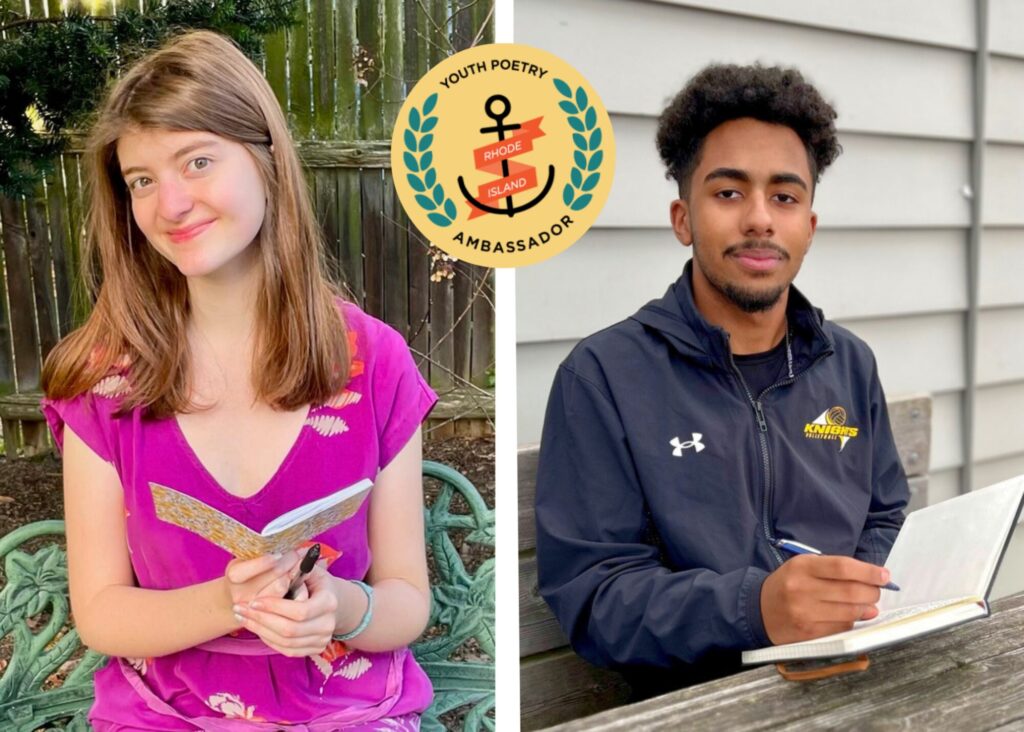
Every year since 2018, former Rhode Island Poet Laureate Tina Cane has collaborated with the Rhode Island Center for the Book to select a Youth Poetry Ambassador from among the state’s high schools. In addition to winning a cash prize, youth poetry ambassadors have their poetry featured on RIPTA buses state-wide as well as on Sound & Vision, the weekly poetry feature curated by Tina Cane for The Providence Eye. Ambassadors also read for the distance series, Poetry is Bread and engage in school visits, workshops, and other public reading or speaking engagements. In so doing, they cultivate their own burgeoning creative potential and serve as advocates for the written and spoken word in our state’s schools and communities.
I had the pleasure of speaking with Josselyn Wolf, the 2026 Youth Poetry Ambassador, and with Angel Cruz, the 2026 Deputy Youth Poetry Ambassador.
Josselyn, who describes herself as a “wanderer,” is a student at Moses Brown School. She is passionate about climate justice and activism for women. She is an actor, a songwriter who just released her first song, “Guardian Guide,” on Spotify, and is director of “Regeneration: A Story of Women, Climate, and the LA Fires,” a documentary film (currently nearing completion). She is connected with Urban Word, performs in poetry slams in New York City, works with The Wild Beauty Foundation to help save wild horses, and serves as editor-in-chief of the Moses Brown literary magazine Omnia.
Angel is a student at Providence Career and Technical Academy, where he studies graphics, pursues photography and videography, and competes on the school’s volleyball team. A visual artist with a drawing practice, Angel aspires to study architecture in college. Outside of school, he tries to be a good role model for his 13-year-old brother, pursues his interests in cars and electric guitar, and nurtures his playful side through building creative forms using whatever materials he has at hand. Angel enjoys watching movies and television shows, including anime, and has an interest in voice acting.
Josselyn and Angel took time out of their busy schedules to talk with me about their new positions as poetry ambassadors and the role that poetry plays in their lives and communities. Their responses have been edited for length and clarity.
What first drew you to poetry? How far does it go back in your life?
Josselyn Wolf: The earliest moment that I can pinpoint is watching Amanda Gorman recite “The Hill We Climb” at Biden’s inauguration. I was in sixth grade, and I stayed home from school to watch the inauguration because I’m passionate about politics and activism. When I saw that, I thought, what is this magic thing that’s happening? I’m an actor, too, so seeing how language could live in someone’s body and then be spoken as the spoken word, that unlocked a new dimension for me.
I’ve always gravitated toward poetry because when I walk through nature, I have so many images and sounds that come to me. Poetry is such an expansive medium. It can be whatever you want it to be, and it can live however you want it to, on the page, or in space and sound.
Angel Cruz: I feel like poetry is still kind of new to me. For example, I always liked writing in general, but then once I discovered poetry, I felt like it was something where not only can I be very expressive, but I didn’t have to say as much to be as expressive. In poetry, you can just put a couple of things down on paper, but it can mean so much with very little.
Is there a particular poem that has inspired you?
Cruz: Walt Whitman is one of the poets that interests me the most. I actually first heard of him from a movie, “Dr. Bird’s Advice for Sad Poets.” I ended up watching that movie about a billion times and also purchasing the book. Because I also do drama club, I spoke to my English teacher and explained that the book had inspired me to want to write a play about Walt Whitman. It tells a good story that shows him struggling with mental health issues.
Wolf: I got handed Mary Oliver when I was really young, and she has influenced so much of my work. I remember reading her volumes on the beach in Provincetown, where my grandfather lives, and where she lived too—I felt that connection was really special. Then a few years ago I got into Ada Limón’s poetry, too. But my favorite poet of all time is Andrea Gibson—when I first heard an Andrea Gibson poem, it rocked my world. Their ability to capture both universality and specificity is extraordinary.
What does being a Youth Poetry Ambassador mean to you?
Wolf: To me, that means inspiring my generation. Poetry is the medium of our generation, and we can use poetry as a force to move forward the change we want to see in the world. It can also express the connections and the deep, embedded interconnectivity that I think is lost in our systems and our laws. As an ambassador, I want to help inspire young people in our state to make those kinds of connections. Right now, Angel and I are working on a project with Tina Cane called the RIsing Poets Collective. It’s a collective for young poets and artists across the state, from both public schools and private schools. I’m really excited about this because there’s such a disconnect right now between public and private school students. The reading and writing scores in our state are so low, and I think there’s a lack of inspiration and engagement with language. This collective would bring people together who might not have found their community in high school, or who might not have found their engagement with language yet. So, in this role, I see myself connecting people with language and also connecting people with each other.
Cruz: Being this year’s Rhode Island deputy youth poetry ambassador means I have an opportunity to have an impact by being part of campaigns and events. It means I can help bring students together around poetry. But even though I have this position, I feel like others can also make a significant impact even if they don’t have the same resources that I’m provided with.
What do you see as poetry’s role in your community right now?
Cruz: In our community, poetry is a way to bring people together and connect them—not just through the writing aspect, but through storytelling. You know, people have even used poetry to tell history, which is a really big way of bringing people together. And especially for youth, having poetry can really help. For example, I heard from one student that poetry helped them get through a state of depression. That’s a big thing, you know?
Wolf: There’s just so much instability in our world right now, and there’s so much intimidation and violence. I’m thinking specifically of ICE and of the climate crisis, and of this really unstable government. I think that in times like these, we have to find community, and we have to find hope and stability in each other. And to me, that’s what poetry can be. It’s the connective tissue between people that helps bridge the divide and create the root system that will carry us forward.
Is there anything that surprised you in your interactions with audiences or other young writers?
Cruz: What surprises me the most is that when I speak, I seem to have confidence, but in my heart, I feel nervous. But then, as the words come out, I feel like I’m being heard, and that makes me feel like I’m making an impact. To see that people are actively listening to me and being impacted by my words—it makes me feel like I have a voice. It’s powerful.
Wolf: Something that continues to surprise me and inspire me is how many different ways there are to be a poet. Some people’s process is to sit and let it steep and be very intentional about every word. But I’m a total “flood” kind of writer. I let everything kind of fuse in my mind and it just comes out. I also think about spoken word poets and written word poets. Many people become poets because they can’t find the language to express out loud how they feel, so they go deeper with words on the page. And then there are other poets who are shouting out messages from the rooftops, and they want to be heard by the people in power. I feel like I’m somewhere in the middle between those two. But there are so many extraordinary young poets, and every time I meet another one, it gives me a lot of hope for our future.
What are you hoping to explore next in your poetry?
Cruz: I want to explore emotions and how to express them in creative ways. I’m also working on how I communicate what I write. I want to be able to speak my poetry without having to look down to read it—how to “be one” with my writing. I want to understand it so deeply to the point where I can just speak it from the top of my head. I’m also thinking about writing and publishing a poetry book. I feel it would be pretty cool to have a book published out there.
Wolf: Right now, I’m working on a poetry collection that I’m excited about called “Mother Matter,” that explores women and Earth as a shared and intertwined force of creation. I am fascinated by ancient wisdom about Gaia and Mother Earth. And I think there’s a reason that we always return to earth as a mother and as a life-giving force. That’s what I’m exploring in my poetry right now.
Do you think poetry can create change?
Cruz: You can write poetry just for fun and for your own interest, but poetry can also be used to speak on important topics, like society. And when that reaches a lot of people, heads start turning, and it can bring a lot of attention. That attention brings people together and brings awareness to whatever you’re writing about.
Wolf: Poetry is for everyone and is as relevant today as it was in ancient times. The world’s first known author was a poet, and she was a “she,” which I find inspiring—her name was Enheduanna. And so, starting from 4,000 years ago up until today, poetry has carried us through tumultuous times. I hope it will do so for my generation, too.
More information about the Youth Poetry Ambassador initiative can be found on the website of the Rhode Island Center for the Book.
Alizah Holstein is the author of My Roman History (Viking Press, 2024). She lives with her family in Providence, RI.


Want to comment? Click!