






Today (5/14), a Providence Teachers Union (PTU) special election will test whether teacher discontent is powerful enough to challenge the current union president’s lock on senior union spots.
PVD CORE (Caucus of Rank and File Educators), a small but vocal and growing group within the PTU, says the union should be doing much more than it has to defend and support teachers.
Anna Kuperman teaches English at Classical High School and has been teaching in Providence since 1997. “Sometimes it feels like we don’t have a union,” says Anna. “There’s so much that teachers can see is wrong. But there’s no sense that we can change it.”
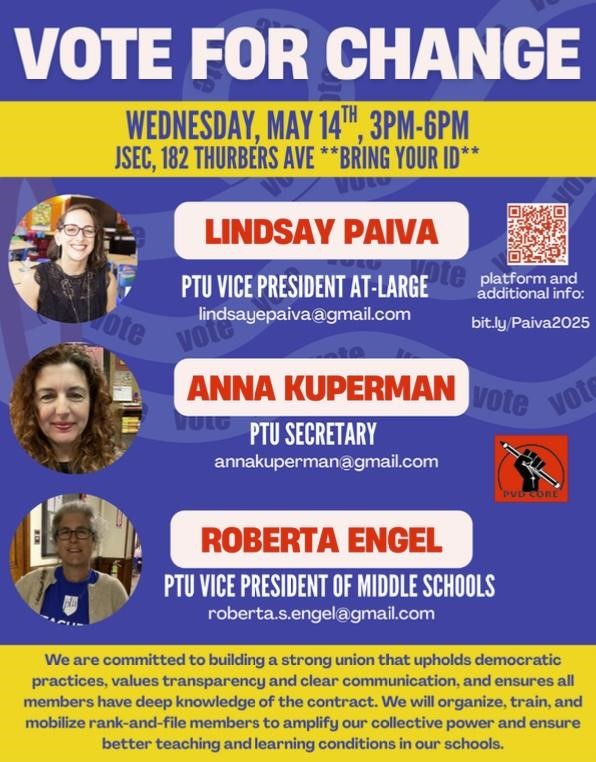
In opposition to the PTU-endorsed slate, she is running for PTU Secretary along with two other veteran teachers: Lindsay Paiva, at Webster Elementary, candidate for VP-at-Large, and a 2022-23 Providence Teacher of the Year; and Roberta Engel, at West Broadway Middle School, candidate for VP of Middle Schools. This comprises CORE’s slate for the three open seats long held by PTU’s leadership.
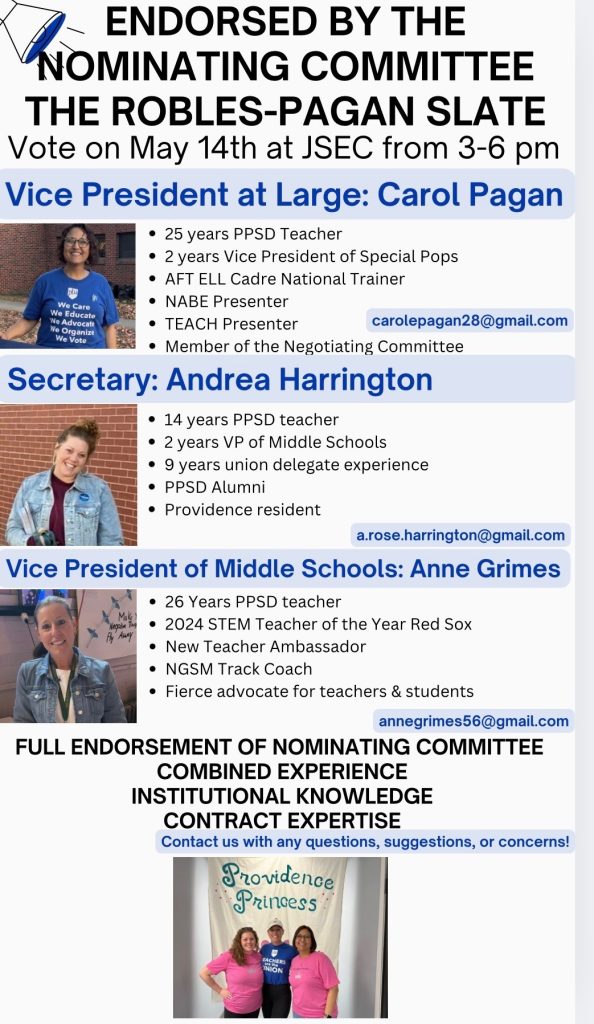
Kuperman’s PTU-endorsed opponent is Andrea Harrington, a 14-year PPSD teacher and current PTU VP for Middle Schools. Andrea is running on a PTU slate with Carol Pagan for VP-at-Large, and Anne Grimes for VP of Middle Schools. Carol Pagan is a 25-year teacher and current VP for non-grade assigned teachers, while Anne Grimes is a 26-year teacher, and a STEM Teacher of the Year and new Teacher Ambassador.
Current PTU President Cindy Robles feels that the PTU-endorsed slate deserves the leadership posts at stake. “All three [nominees for contested offices] are fierce advocates for children, for teachers and for learning. These are workers. They show up, they run committees and they are not afraid to go to bat for us in ways that are effective.”
The PTU Elections and the Current Contract
Leadership elections are held every two years, but challenges to the PTU-endorsed slate of candidates are infrequent. The time and energy demands of these offices are substantial and outweigh the rewards. PTU officers maintain their teaching positions and get some paid time in the school week to do their union duties. None of these are paid positions, though officers are relieved of their union dues of about $900 annually, according to Kuperman.
Typically, union officers rise through the ranks: they volunteer as their school’s union delegate–a position that situates them as an intermediary between staff and administration, and seats them on the school’s Instructional Leadership Team (ILT). For this and other services, such as showing up for union events, State House hearings and other advocacy, a union activist may receive the PTU Board’s endorsement to run for leadership roles. A teacher really has to care deeply about the union to put themselves forward for a union office.
But just being a good PTU volunteer is not enough, according to Kuperman. She and CORE fault past and current PTU leadership for not doing enough to defend rights that teachers already have in their district contract.
“It’s a good contract, but teachers do not know it enough to enforce or ask for their rights, such as helping a kid get Special Ed services.” And, she continues, “A good contract goes hand in hand with a good relationship with the community–this is about making schools better for kids.” Also, widely unknown by teachers and ignored by management are the extensive contractual and legislative provisions mandating building-level collaboration and information-sharing between administrators, teachers and parents.
The PTU contract creates an Instructional Leadership Team (ILT) chaired by the principal and PTU building delegate. The contract states that “The ILT shall use a collaborative decision-making model in all aspects of school operations, especially instruction.”
Under the contract, the ILT should also work with a School Improvement Team (SIT), a collaborative body of teachers, administrators and community members charged with guiding each school’s improvement efforts. By law, SITs are required at every public school. Kuperman notes that they have some oversight of the budget, though in some cases, “They have not even seen the budget,” she says. At many Providence schools, it’s not clear whether there is an active SIT at all.
“The ILT is co-run by the delegate and the principal. It is a majority teacher committee: Teachers could bring issues, suggestions, innovations to these committees.”
However, Anna Kuperman says that this structure is not working. ILTs are not meeting, or are undermined by administrators. PTU building delegates are not well-trained to represent their members. PTU has done little to make the ILTs or SITs effective or to enforce teachers’ rights to become a collaborative voice in instructional policy.
This critique ties into one of the tenets of PVD CORE’s platform: “Training for ILT and SIT members.”
“There is a lot of fear of the administration – it’s an adversarial relationship. There are more of us and we know more, we do more in the day to day, but our voice is not considered, not amplified. The building can be a place to build confidence, to build solidarity among professionals.”
PVD CORE’s platform calls for “Contract Teach-ins,” to bring teachers into an understanding of what is in the contract. While the contract between PPSD and PTU expired in August of 2024, it remains in force under Rhode Island’s ”evergreen law” governing union contracts, which keeps expired contracts valid and enforceable until a new one is negotiated and agreed upon.
Teachers’ Power Has Eroded
“We need a win,” said Anna Kuperman of her demoralized colleagues in Providence. She adds, “there is a lot of fear that if we do anything we will lose what we do have. The fear comes from PTU leadership: They constantly say ‘No actions are possible.’”
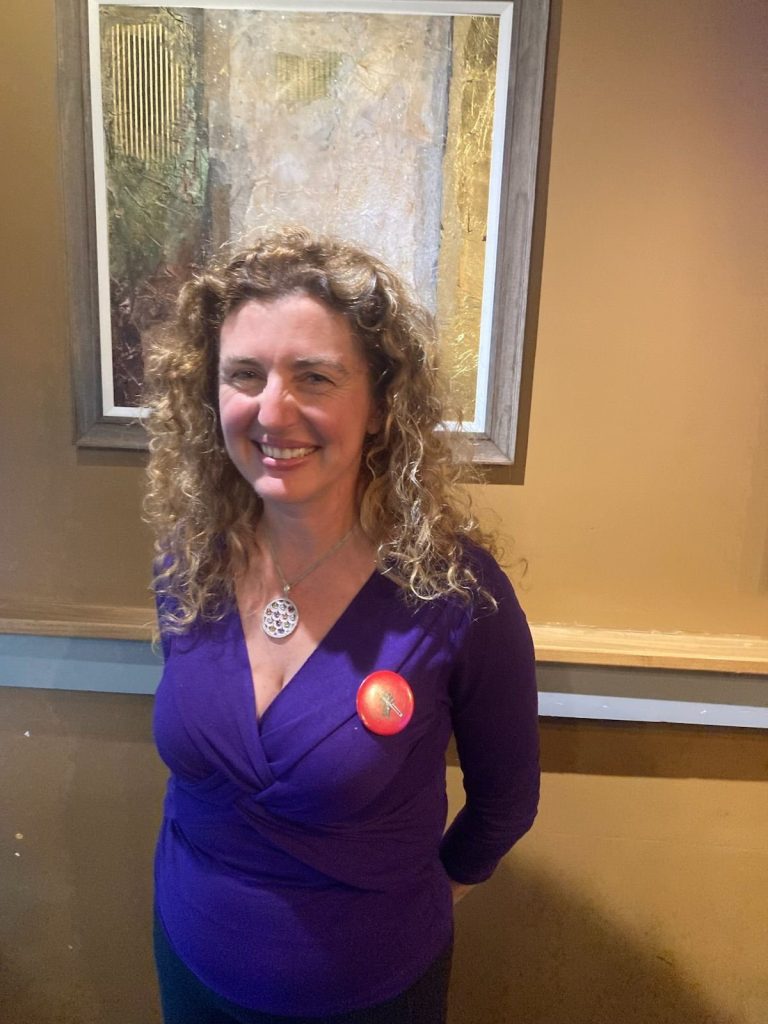
Anna has seen change a-plenty in the 24 years she has been teaching in Providence: Her first school, Oliver Hazard Perry Middle School was closed in 2012 due to neglect of the historic building. Anna was among the teachers rehired that same year after Providence Mayor Angel Tavares fired every last teacher in Providence, citing a fiscal crisis to justify the drastic measure. The city rehired many of the same teachers to staff the schools, but offered reduced salaries and benefits.
2012 was also the year that the national narrative around urban educational reform shifted, with the substantial gains won by the Chicago Teachers Union under its newly-elected MORE caucus: Movement of Rank and File Educators. They fought not only for so-called bread and butter issues like salary and benefit increases, but also for class size reductions in elementary schools, and increased staffing of counselors and social workers. They won many of these concessions after a nine day strike under the rallying cry, “Our working conditions are our students’ learning conditions.”
The Chicago victory carried forward to other school districts around the country: West Virginia teachers went on strike in 2018 under the same slogan and won considerably, as did Arizona teachers. Los Angeles Unified School district teachers struck and won with demands for more counselors, restorative justice to replace punitive suspensions of students and caps on charter schools. Chicago teachers won further gains after a 2019 strike. Until these victories it seemed that urban teachers unions would roll over to corporate interests that supported charter schools and de-unionization of the teacher force.
Meanwhile, teachers in some charter schools in Providence and around Rhode Island are working to unionize. Teachers at Paul Cuffee Charter formed a chapter of the American Federation of Teachers and are now trying to secure a contract. “They [PTU leaders] are not connecting us to the [Paul] Cuffee effort, though it is an AFT chapter. Our union is isolated and struggling,” says Kuperman.
PVD CORE Platform
The PVD CORE platform calls for education, teacher empowerment and amplification of teacher voice. One goal is to strengthen solidarity among teachers and across schools: “There is a lot of institutional knowledge, but people are siloed,” says Kuperman. “If people knew one anothers’ stories, we could file one grievance rather than disparate grievances; we could work together to win a change.”
PVD CORE has strong racial justice values. They are disappointed that newly hired educators of color have also been the first ones laid off. “We are in a majority black and brown community,” says Kuperman. “If we don’t stand up for students and families of color, they won’t stand up for teachers.”
“We need to be rebuilding the union as membership-driven, where teachers are involved…. And where the union really wants people to be involved,” says Kuperman. She is perturbed that PTU has been so secretive about the ongoing contract negotiations.
PTU President Robles says a final agreement will be “coming soon,” but declined to offer any specifics. Both PTU and PPSD have long-standing policies of maintaining secrecy around the specifics and status of ongoing teacher contract negotiations.
“At the end of the day everyone has the same goal: better working conditions and better outcomes for students,” Robles says in response to PVD CORE’s platform. “We may just have different approaches.” Robles said she’d be willing to elevate common building level concerns to the district level, as PVD CORE advocates, “but we’re not [getting] information about these types of things.”
Win or lose, Kuperman says, PVD CORE candidates will continue the persistent building-based organizing that has characterized their election campaign.
The contract and current negotiations may concern PTU members greatly, though the elections may or may not. In the last PTU election only 88 of PPSD’s roughly 1,900 teachers even voted. In most years, Board endorsement pretty much guarantees a win on election day.
But maybe not this year. With leadership positions contested by vocal members of a new caucus, maybe teachers will get out and vote.
Catlin Preston has taught kids in public elementary school and at the college level for over 20 years. He teaches, writes, and lives in Providence.
Jonathan Howard is Co-founder of Cause & Effect, Inc., a consulting company that provides strategic planning facilitation, fund development planning and board strengthening to mission-driven organizations. He is a long-time resident of Providence.


Want to comment? Click!