



As the early summer days slip from June into July, there is some certainty in Providence life. The weather forecast will start using the phrase “heat wave,” frozen lemonade will be sold by the cup, and the first quarter City of Providence tax bills will arrive at homeowners’ doorsteps.This year, however, Providence tax bills will arrive later and will be larger. There’s been a lot of push and pull in the proposed City of Providence Fiscal Year 2026 Budget (the fiscal year runs from July 1, 2025 through June 30, 2026) and the accompanying increase in property taxes. Here’s a breakdown of some need-to-know aspects of the proposed budget:
How much money is Providence proposing to spend in the FY 2026 City Budget? Where’s it coming from?
Mayor Smiley and the Providence City Council are proposing to spend $624 million to operate the city for FY 2026. The biggest expense buckets in the budget are public safety, $230 million; schools, $147 million; and the City’s contribution to employee pensions and health benefits, $123 million.
The revenues to fund the $624 million budget come primarily from the following sources: $401 million from property tax revenues; $125.6 million from the state; $26 million in department revenue; and $14.7 million in fines and fees. This last source of revenue includes parking tickets, traffic camera violations, and other court-related fines.
Why Isn’t There a Final City Budget and Tax Bills Yet?
The city wants to collect $401 million, the “tax levy,” from taxpayers. That’s a 6% increase from last year’s proposed tax levy of $379 million. By state law, municipalities are limited to a 4% annual increase in tax levy. To exceed that amount, Mayor Smiley had to submit his proposed tax increase to the General Assembly for its approval.
The state General Assembly eventually and reluctantly passed that legislation on June 20.
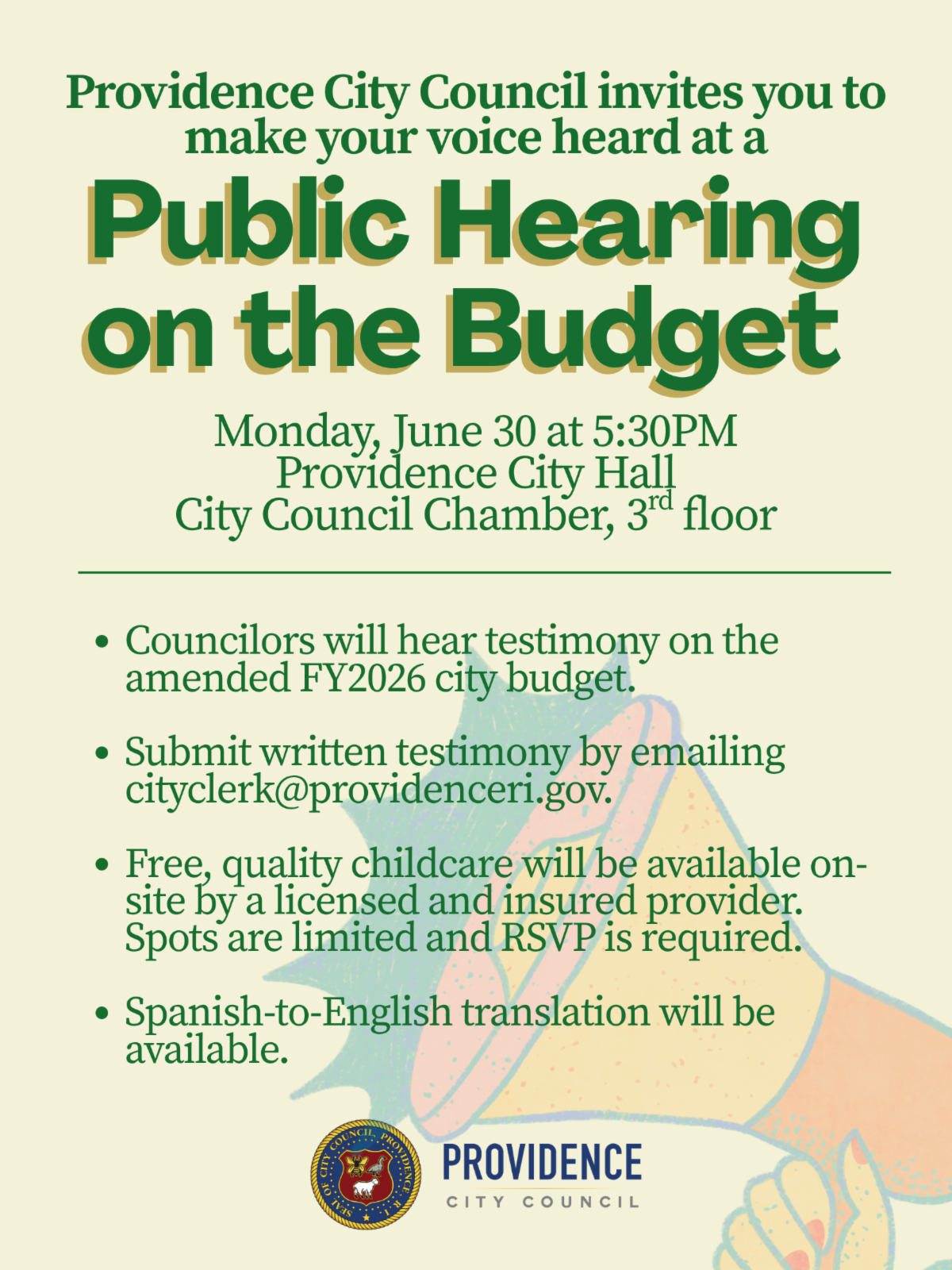
On June 30, the City Council Finance Committee will hold its second public hearing regarding the Mayor’s proposed budget and submit their recommendation to the full City Council. Then, the City Council has to pass it and the Mayor will need to sign it. An optimistic date for the signed budget is early July.
What Tax Rate Changes are the Mayor and City Council Proposing?
The City just completed revaluation of all property to reflect the substantial increases in real estate values throughout the city. Valuations have increased dramatically in residential property, and most tax rates will go down — but not in proportion to valuation increases, as the city needs to bridge the debt gap in tax levy funds. Estimates of the final tax rates, provided by the Mayor’s Office are shown below.
There is also a tax calculator on the City’s website at providenceri.gov/tax-calculator.
PROPOSED FISCAL YEAR 2026 vs. FISCAL YEAR 2025 PROPERTY TAX INCREASES*
| PROPERTYTYPE | FY 2026
Average Assessed Value |
FY 2026
Proposed Tax Rate |
FY 2026
Average Tax Levy |
$ Change
FY 2026 vs. FY 2025 |
Monthly $
Change FY 2026 FY 2025 |
% Change
FY 2026 vs. FY2025 |
| Owner-
occupied single family |
$551,880 | $8.25 perthousand | $4,553 | $160 | $13.33 | 4% |
| Owner
occupied 2-5 unit |
$582,027 | $8.29 perthousand | $4,825 | $649 | $54 | 16% |
| Owner
Occupied condo |
$507,713 | $8.25 perthousand | $4,188 | $165 | $13.65 | 4% |
| Non-owner
Single family |
$445,385 | $14.40 perthousand | $6,413 | $286 | $23.83 | 5% |
| Non-owner
2-5 unit |
$606,385 | $14.40 per
thousand |
$8,731 | $1,197 | $99.75 | 16% |
| Non-owner
condo |
$335,877 | $14.40 per
thousand |
$4,836 | $219 | $18.25 | 5% |
| 6-10 unit
housing |
$947,975 | $24.50 per
thousand |
$23,225 | -$1,156 | -$96.33 | -5% |
| 11+ unit
housing |
$4,832,121 | $27.75 per
thousand |
$134,091 | $1,699 | $141.58 | 1% |
| Commercial | $855,368 | $28.80 per
thousand |
$24,634 | -$400 | -$33.33 | -2% |
*Before individual property exemptions
Here are key takeaways from this chart:
- Owner occupied residential single-family property gets off fairly lightly with only a 4% increase.
- Previous Mayors have shifted the tax burden in the city to commercial property. Providence presently has the third highest commercial tax rate in the country. Mayor Smiley is proposing to reverse the trend of increased commercial property taxes by reducing commercial taxes slightly this year.
- The largest change in tax rates is seen in 2-5 unit rental properties, both owner and non-owner occupied. Landlords are likely to raise rents to adjust for the increased costs, potentially exacerbating limited housing affordability for Providence renters.
How Did Providence Get into a Situation Requiring a Major Tax Increase? The Tax-Exempt Property Problem.
The Providence budget and revenue stream is hampered every year by a major structural problem: Between 40-44% of the property value is tax-exempt. Institutions like universities, hospitals, government-owned land, churches, and nonprofits all pay no property taxes.
In the last twenty years, the City entered into agreements with the four Providence-based universities to pay Payments In-Lieu of Taxes (PILOT); however, the payments were minimal, a tiny fraction of the $90 million in taxes per year that would have been levied if the universities had to pay taxes. Mayor Smiley has renegotiated the PILOT payments for the universities, Lifespan (now Brown Health), and the Port of Providence. As a result, revenues this year are $17 million, but still a fraction of what universities would owe if taxable. The state has also provided PILOT payments to Providence since 1988 ($38 million last year) in recognition of the tax-exempt problem.
How Did Providence Get into a Situation Requiring a Major Tax Increase? Questionable Political Fiscal Decisions, Small and Large.
Some are some of the political decisions:
- The City deliberately underfunded the Providence Public School Department (PPSD) since 2018. In November of last year, a RI Superior Court judge found that the City violated the Crowley Act in FY 24 by failing to increase municipal funding for school districts by the same rate as statewide school aid. This year’s major tax increase is, in part, a result of the City needing to bridge this gap in school funding, rather than incrementally increasing funding year-to-year.
- The city received and spent $166 million in COVID American Rescue Plan Act (ARPA) funds on a variety of investments between 2022-2025. The federal government allowed expenditures on programs that expand “racial equity” in Providence. Providence finally used $4 million of ARPA funds in late 2024 towards the $15 million required by the RI Department of Education (RIDE) for Providence schools. For some reason, the Providence school system, which has a majority of minority students, didn’t use ARPA funds for the schools before the RIDE intervention.
- As mentioned above, several previous mayors minimized residential tax increases and shifted the tax burden to commercial property. As a result, Providence has had a low commercial tax base in the last 10 years because of the high taxes on commercial property.
How Did Providence Get into a Situation Requiring a Major Tax Increase? The Recent Decline in Valuation of Downtown Office Buildings.
COVID changed the work culture for offices. Lots of people worked at home during COVID. Lots of people are still working at home. Downtown Providence offices have seen a sharp decline in office space demand. As a result, the assessed value of Downtown office buildings has decreased every year for the last five years. And the tax levies for the city budget have declined accordingly. Here are some of the Downtown buildings that are becoming “ghost buildings.”

What are Providence Taxpayers Saying About the Proposed Providence Budget?
“I represent a district (Elmwood and Olneyville) that cannot pay $1 more in taxes.”
– RI State Senator Ana Quezada
“I think it is really vital that we dig down on other revenue sources.”
– Helen Anthony, Chairwoman, Providence City Council Finance Committee
“I support the proposed budget. I am glad to see the elderly tax exemption for homeowners increasing from $600 per year to $750.”
– James Wolfgang, Mount Pleasant
“This budget will further burden renters by targeting 2-5 unit residential housing. I am against this budget. Why are we spending more on fancy police uniforms than we provide our neighborhood libraries?”
– Zoe Nadig, West Broadway.
“We need rent stabilization. We need a tiered system of property taxes for multi-family housing. The landlords who own 6+ units should pay higher per unit taxes than landlords who own 2-5 units. Providence is not the Creative Capitol. We are the Unaffordable Capitol.”
– Andrew Poyant, Elmhurst
“I support the proposed budget, particularly the funding for the Police and Fire Departments.”
– Sharon Steele, Jewelry District
“I stand in opposition to the Mayor’s budget. I own a two-family house and my mother lives in one of the units. My housing shouldn’t be taxed at the same rate as the LLC’s in Providence who own scores of rental units.
– Carol Lisi, Valley
“I am opposed to this budget that taxes the poor while giving tax breaks to wealthy developers. The Mayor should have worked with the City Council to get more taxes from Brown and the other universities and from Lifespan.”
– RI State Representative Enrique Sanchez, West End
“I am in support of this budget. It strikes a balance between maintaining vital city services and being fiscally responsible.”
– David Salvatore, Providence Foundation and former Providence City Councilman, Elmhurst
“We shouldn’t be raising taxes like this. We need a tax structure that people can afford.”
– Jackie Goldman, Elmhurst
Bob McMahon has been a Providence resident since 1978. While an officer in the US Navy, he participated in the recovery of the Apollo 11 astronauts in the Pacific Ocean in 1969. He has a city planning background and worked in the Providence Parks Department for 30 years, first as Deputy Superintendent under Nancy Derrig and later as Superintendent. Married to Pam Kennedy, they have two adult sons, James and Robert. He is a volunteer for the San Miguel School and St. Pius V Church in Providence. Daily devotee of the New York Times word games: Wordle (3.0 average guesses) and Spelling Bee (859 straight days Genius level).


Want to comment? Click!