


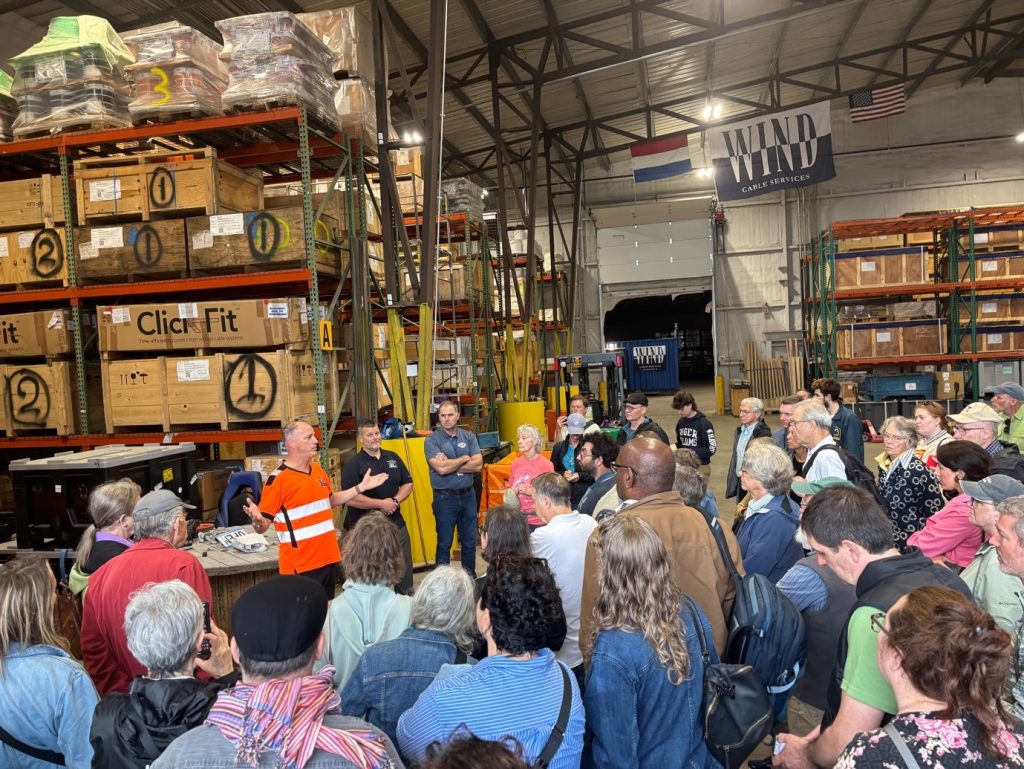
EDITOR’S NOTE: After the Eye’s first major public event — Providence Port Day, on May 17 — the Readers Voices section put out a call for readers to share their experiences. A number of people submitted a few sentences, which we compiled in the May 21 essay “Readers Respond to the Eye’s First Event: ‘Providence Port Day.’” A few days later, one attendee — Mark Douglas, of Riverside (via England and Jamaica) — responded with a lengthy account that captured the day with detail, insight, and humor. We are pleased to share it with you.
I recently got lucky.
At dinner with friends I happened to mention that I’d gone on a couple of Jane’s Walks in Providence – around Fox Point and the Jewelry District – which I’d found stimulating. One friend, a journalist and Rhode Island advocate, suggested I register for the upcoming “Port Day,” organized by the Providence Eye, a community news site he’s involved with.
I’m a recent immigrant from the UK – a Jamaican Londoner not long retired. I cycle and I cook, and some nights I dream of America. From our new home in Riverside we can sometimes hear the port humming. One night a ship festooned with lights slipped past the bottom of our road and I imagined I was Mark Twain, standing watch over the Mississippi. My wife told me to calm down.
Now, to my friend’s offer I said “Sure!” (I’m trying to practice my American). I’m very glad I did.
*
I nearly didn’t make it.
When I clicked on the link the next day I came unstuck at the sight of the 8 a.m. registration time. To see a port?
I’ve never been a morning person and, since I retired, I regard sunrise as a time for catching planes. I dithered. Embarrassingly, by the time I clicked two days later the link produced a red We are no longer taking new registrations message. My kind friend intervened and got my name added to the list. “You’ll get an email,” he said.
I did get an email and I almost stumbled over that too. It was pretty detailed. Apart from an array of tours, there was talk of a choreographed lunch, followed by “workshops.” For some retirees the word “work” can be triggering. I wondered if it might be a long day. In the end I decided to come for the morning tours and then maybe slip away before lunch.
Naturally I woke up before the alarm went off. In my experience, the rare act of setting an alarm itself produces adrenaline. Bleary-eyed, I drove up the river from Riverside and then down the other side on Allens Avenue to the Narragansett Boulevard entry to the Johnson & Wales Harborside Campus.
It was an uncharacteristically grey morning, where only the outlines of wind turbine blades showed through the low hanging mist. They were very close here overhead, while the opposite bank of the Providence River where I’d opened my eyes presented as a grey wall, a memory. At 7:50 a.m. I climbed out of the car and looked across at the crowd of people gathered in front of the Johnson & Wales building.
I was reminded of a favorite anecdote about a French writer who was famous for never being seen before midday. It came to pass that he had money problems and, after dodging various summonses, was told by his lawyer that he had to come to Debtors Court for his case early in the morning. The lawyer arrived to find the writer standing outside the court gaping at the people thronging the sidewalk, heading for work through the morning mist.
“What’s the matter?” asked the lawyer.
“I had no idea!” said the writer.
“What?”
“I had no idea so many people were in debt!” he exclaimed.
People just kept coming. It might have been a Berlin nightclub shifting over to the morning session, except there was no hint of intoxication and the signs said “Providence Eye Port Day.” I saw other signs with what looked like tour names, and a table marked Registration, decked out with stacks of paper. I approached and gave my name and the woman started checking the list.
I’m good at reading upside down (weird) and I enjoy alphabetical ordering (weirder), so I could see almost immediately that my name wasn’t in place. Sure enough she started to say “I can’t seem to find…” when another woman standing to the side with a kindly proprietary air said confidently “Yes you are here!” and pointed with a big smile to a pencilled entry at the top of the page. I wondered if she’d written it there herself. They then handed me an itinerary with my name printed at the top of the page, and they chorused “Welcome!”
That was the beginning of an astonishingly good day.
*
This was some operation. I soon realized that the reason I had my own itinerary was because there were multiple tours and workshops and that people who had registered properly had made choices. The detailed instructions the organizers had issued represented great care taken in the face of complexity. I felt guilty about my truculent reaction to the email.
I blame culture shock. Living over here I feel like it’s more the norm to experience rigid protocols and finger wagging instructions. Everywhere I encounter the words “YOU WILL” (as in “you will go for your lunch at 12:20”), “YOU MUST NOT,” “STOP,” and my personal eye-popping favorite “WRONG WAY.” On a recent afternoon I went to Shaws to buy cough syrup and the young woman at the till looked into my weather beaten, grey bearded face and asked for my date of birth. I smiled and thanked her for asking. That was a better reaction.
I really shouldn’t let this stuff rile me up, but sometimes I feel like I’m a boy of nine again learning the rules. I once went to the Newport Jazz Festival. I can honestly say it was the most orderly festival I’ve ever attended, right down to the chalk marks on the grass to contain the audience. And don’t get me started on the Alcatraz beer tent with ID checks. Of course the music was great and the event went off without a hitch, but it’s not like Europe. It’s definitely not like Jamaica. It’s like Rhode Island, U.S.A. and I need to learn the language.
I looked at my itinerary. Today I was going on the Providence Port Bus Tour which was reassuring because it sounded exactly like what I thought I’d signed up for. Later I was also going on something called Public Site Access. I was intrigued.
Three yellow school buses were parked by the curb. I’ve been seeing these buses in the movies it seems since I was a kid. They say “America” to me like nothing else. Iconic!
Since I’ve lived here I’ve learned that they can actually stop four lanes of traffic simply by raising their arms and flashing their lights. Awesome! Could it be that Providence Eye had somehow got control of them? Could it be that I was going to ride in one? They had! I did! How cool is that?
On the bus I sat next to a guy I’d been briefly introduced to when we were milling around. He had a long grey beard and eyes that looked like they might twinkle. He told me he’d been working in the nonprofit sector all his life. He said he was really looking forward to his second tour which was something called the Narragansett Bay Commission. It turned out he was going to go underground into a great sewer.
“And you’ve been wanting to do this for years?” I asked, keeping my voice carefully neutral.
“Yes I have!”
“OK.” I said, even more non-judgmentally.
He laughed.
“It’s all about the engineering. It’s an incredible feat!”
He described something like two huge tunnels leading sewage overflow out to a pair of vast subterranean chambers where it could be held, swilling around, for processing, instead of going unfiltered into the Bay. Oh wow!
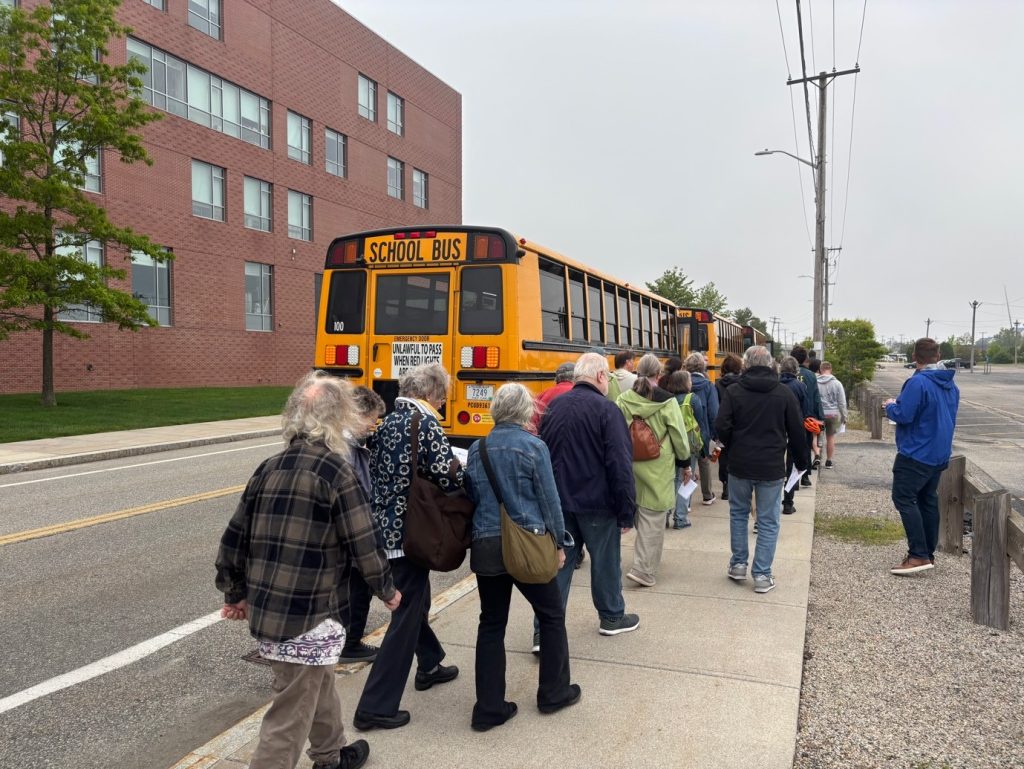
Meanwhile our school bus was rolling. The tour guide turned out to be the CEO of Waterson Terminal Services, the company running ProvPort. He kept up a constant stream of patter as we drove slowly through an enormous parade ground for holding product, and his grasp of facts, figures, business and technical operations was truly phenomenal. We were shown great mountains of salt – from rock and from sea – brought in by Morton Salt from other states and from as far away as Egypt, and he described how in winter platoons of trucks arrive in waves from around the state of Rhode Island, load up, and head out to keep the roads safe. We drove past acres of packed timber, formerly from Canada but, since the tariffs, now coming from Scandinavia. He stressed that ProvPort as an entity is continually on the hunt for product suppliers and aims to stay agile in case of turbulence.
We stopped by an oil storage depot and heard of a fire last December caused, he said, by a faulty sensor not registering an empty tank and continuing to heat. But all the safety systems worked, he assured us, smoothly ending on a positive note. Moving on, an extraction system that suctions liquid cement from ship storage up to a giant dome in St Mary’s Cement Distribution lot was surprisingly fascinating to consider. We drove past more scrap metal than I’ve seen in my entire life, and I think I remember him saying that practically all steel is the product of recycling. (Please don’t take my word for this as my head was already spinning at that point.)
As we rolled past rows and rows of tanks marked with symbols and occasional words, he responded to a question from someone behind me to say that they at ProvPort didn’t know what chemicals were in the tanks and weren’t allowed to know. The company name was Univar Solutions. There was extra security involved. Unease seemed to seep into the bus as we continued past the anonymous tanks.
The last coal shipments left the port around five years ago, I believe he said.The buzz on the port was around renewable energy. Even the oil terminals mandated a biological component. Recent politics had placed a question mark over the rate of renewable expansion but our guy was bullish that the long term direction of travel was clear. Our last stop was by a large Dutch operation, WIND, that supplies parts and cables for wind turbines.
“Cable” makes it sound like something you’d stick in the back of your TV, but the export cable that carries the power back to shore from an offshore turbine has a diameter such that if it were a tunnel you could probably drive a family car through it. We inched past a gigantic cylinder containing one such cable. The case was designed to slot into a spooling device on a ship, all ready to lay that fat snake out along the ocean floor. Here, as so often on the tour, the role of automation loomed large. We were told that the entire base of a wind turbine is assembled out on the ocean by robotics. Only when it’s fully assembled does the first human step onboard. At the same time our guide was keen to point out the reliable long term employment opportunities for longshore men at ProvPort. They were well supported and the camaraderie was exceptional.
Longshoremen. It had a romantic ring to it. I found myself wishing that I was a longshoreman, deftly handling hawsers and forklifts and shouting to my comrades through the salty air, instead of being just an old guy on a school bus. But then I considered that the whole school bus thing was working out pretty well for me, so I got over that.
When we got back to campus everyone clapped and our guide’s face went pink with satisfaction.
*
We all swirled around for a bit, like in one of those square dances you see in old Hollywood movies. People were generally buzzing. I was enjoying being with people who clearly cared about their environment and wanted to learn more. My bus companion went off to hook up with other subterranean explorers. I reconnected with my journalist friend and a group of us started walking behind the mild mannered landscape architect who was our new designated guide. He led us toward the water’s edge.
We were quite a large group until a second leader materialised to siphon off half of the folk for a boat tour from an organization called Save the Bay. This had happened earlier when we were being shepherded onto the school buses. A bunch of people were led away to the water for a Providence Port Boat Tour. Never mind the means of production, these Providence Eye people clearly controlled the means of transportation! At this point I wouldn’t have been surprised if a helicopter had swung down like a chariot to take a select few for ProvPort from the Heavens.
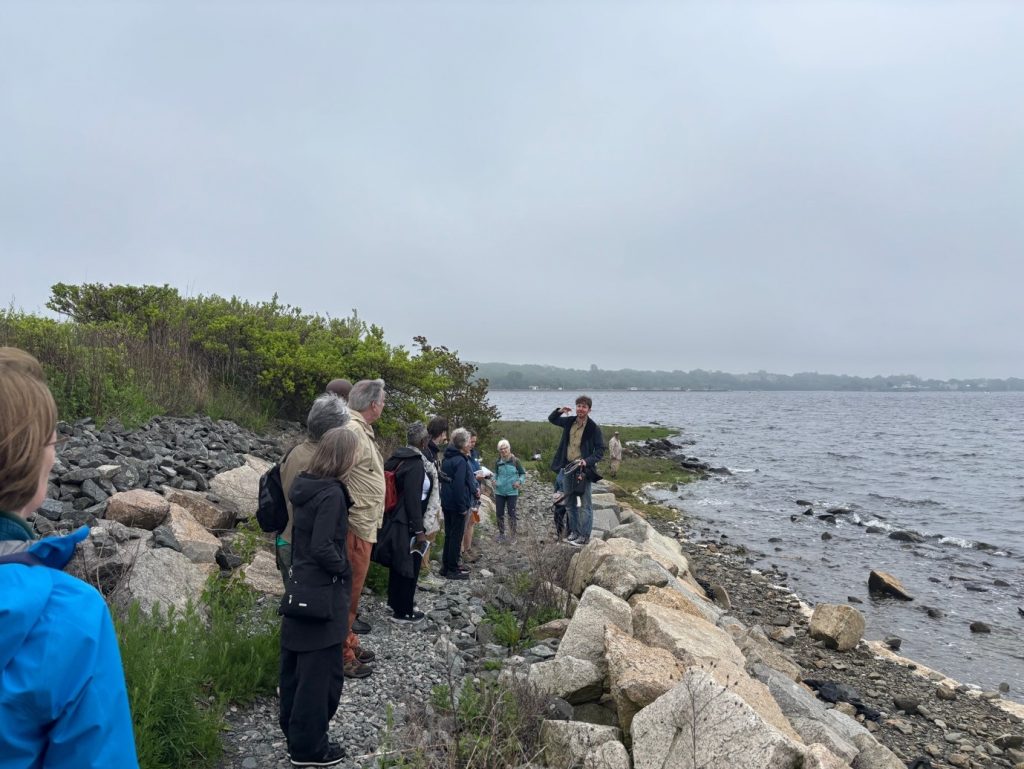
The Public Site Access Tour was a more gentle, intimate affair. Our guide, Adam Anderson, the founder and principal of the Providence landscape architecture firm Design Under Sky, was soft spoken so we tended to gather close. Also we were always in the presence of greenery: grasses, shrubs, rushes, sedges, whispering trees. This was kind of the point of the tour. Our guide explained that the area had long been a dump, but then was rescued for development and capped.
I’d recently heard about “capping” on the Jane’s Walk around the Jewelry District. Apparently the chemicals involved in jewelry production could be particularly toxic, so they capped the ground and banned new buildings as unsafe. That guide said that this explained the proliferation of parking lots in that area. I’ve long thought of parking lots as dead ground, and this idea that some were brought into being as a scab over poisoned earth had struck me as poignant and ironic. Here, where the cap concealed something not quite so noxious, they had added soil on top and planted suitable vegetation to bring life.
We meandered along paths near the coast and visited maybe five such oases. Our guide had developed other natural areas around Rhode Island and shared lots of specialist knowledge about types of vegetation, names of trees, special ponds created as a means of sediment filtration. It was all about reviving the land and protecting the bay. I wish I’d recorded him because many of the particulars have flown out of my old head.
In our group there was a teacher of Environmental Science from East Providence High School who was smarter than me. She made notes and sometimes got him to repeat the names of trees. Later, when we all gathered for lunch (yes I did go for lunch in the end), she explained one of the terms he’d used: “Superfund.” I now know that this is a legally sponsored way for the federal government to clean up areas designated as seriously toxic, where local resources would not be sufficient for the rescue. Pretty cool. The port area didn’t qualify for that status but I imagine the Jewelry District might have.
Of course the tour was also about “public access.” Adam showed us newly erected signs indicating public right of way (and of course responsibilities). He pointed to secret paths. He dreamed of further sensitive development. When quizzed by my friend the journalist, he told us the magic words to say if Port Security questioned your right to be there, and he mentioned a Rhode Island law granting passage along the shoreline up to the high tide mark, and a more recent shoreline access law that attempts to clarify that.
On the walk back a small group of us chatted about access. My own impression, as a recent arrival and as a cyclist who explores, say, a 20-mile radius around Providence, is that at first look there seems to be water everywhere; the bike paths are often luminous with it. There’s the East Bay Bike Path, there are rivers, there’s the Blackstone River Bikeway, pulling you up country. But if I go hunting for quiet coast, for beach, it can sometimes be difficult to even find.
I often cycle along knowing that the sea is close – I can smell it or even hear it – but all I can see are houses and “No Trespassing” signs. With some quite beautiful exceptions, (half hidden passages that lead to wild coves, a sweep of reeds catching the light, or else stark stretches of beach) it feels to me altogether too rare to see an arrowed sign pointing the way down past the houses to the coast, so the shoreline access legislation can feel somewhat theoretical. The others talked of disputes with property owners and with security guards, and even court cases.
In my opinion, the National Trust in England is quite good at managing this kind of access. In Jamaica, not so much – the hotels and the beach house owners run roughshod over everyone else. I told a story from my teenage years where a walk down a long sandy beach came to an end with a barbed wire fence that extended down into the water, plus an obnoxious armed security guard. We knew there was music further down the beach. So we went back a ways and then dived into the turquoise sea. We swam out until the barbed wire came to an end. Then we tracked the coast for a while and swam back in. Nearly fifty years later I remember a golden afternoon that could easily have ended badly.
*
When Port Day took place, I was going to the Caribbean to see my mother soon and I planned to go to a local craft market to buy her a handmade birthday present. But I’d had such a good time that first I decided to stay for lunch. If I’m honest I don’t even know what time it was, but given the supreme organizational skills in evidence, it probably was 12:20.
After the Public Site Access Tour, we strolled past the main Johnson & Wales building that sat on the crest of a wave of land, overlooking the port. It looked not unlike an enormous cruise ship. The East Providence High School teacher told us that the expansive panes of glass all along the ground floor (sorry, first floor!) were designed to collapse immediately in the case of a major flood, to prevent the building from being toppled. I found this fact simultaneously impressive and disturbing.
We entered the lunch building where the corridors were lined with photos of smiling chefs wearing spotless hats and aprons. They looked fondly down on us as we chose from the array of boxes stacked on creaking trestle tables, oddly reminding me of the packed lumber I’d seen earlier. For lunch, the Providence Eye offered red meat, white meat, vegetarian, and a separate table with specialist meals requested in advance. I chose turkey with sauce and slaw, which came with a crumbly cookie like someone’s mother used to make. Give these people the keys to the city!
Now I felt bad about eating and leaving, plus everyone was heading to the auditorium for a plenary session where the Mayor of Providence was to say a few words. I don’t think I’ve ever seen a US politician in the flesh so I let myself be carried along a corridor where various community groups sat behind tables piled with information leaflets. We all filed into the sleek auditorium where we were treated to two informative but fairly anodyne speeches: one by the mayor and the other by the CEO of Waterson Terminal Services who had hosted the cool bus tour of the port earlier.
They mainly talked about the 30-year Master Plan proposed for the port’s development. There’s a good article in the Providence Eye that sums this up far better than I could. Basically the challenge is to find “solutions to improve coastal resiliency, environmental outputs, and community transparency; but additionally, these solutions can’t interfere with ProvPort’s financial sustainability in an especially unclear future economy.”
I thought we were done. But then a woman in the audience stood up. She said she wanted to ask a question, but it was one of those questions that is really a speech. She was from an organisation called the People’s Port Authority and it’s fair to say that she was passionate. She talked about the communities of Allens Avenue, Washington Park, and South Providence. She talked about noxious smells, children with mysterious illnesses, pregnant women at risk. She talked about consultations that weren’t really consultations.
The question, when it finally came, was a request for the speakers to commit to having two community members on the Master Plan board. The cool CEO guy thanked her for the question and for her engagement. He said he could only hope that she would stay engaged and that a way forward could be found. Or something like that. The expressive face I’d noticed in the morning suggested that maybe some of the shine had been taken off his day. I felt bad on a human level in spite of myself. My journalist friend who I know to be a model of dry understatement said “Well that could have gone a lot worse.”
Now the nice lady who had welcomed me in the morning stood up for closing remarks. It was clear now that she was our leader. [Editor’s note: this was the Providence Eye’s publisher and managing editor, Debbie Schimberg.] She reminded us of the many workshops planned for the afternoon where all these questions could be discussed. We filed out past all the community activists at their tables. My itinerary had me down for a workshop discussion with the People’s Port Authority. That was guaranteed to be lively but no I couldn’t, I really couldn’t. The Craft Market was waiting. I hurried away before I could change my mind.
At the exit I bumped into my bearded companion from the bus.
“So you’ve been down into the bowels of the earth?” I asked him.
“Yes I have,” he said.
He smiled and I’m sure I saw a twinkle.
“And I’ve returned!”
Mark Douglas was born in London, schooled in Jamaica, and pursued adulthood back in London. He is an ex-poet, musician, cook, and computer programmer who retired to Rhode Island four years ago to be with his wife, who is very smart. They have one spectacular daughter who divides her time between London and Berlin.
Want to comment? Click!