



When most people hear the catchy chant and echoing barks of “Who Let The Dogs Out” they think of boom boxes, glow sticks, and an illuminated early-2000s dance floor. But for Ben Sisto, the song isn’t just a throwback — it’s a piece of art in culture, one that tells a story of the importance of artistic collectiveness, intellectual property law, copyright law, and how historical artifacts show us more about the past than a music byline.
Now, as the world’s leading expert on the song, Ben Sisto is bringing his findings back to his home city, Providence, Rhode Island. Through a collection of about 300 artifacts, a reverse chronological story, and a partnership with OPEN and Providence Public Library, Sisto presents The Museum of Who Let Who Let The Dogs Out Out.
His message? A gentle push to consider the concept of individual authorship, and realize that art is not just an individual or genius concept, but rather, a collective process.
Why the song?
Sisto’s interest in individual property law and copyright law is nothing new. He has a long-held interest in the Wikipedia community, and around 2010, while spending time in the New York Public Library, he found himself on a side tangent, eventually ending up on the Wiki Page for the global hit “Who Let the Dogs Out.”
“I clicked a link and browsed it, and I noticed a missing citation where it said the song was originally heard by a hairdresser named Keith, but there was no last name, and no citation,” Sisto said, “And I just thought, oh, I’ll figure out who Keith is and I’ll fix this.”
Sisto tracked Keith down and got way more than he bargained for. After finding court documents from Toronto showing legal action about the song, he became fascinated by the personalities in the story. He reflects that at the time, he thought to himself: “I’ve never really done a journalism project before. I wonder if I keep asking Who Let The Dogs Out, if I’ll keep getting interesting answers.”

The Museum
Sisto’s layout of the exhibit unfolds much like his research did — in reverse. The story that will be told to its visitor is exactly what the title says: Who Let “Who Let The Dogs Out” Out?
In regards to the name of the exhibit, Sisto admits that the more literal the name, the funnier the concept truly is.
“When I said to myself, ‘I’m trying to find out who let Who Let The Dogs Out out,’” Sisto said. “It had such a beat and cadence to it, and it’s the kind of thing where people are like ‘what did he say’ but then they immediately understand it.”
It opens with memorabilia from the Baha Men’s 2000 hit: a luminescent vintage poster, frisbees, remix disks, and biographical documents. Around the room, displays of vintage t-shirts featuring bulldogs with spiked collars, signed baseballs, toy cars, and plushies speak to the creative collectivity and cultural weight the song carried.
Moving backward through earlier versions, Sisto highlights artifacts from the 1998 original “Doggie” by Trinidadian Anslem Douglas. Nearby are items from the 1999 cover by Fat Jakk and His Pack of Pets, featuring a dog with sunglasses, lounging on a dog house, oozing the same swaggy energy that the Baha Men would later portray and popularize.

Sisto’s trail into the past continues with items from a 1995 version of the song by 20 Fingers called “You’re a Dog,” including a t-shirt dated Aug. 11, 1995, with words on the back saying “WHO LET THE DAWGZ OUT?”
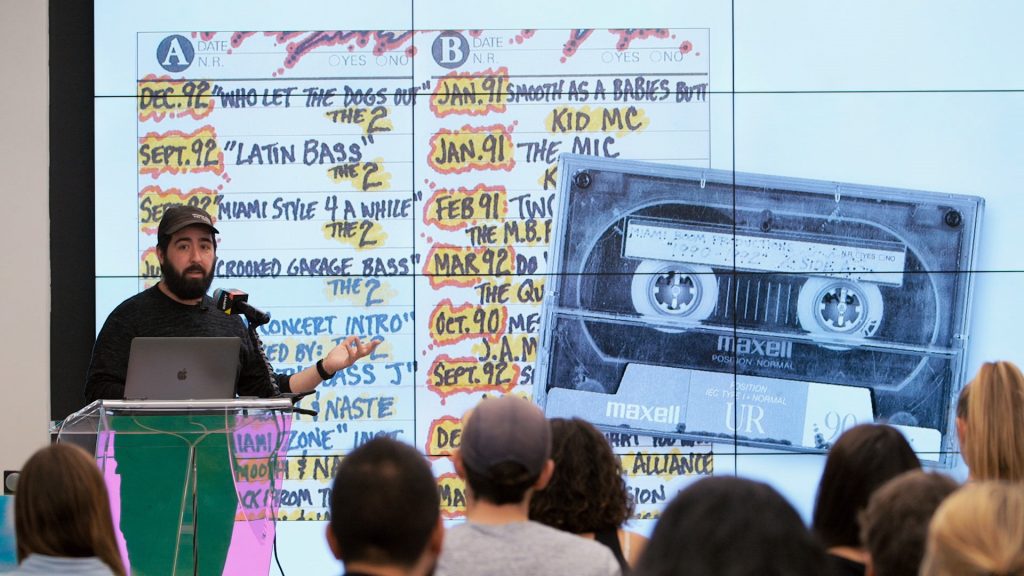
Continuing on, Sisto presents evidence from 1992 of a demo crafted by Jacksonville teens Joe Gonzales and Brett Hammock called “Who Let The Dogs Out?” under the name Miami Boom Productions. This was the earliest known recording of the song.
And finally, Sisto takes viewers to the earliest paw prints of the song and chant in the 80s, when the chant rang through high school pep rallies and bleachers.
Bringing the story back to Providence
Regarding bringing his findings back to the city of Providence, Sisto explained that it would be a good way to meet people in his city, where he considers himself a “townie.” Still, he highlights the particular artisticness of Providence, calling it a creative capital.
“The city is culturally literate in the way that it can be experimental and take risks,” Sisto said. “The climate of the city makes left-of-center projects like this possible.”
And Sisto saw how open the Providence Public Library was in not only supporting his project but also providing a humanities council grant.
Jordan Goffin, Director of Special Collections at the Providence Public Library, has worked closely with Sisto to help the exhibit come to life at the library. In his opinion, this was the best place for Sisto’s exhibit to live because of the library’s emphasis on open and free resources and knowledge, which so closely aligns with Sisto’s beliefs.
“I think it [the partnership with Providence Public Library] sits well with what Ben does, and it’s almost a testament to the fact that he’s interested in public knowledge and people having access to things and experiences,” said Goffin.
Goffin, like Sisto, understood that the city of Providence would welcome this project, in all its uniqueness.
“It’s hard to capture the personality of a city, but the idea of taking something like this particular song, a goofy novelty song, and approaching it with seriousness and sincerity,” Goffin said, “it’s a good match for what I tend to think Providence is.”
The message
For Sisto, this project was a way for him to nudge against individual authorship and genius artists and emphasize that works of art are made through collective artisticness.
But for visitors, his only hope is that they have fun and enjoy it.
“I’ve watched different people get very different things out of it,” Sisto said, “and it’s too much pressure to have any strong expectations or hopes about what viewers are going to get.”
What’s next
Sisto’s next endeavor is unsurprisingly in line with his goal of highlighting the importance of art in culture. He is currently working on the founding of a space in Providence called OPEN, which will serve as a hub for projects that bridge the arts and humanities.
Calling it “a true experimental in between,” Sisto described the space, which will open in September at 50 Sims Avenue in Providence, as “a 200 square foot micro-shipping containeresque gallery.”
“I want it to be a place where people can just sort of be, and not feel like they have to spend money or buy coffee to participate in creative culture,” Sisto said.
So who did let Who Let the Dogs Out out? Well, the answer is complicated and collective, involving a whole group of people, from artists in the 80s to the Baha Men’s release of the 2000 hit. The next time you hear your favorite song or see a work of art, consider who made it — maybe you can uncover an entire mystery, just like Ben Sisto did.
Emily Bruck is a writer and storyteller currently based in Charlestown, RI, and originally from Massachusetts. A recent Syracuse University graduate, she enjoys covering internet culture, lifestyle topics, the arts, and human interest stories. She currently freelances and shares more of her work at emilybruck.com.


Want to comment? Click!