







This year’s legislative session was a morbid failure for local environmental activists: only one out of the 20 bills endorsed by Climate Action Rhode Island became law. A mock funeral was held at the state house for the 19 pieces of legislation that died during the spring legislative session, complete with a coffin and tombstones. A new investigation from Providence’s Ivy League university unmasks the forces behind their demise.
Groups that opposed environmental legislation in Rhode Island outspent their green counterparts by more than six to one on lobbyists between 2018 and 2025, according to a report from the Climate and Development Lab at Brown University.
By tracking opposition to legislation sponsored by the Climate Action Rhode Island and the Environmental Council of Rhode Island, researchers found special interest groups spent more than $2 million lobbying against environmental bills in the last seven years, while the bills’ leading supporters spent around $300,000.
Why is environmental legislation failing in Rhode Island?
“Rhode Island, a few years ago, was really leading the nation in some ways. Some of our goals are the most ambitious in the nation,” said Jeff Migneault, executive director of Climate Action Rhode Island. “But the follow up in the last three or four years has been pretty poor.”
A report from Brown University’s Climate and Development Lab attempts to shed light on what’s behind the state’s slow movement on climate law.
Seven years ago, the team led by Professor J. Timmons Roberts began investigating groups opposing climate policy at the state level. By parsing through about 18 million lobbying and testimony records, research specialist Trevor Culhane and teams of undergraduate students produced reports dissecting lobbyist influences on climate change and energy legislation for seven states. After completing investigations in neighboring states Massachusetts and Connecticut, this new report focuses on their home turf.
“Why is it so hard in this blue state? This should be the best kind of state,” said Professor Roberts, who was inspired to investigate why the state failed to pass the Energize Rhode Island Act in 2019. “We’re highly vulnerable to climate change. We have 400 miles of coastline. We have no fossil fuel extraction.”
Despite the Democratic dominance of the legislature, CDL’s findings suggest the structure of state government hinders lawmakers’ capacities to act on climate legislation. CDL points to an “extremely hierarchical” power dynamic on Capitol Hill that places nearly all control in the hands of the Speaker of the House and President of the Senate. Whether a Democrat is “pro-business” or “progressive,” conflict with Rhode Island’s leadership can lead to political marginalization.
“The legislative process is famously messy, with all sides presenting their cases and advocating for what they think is right,” said Democrat Rebecca Kislak, a state representative for District 4 in Providence. Kislak sponsored the Building Decarbonization Act of 2025, which passed the House but failed to move forward in the Senate. “Organizations with more money do unlock different levels of access.”
With low salaries for elected leaders, limited support staff and short legislative sessions, CDL researchers argue Rhode Island’s politicians make decisions while relying on outside information from special interest groups. These influential private interests often compete with environmentalists over state climate policy.
“They have paid lobbyists that are talking to people on the sidelines. We just don’t have the resources to match,” said Migneault, who said the last few years were “frustrating” for green groups. “We get people to go and testify at hearings, write letters, call their reps … but the opposition seems to get listened to more.”
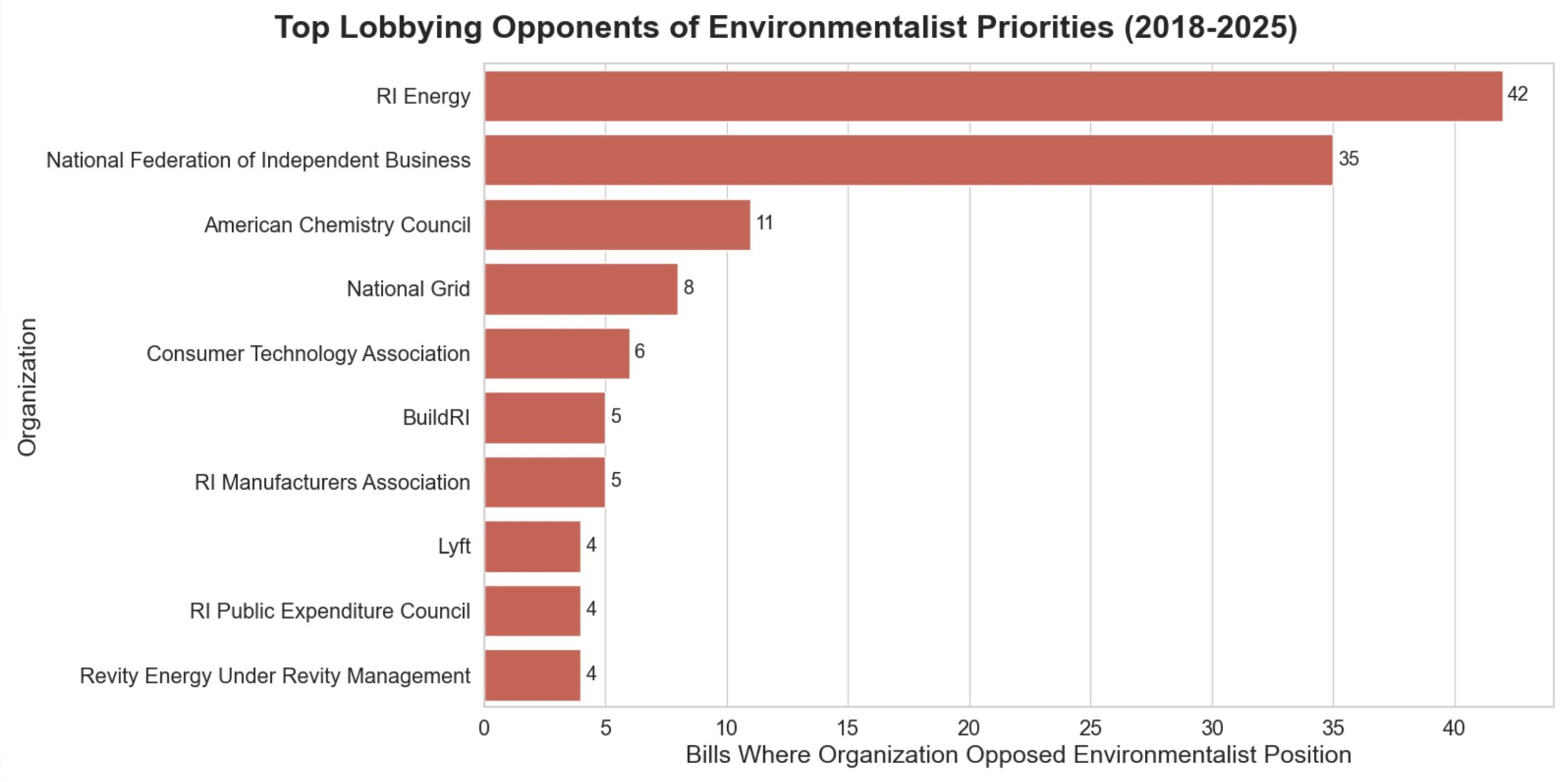
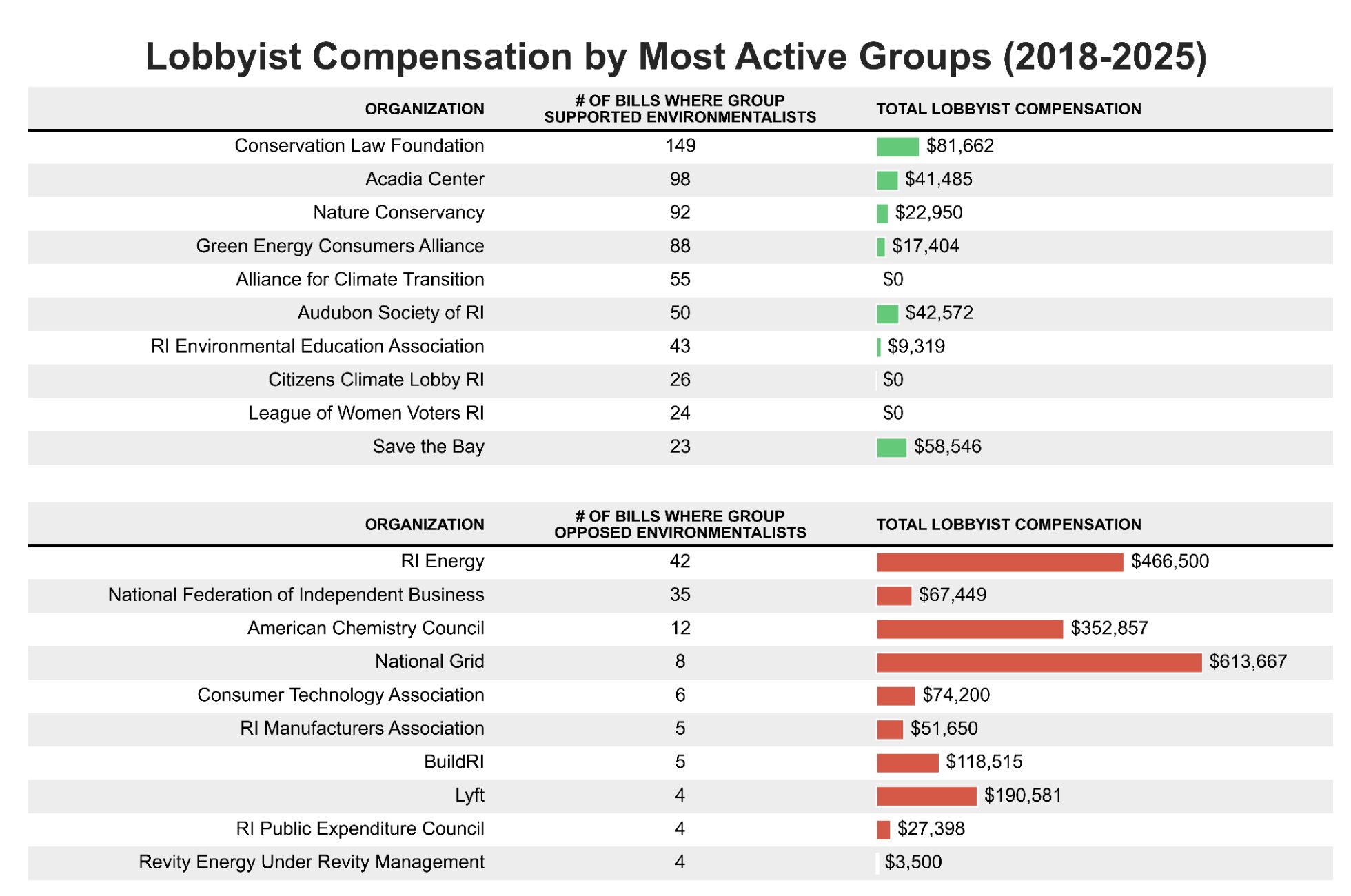
Graphs via CARI.
Utility Companies Named Top Anti-Climate Lobbyists
CDL’s team combed through lobbying records from Rhode Island’s Secretary of State and testimony about legislation supported by Climate Action Rhode Island and the Environmental Council of Rhode Island between 2018 and 2025. Energy companies emerged as the largest lobbyists against state-level climate legislation.
Pennsylvania Power & Light (PPL) bought the Narragansett Electric Company four years ago and renamed the state’s largest utility company Rhode Island Energy. Since then, RI Energy has spent $466,500 on lobbyists and opposed 42 bills supported by environmentalists—about two-thirds of the bills examined in the report.
Researchers found the utility voiced support for the landmark 2021 Rhode Island Act on Climate, which set enforceable targets to reduce carbon emission, but RI Energy generally opposed policies designed to achieve those goals. The company often testified that environmentalist-backed laws would financially burden ratepayers, were inadequately designed or could conflict with the Public Utilities Commission’s authority.
“The report’s characterization of RIE’s extensive legislative testimony as mere “opposition” is misleading and omits critical context,” said Rhode Island Energy spokesperson Caroline Pretyman. Pretyman said the company engages in lobbying lawfully and has a responsibility to act on behalf of their customers. “Highlighting cost impacts is not obstructionism; it is transparency that supports sound policymaking.”
In 2024 alone, the company spent $139,000 on lobbying. That’s 12 times as much as the highest-spending environmental group, the Conservation Law Foundation, during the same time period. Rhode Island Energy testified against bills designed to expand net metering, address utility rates and expand thermal energy, saying the bills lacked foundational analysis, proper regulations or sufficient stakeholder engagement.
“Renewable energy is local, abundant, proven and therefore cheap,” said Migneault. “Rhode Island Energy is saying that they’re looking out for the rate payers, and yet they’re maximizing the profits of their investors and not doing what would clearly lower electricity rates for their customers.”
The report also points out that Rhode Island Energy’s Political Action Committee made financial contributions to major Democratic players. From 2024 to 2025, their PAC donated thousands of dollars to Governor Dan McKee, Speaker of the House Joe Shekarchi, both former Senate President Dominick Ruggiero and current Senate President Valarie Lawson and Mayor of Providence Brett Smiley.
“There are roughly 280 PACs registered in Rhode Island,” said RI Energy’s Pretyman. “Our PAC is funded entirely through voluntary employee contributions, complies fully with all applicable laws, and does not recover any lobbying costs from customers through rates.”
Researchers said the company’s arguments are common in efforts to stop climate legislation across the energy industry. The report notes PPL is currently a member of the American Gas Association and the Edison Electric Institute, trade groups that have pushed for using natural gas and blocked efforts to expand solar energy.
“The company has resisted most of the nuts and bolts legislation, which is really the implementation part of everything,” said August DeVore, program manager for the Climate Social Science Network. Devore also points out that PPL was formerly a member of the Global Climate Coalition, a climate denying lobbying group that played a critical role pushing the U.S. to withdraw from the Kyoto Protocol. “GCC was a public relations firm that studied finance and conducted large campaigns in the 80s and 90s that actively misled the public on climate change.”
Rhode Island Energy characterized the report as “an opinion piece designed to marginalize viewpoints” and said the research “lacks balance and rigor.”
“References to the long-defunct Global Climate Coalition are irrelevant. PPL’s membership in AGA and EEI does not equate to opposition to clean energy,” said Pretyman. “Meaningful progress on climate policy requires facts, balance, and a serious commitment to affordability. Rhode Island Energy will continue to engage constructively, transparently, and lawfully to ensure those principles remain central to the discussion.”
The utility provider’s former parent company, National Grid, spent $613,667 lobbying during the study’s time period but only submitted their opposition to eight environmental bills.
Business Community and Utilities Regulators Frequently Oppose Environmental Legislation
The report also reveals business associations are key opponents to environmental groups, spending less money but frequently testifying against legislation.
According to the CDL, the National Federation of Independent Businesses opposed 35 of the bills supported by environmental groups and spent $67,449 dollars on lobbying from 2018 to 2025. Along with the Rhode Island Business Coalition and the Northern Rhode Island Chamber of Commerce, business groups argued these environmental bills would undermine their ability to compete economically and be insignificant in addressing global climate change.
CDL researchers say these business associations deploy discourses of climate delay, including “policy perfectionism” Even when recognizing an environmental issue, opponents of environmental legislation might claim regulations would lower quality of life or advocate for policies that avoid restrictions on businesses.
“It’s really easy to say, this bill should be better, we need to do another study, this will cost somebody money,” said Migneault. “You can always study something more, but then you never get anything done.”
Regulators tasked with monitoring businesses also opposed some piece of environmental legislation.
Rhode Island’s Public Utilities Commission (PUC) is a board appointed by the governor to oversee electricity rates and other key utilities. Both the PUC and the Division of Public Utilities and Carriers (DPUC), a separate entity that executes laws related to public utilities, frequently testified against environmental groups’ efforts.
More than 40 pieces of written testimony submitted by the PUC and the DPUC challenged environmental groups’ efforts since 2020, arguing the new bills would replicate existing energy regulations, increase consumer costs and weaken their authority.
“While our testimony on specific bills in the past has prioritized any negative impact to consumers, it should not be viewed as an overarching opposition to climate goals,” said DPUC spokesman Thomas Kogut. “Burdening electric ratepayers with what we see as unnecessary additional cost actually works counter to the decarbonization effort.”
Ways Forward for Environmental Groups
The Climate and Development Lab ends their report with tactics for environmentalists looking to advance climate policy in Rhode Island. Their report accomplished the first strategy: name the opposition. CDL illuminates political players by spotlighting the well-funded special interest groups influencing state policy.
Researchers also found state environmentalists accomplished major legislative goals by building coalitions like Climate Jobs Rhode Island. Their team said combining environmental efforts with pro-labor policy was key to passing the Act on Climate and a 2022 mandate requiring completely renewable electricity in the state by 2030.
“The environmental labor alliance is one powerful way to balance the scales,” said Rep. Kislak. “Our kids deserve real solutions, and we need to keep talking about what is stopping us from building them a better and more sustainable future.”
Despite Donald Trump’s efforts to undermine climate policy on the federal level, CDL recommends environmentalists push forward on statewide regulation and work to debunk claims that environmental policies would have a negative financial impact on Rhode Islanders.
“These [groups] are serving their own interest and putting a lot of effort into stopping this, and it’s not in the best interest of Rhode Island citizens,” said Migneault, who is looking to build coalitions of groups that want to advance state climate laws. “Addressing climate change only happens if everyone, every state, every nation, does its part.”
Eric Halvarson is a multimedia journalist based in Providence, Rhode Island.


Want to comment? Click!