





The monumental, 150,000 square-foot, Gilbert Stuart School Middle School that has been at the heart of Elmwood and the West End neighborhoods for 95 years, may be demolished in a matter of weeks. But the building’s closest neighbors know almost nothing about it.
The planned demolition is part of a complex initiative to make every building operated by the Providence Public Schools “new or like new.” The plan has been slowly moving forward for more than a decade, but it has accelerated dramatically from planning to action during the last three years after state and city voters approved separate bond issues to fund school construction. The total project will cost about $1 billion. The project’s stated goal is to make every Providence school “new or like new” by 2030.
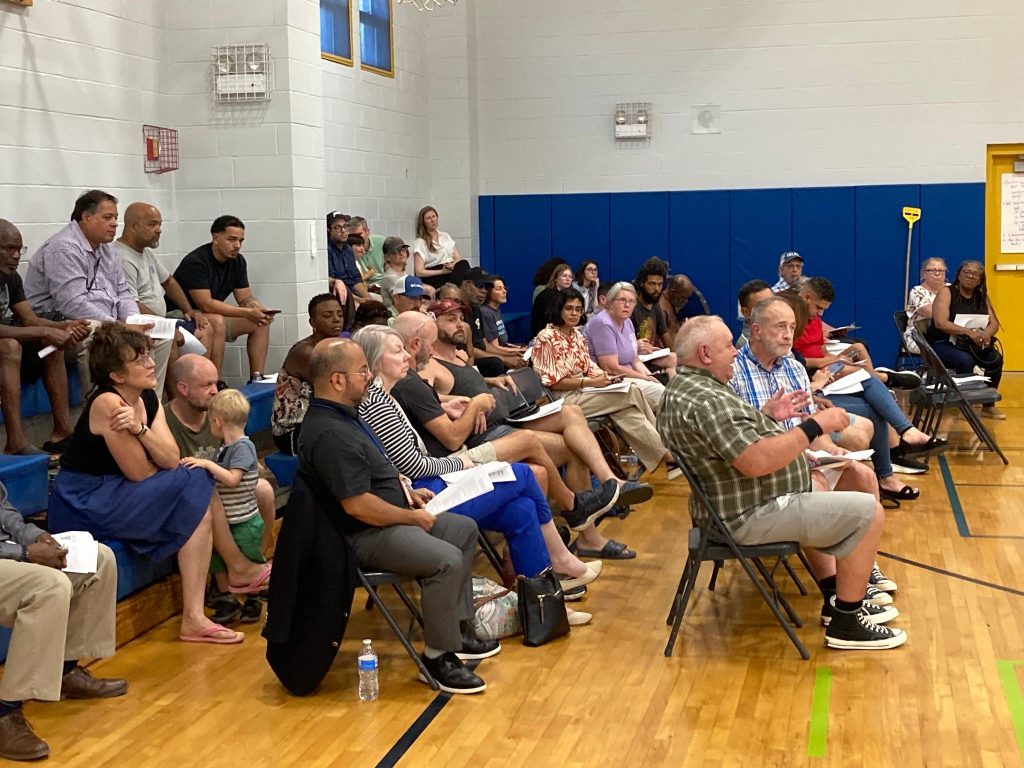
On Tuesday, more than 50 community members gathered at the Sackett Street Recreation Center to ask questions and share what they know – or think they know – about why the city is spending more money to demolish and replace the much-loved Gilbert Stuart building than it would cost to renovate it to like-new condition.
Their biggest questions: Who had the power to make this decision? And who has the power to look at the alternatives before the wrecking ball hits?
Tuesday’s meeting was organized by community activists Jennifer Dalton Vincent and her husband, Diego Arene-Morley, along with Providence School Board member Mireya Mendoza, whose own children attended Gilbert Stuart. No other School Board, City, PPSD or Rhode Island Department of Education representatives responded to their invitation to attend, so it was left to those present to ask and answer their own questions as best they could.
Fortunately, there were a lot of well-informed residents, neighbors and community leaders on hand. Marisa Brown, Executive Director of the Providence Preservation Society (PPS), briefly made the case for a deeper look at alternatives to demolition based on the building’s historic value, its civic meaning to residents, and the higher environmental impacts of demolition and replacement. Dr. Harlan Rich of the East Side Public Education Coalition spoke about the successful effort that they made in the early 2000s to prevent the closure and demolition of Nathan Bishop School on Elmgrove Avenue.
The following account combines some questions and re-orders some of the discussion.
Why would anyone choose to demolish and rebuild when renovations would cost $12 million less according to cost estimates provided to state officials?
To most people in the audience, this difference in cost settled the question. The savings of $12 million was a “no-brainer” to one questioner.
However, Miguel Youngs, Deputy Policy Director for the City Council, suggested that state rules for reimbursement and safety considerations for younger students might incentivize demolition over renovation. And, Marisa Brown of PPS said that the state reimburses 5% more of the city’s expenses for demolition and new construction than it does for renovation. However, she also noted that there are important environmental and social impacts to demolition that are not included in the cost/benefit calculation used by the project managers.
Is there one report that explains the decision?
Marisa Brown said, “This is what Jen [Vincent] and I have been trying to obtain and getting no answer. What I hear is ‘We’ve done the analysis,’ period. But it’s not enough to say, ‘Trust us.’ Everyone in this room has a right to get these answers.”
What are the impacts of demolition? What is the City doing to notify and protect neighbors?
Jennifer Bandy, Education Director at the West End Recreation Center, which is directly across Bucklin Street from the school, said, “There is no clarity about what is happening. Our Rec Center and the athletic fields serve hundreds of children and their parents and none of them know about what’s happening.” She wanted to know what impact asbestos or other pollutants from demolition might have on children at the Center, some of them as young as 18 months.
Lenni Martinez said, “I live on Princeton Avenue across from the school and my daughter has respiratory problems. Asbestos can stay in the air long after demolition. Is anyone going to monitor air quality?”
Bandy noted that Brown University students have installed air monitoring equipment on the roof of the Rec Center, but she didn’t know if the equipment would measure asbestos or other specific pollutants.
What restrictions apply to Gilbert Stuart as an historic building?
Brown noted that Gilbert Stuart is eligible for listing on the Federal and State Registers of Historic Places, a status which triggers certain requirement for review of proposed changes by the Rhode Island Historical Preservation and Heritage Commission (RIHPHC), a state body with regulatory oversight of qualified properties under state law.
In a separate interview with the Providence Eye last Friday, Jeff Emidy, the Executive Director, of RIHPHC said that as far back as 2010 the RIHPHC had told the Providence Public School Department (PPSD) that any major changes to Gilbert Stuart Middle School were subject to its review. In 2023, as PPSD made its tentative plan for demolition at Gilbert Stuart known, RIHPHC specifically requested detailed cost estimates comparing renovation to replacement and what other options, such as alternative sites for the new building, were considered by project managers.
Emidy noted that under the RI Historic Preservation Act, his office’s advice on historic structures “shall be followed” by the department or agency concerned “unless there are compelling reasons for not doing so.” On Thursday of last week, Emidy sent a letter to Torado Architects who are creating the plan for the new Lima/Gilbert Stuart school, restating their 2023 request for documents and information needed to initiate their mandatory review. Emidy planned to meet with PPSD facilities managers this week.
Who is in charge? Who signs off?
Marisa Brown said it hasn’t been easy getting an answer to this question. But the City owns the site, and the State is providing funding, so both are responsible.
Pat Ford, an independent reporter for Coalition Network Radio contributed his knowledge from covering other school building projects in Woonsocket and Pawtucket. “RIDE micromanages school construction projects and it has an elaborate process.” Since RIDE is now in charge of PPSD, he suggested that the state agency had even more control over the process in Providence.
In The PVD Eye interview on Friday, Jeff Emidy at RIHPHC also confirmed that it’s hard to know who is in charge. “We’ve had various architects reaching out to us over the year with different architects at different stages. They say, ‘we are working with Providence.’ But the way we look at it, RIDE is responsible because they are providing the money.”
Diego Arene-Morley noted that there is a body called the “Providence School Building Committee,” comprised of people representing the Providence School Board, the Providence Mayor and City Council, PPSD, RIDE and other agencies. This body reviews and approves elements of the construction plan for implementation. Jennifer Dalton Vincent said she recently discovered that this public committee had not filed its minutes as required since July of 2023. (Minutes have since been posted for meetings through April 29 of this year. Minutes for the most recent meeting on June 24 are not yet posted.)
He pointed out that the School Building Committee would be an appropriate place to ask more questions about Gilbert Stuart.
Can demolition go ahead if the community doesn’t want it? What is the impact? What about rats coming out? What is the timeline?
Vincent noted that as of Friday, the demolition permit had been submitted to the City Department of Inspection and Standards but that it had not been approved, according to department officials, for lack of required documentation from the City. She also noted that she had spoken to the Rhode Island Department of Health. They must inspect the property to ensure that no asbestos will be released by demolition. RIDOH told her that the City had submitted an asbestos removal plan and that removal was in process, but not complete.
Senator Ana Quezada (D – District 2) said that based on her work experience at the City’s Dept. of Inspections and Standards, there are quite a number of required documents that must be submitted before a demolition permit is approved, such as an inspection from RI Energy to ensure that gas and electrical systems pose no hazard. In response to a neighbor’s concerns about rats, she also noted that a full pest extermination must also be conducted prior to demolition.
These restrictions probably mean that demolition is at least several weeks away. However, noted Princeton Street resident Brent Runyon, a former PPS Executive Director and current member of the State Historic Preservation Commission, “the city tore down other schools before without notice or consequence.”
Who enforces the law? Could we get an injunction?
The state Attorney General Peter Neronha would represent the RIHCPC in any court action. Some suggested that calling his office would be a good next step.
What has been done to inform and consult the community? Why didn’t we know all this before tonight?
One person recalled a meeting convened about 20 months ago by City Councilman Juan Pichardo at which the plan to replace the school had been described, but few in the room on Monday were aware of that meeting.
A few of the 5 or 6 residents of Princeton Avenue present said they had received a letter recently informing them about the demolition plan.
Apparently, the architects and the School Building Committee have relied on PPSD community engagement models, which are directed only at parents, not the many neighbors and other stakeholders who will be affected by school building decisions.
“This city does a very poor job of community engagement,” commented Kai Cameron, who formerly worked in the Family and Community Engagement Office at PPSD for 25 years. “It’s not enough to send notices home with children or send an email. Information has to go where parents are: at the laundromat, the beauty parlor, the grocery store buying food for their families.”

Participants suggested churches, Tik-Tok and radio as better ways to find and communicate with the community.
How can we stay together as a community fighting for safety and health?
The meeting ended with discussion of what the community can do get the best outcome. One parent said the worst outcome would be for Gilbert Stuart to remain empty with no school to replace it. Meeting organizers urged participants to attend three upcoming meetings:
The PPSD School Building Committee was to meet on Tuesday (yesterday) at 4pm.
The Providence School Board meets tonight, Wednesday the 23rd at 5:30 in the PPSD headquarters at 797 Westminster Street.
City Councilman Juan Pichardo and City representatives will hold a meeting about Gilbert Stuart on August 14. Organizers will forward the questions from Monday’s meeting to Councilman Pichardo and other participants.
Thirty-nine participants responded to a brief survey from the organizers. Respondents ranked the importance of saving the building at 8.4 on a scale of 10 and they rated the City’s efforts to engage them at an average of 1.87.
“The building is worth saving.”
In comments over the course of the meeting, people noted the stark difference between the outcome for Nathan Bishop Middle School on the city’s affluent East Side and the dire fate facing Gilbert Stuart Middle School. Twenty years ago, the city made an investment to save and modernize an historic school and today, the Nathan Bishop Middle School is “easily one of the finest public buildings in Providence,” according to Andy, a teacher in Providence Public Schools. “I’m proud we send kids to that school.” The renovated Nathan Bishop earned the highest “Facility Condition Index” among all Providence Schools in the last comprehensive building assessment, done in 2022.

But disinvestment in Gilbert Stuart in the working class South Side has steadily tipped the scales toward demolition. In 2017, a building assessment concluded that all recommended renovations and updates at Gilbert Stuart would cost less than half of the cost of replacement. After five more years of deferred maintenance, the costs of renovation had gone up relative to replacement, but were still significantly less, according to the 2022 building quality update. Since the school closed in 2023, the city has allowed the building to deteriorate even further.
“It’s been an eyesore,” said Michelle Freeman, a Princeton Street neighbor and director of the Knight Memorial Library, which is adjacent to Gilbert Stuart on the Elmwood Avenue side. Princeton Avenue neighbors confirmed that there are trespassers living in the building and shooting up on the site.
Still, she says, “The building is beautiful. I loved living across from it until it was abandoned, It’s a jewel. The building is worth saving.”
Tens of thousands of neighbors in the area share linked memories of attending Gilbert Stuart and doing their homework in the equally stately library next door to it.”
Last week, Jeff Emidy at RIHPHC said that “Nathan Bishop is our shining example of historic school preservation. More recently, Windmill Avenue School was fully remodeled. They were able to do this.”
“We get the same assertion of non-feasibility from other communities,” he continued. “Yes, renovation can be a challenge. It comes down to thinking outside the box and how much you want to do it. Is it not feasible or do you just not want to do it? Moving walls in old buildings happens all the time.
“It comes down to what does the community want and need?”
But do the South Providence community’s wants and needs really matter?
At 4 pm yesterday, the day after the unofficial meeting at Sackett Street Rec Center, the School Building Committee met. And Gilbert Stuart was on the agenda. Five members of the public attended the session in person, all of them participants in the Sackett Street meeting.
According to Deigo Arene-Morely, who attended the meeting, the committee heard Torrado Architects present some preliminary drawings for the new Lima/Gilbert Stuart Pre-K through 8 school. They approved continued work to complete demolition of Gilbert Stuart and to further develop plans for the replacement school.
The architects also defended their public engagement strategy. They cited one public meeting in 2023 and another in 2024. And they pointed to a list of meetings at Lima Elementary School-most of them for staff only, but at least two that included Lima parents. Finally, they pointed to the School Building Committee meetings, themselves, as evidence of great public engagement.
Then came public comment. Diego Arene-Morely commented on the need for more transparency and a better public engagement process. He said that Keating Zelenke, a journalist working for PPS asked three very specific questions.
She asked what the outreach was made to other important institutions in the community, such as the Knight Memorial Library and the West End Recreation Center, both of which abut the Gilbert Stuart site and serve hundreds of students and their families.
She also asked whether every Lima teacher was invited and included in the staff meetings about the new school.
And she asked what the School Building Committee and the project managers intended to do to respond to the RI Historical Preservation and Heritage Commission’s insistence that it follow the law.
Immediately after Ms. Zelenke ended her comments, a Committee member made a motion to adjourn. The motion was quickly seconded and passed. But the questions remain.

Jonathan Howard is Co-founder of Cause & Effect, Inc., a consulting company that provides strategic planning facilitation, fund development planning and board strengthening to mission-driven organizations. He is a long-time resident of Providence.


Want to comment? Click!