




Let me start with the most honest sentence I can write: I am sleeping in a shelter in Providence and building a free app to help people find shelters.
Take a moment with that. I’ll wait.
If your first reaction was somewhere between “that’s either incredibly inspiring or deeply alarming” — welcome. That’s the correct reaction. It’s both. And it’s also, in a strange way, exactly why the free app I built, HOPE, exists.
Here’s the problem HOPE was built to solve, and I promise you’ve met it even if you’ve never needed a shelter in your life.
Somewhere in Rhode Island right now — in a church basement in Providence, a community center in Pawtucket, a hospital waiting room, a VA office — someone is being handed a piece of paper. It lists places to get food, find a bed, apply for benefits, see a doctor, talk to someone. It was probably printed last month. Maybe six months ago. At the top, almost always, there is a small-print disclaimer that reads something like: “Please call ahead. Some of this information may be out of date.”
That sentence is doing an enormous amount of heavy lifting.
It is politely covering for a system that has not figured out how to keep a list current. It is transferring risk — very gently, with no bad intentions — onto the person who is about to walk across Providence, spend their last bus fare, and arrive somewhere to find the door closed.
This is not a minor inconvenience.
For someone in crisis, a wrong address is an hour of energy they don’t have, a dollar they can’t spare, and a layer of trust worn away from a system they’re already not sure they can rely on.
The paper with the warning has existed for decades. I have been on both sides of it. I ran a food bank. I know the embarrassment of handing someone a list you suspect may already be wrong. And I know what it costs to follow one.
So I built HOPE. And here’s the thing I figured out while building it — the thing that changed what HOPE actually is. This isn’t a homeless app. It’s a survival guide for the entire state.
I built it here, in Providence, for a reason. This is where the need is most concentrated — the most shelters, the longest lines, more people than anywhere else in Rhode Island who are one phone call away from an answer they can’t quite find. If a better front door works anywhere, it has to work here first. But the thing I learned building it in Providence is that the problem it solves doesn’t stop at the city line.
Because the truth is, “needing help finding help” is not a homeless problem. It’s a Rhode Island problem. It’s a being-a-human-in-a-complicated-world problem.
It’s the 74-year-old in South Providence who needs Meals on Wheels, free Medicare counseling, and a ride to her doctor — and has no idea all three come from a single phone call to a program called POINT Access. It’s the veteran who doesn’t know that dialing 988 and pressing 1 connects him to someone who specializes in exactly his situation, day or night. It’s the family that’s one bad month away from trouble and doesn’t know what they qualify for until they’re already drowning. It’s the college kid, the new immigrant, the person who just got out of prison and is trying to rebuild, the neighbor who’s too proud to ask but would absolutely tap an app at 2 a.m. when no one’s watching.
It’s also — and I say this with love — you.
Maybe not today. But everyone is one car accident, one layoff, one diagnosis, one bad season away from needing to know where the help is. A survival guide isn’t for “those people.” It’s for all of us, eventually.
That reframe is the whole point. HOPE is the thing you keep in your pocket and hope you never need — like a fire extinguisher, or a good umbrella, or your one friend who somehow knows a guy for everything.
So here’s what it actually does.
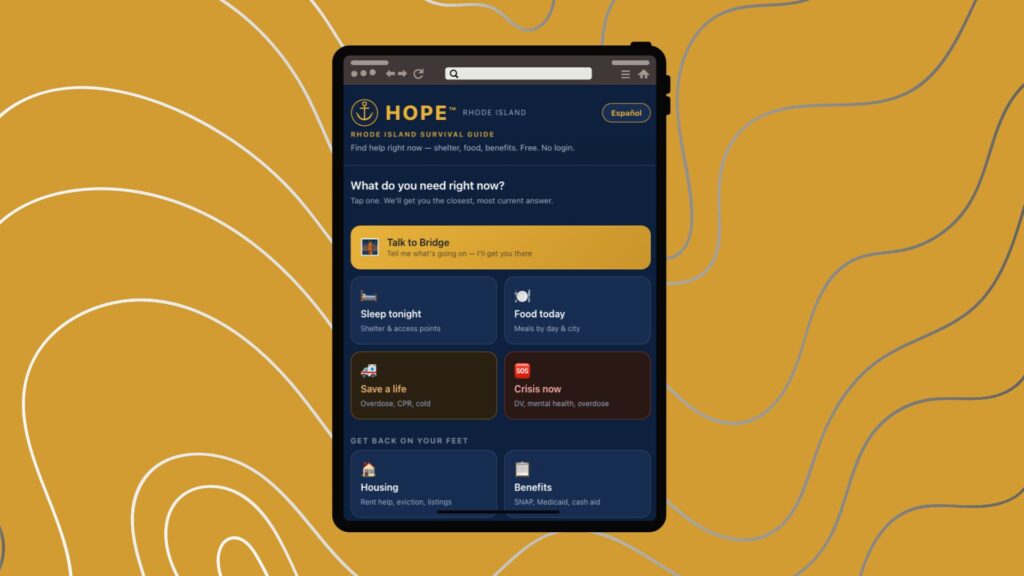
HOPE is a free app — no login, no account, no tracking — that answers one question: what do I need right now?
You tap once. You get the closest, most current, verified answer — with a phone number that calls in one tap and an honest note on every listing telling you exactly when it was last confirmed. The app covers: shelter, food, SNAP, health care, dental, mental health, crisis lines, libraries, clothing, legal help, and employment. It features dedicated sections for seniors, veterans, youth, immigrants, people with disabilities, and folks rebuilding after incarceration.
It also covers things most people don’t know exist — and here is where it gets genuinely fun.
Did you know that if you’re on Medicaid and haven’t eaten today, your EBT card works at participating Subways? The program is called the Restaurant Meals Program. It is real. It exists in Rhode Island. HOPE knows about it. The overwhelming majority of people who qualify for it do not know it exists. They are currently not eating a footlong. This is a problem HOPE can actually fix.
This is not a criticism of Rhode Island’s services. They’re actually quite good. Finding them, however, currently requires the research skills of a reference librarian, the patience of waiting through a DMV line, and the optimism of someone who has never actually been to the DMV. HOPE is the navigation layer for a system that exists and works — it just needs a better front door.
Its AI guide, Bridge, speaks plain English and Spanish. You don’t need to know the right terminology. You don’t need to know what a Regional Access Point is, or whether you qualify for General Assistance, or the difference between SSI and SSDI. You can say “I’m 72 and can’t afford my medication” and Bridge will tell you, step by step, what to do. It works when your signal is weak. It works when your battery is almost dead. It was designed for real conditions, not ideal ones.
HOPE is live right now at hope401.org. Free. No login. English and Spanish. Download it. Use it. Keep it on your phone for the day you — or someone standing next to you — needs it.
And then — this is the part I really want you to read — help us build it.
Right now, I am looking for anyone who can use the app and tell us what’s missing. If a phone number is wrong, tell us. If you know a resource we’ve overlooked, help us improve it. HOPE only succeeds if Rhode Islanders help build it.
More specifically, I’m looking for founding “parents”: people and organizations who want to be part of HOPE from the beginning. That might mean being a community partner who helps keep the data accurate. It might mean fiscal sponsorship or funding (HOPE is a nonprofit venture), an advisory role, or simply knowing someone I should talk to and making that introduction.
If you are a senior services coordinator who sees the gap every day, a veteran’s advocate, a social worker handing out that piece of paper with the warning and wishing it weren’t necessary, someone who has navigated this system and knows exactly what a better front door would have meant, I want to hear from you.
The paper with the warning at the top gets handed out everywhere. It doesn’t have to be.
Robert Diamond is a writer, investigative journalist, and documentary filmmaker in Providence. He is also the founder of HOPE, Rhode Island’s free survival guide. Before this he ran a food bank, raced yachts for a living, and assembled the kind of résumé that refuses to fit on one page. He’s had a dog at his side for most of his life, believes everyone is one bad season from needing a good front door, and is, at this very moment, probably confirming whether one more phone number still works. You can reach him at [email protected].


Want to comment? Click!