






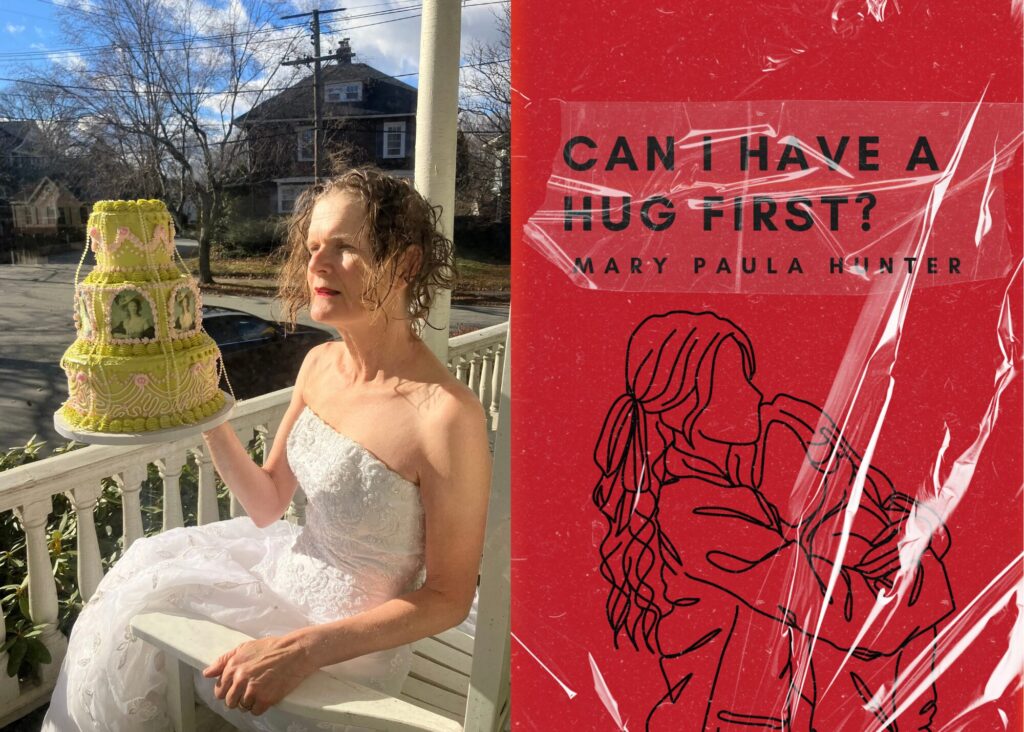
The fourteen stories collected in Can I Have a Hug First?, the second full-length work of fiction by Providence writer Mary Paula Hunter, have an enjoyably frantic energy. Charming and often very funny, Hunter’s stories feature characters, mainly women, whose response to the competing attentional demands of everyday life is to embrace the slapstick.
If you’ve ever tried to retrieve your keys from deep within your handbag while balancing a full grocery bag, a passel of mail, and a wailing infant, you already know Hunter’s artistic terrain. In the imaginary worlds of her stories, everything is always happening all at once. Her narrators share a talent for keeping all of life’s balls (not to mention babies) in the air. No one is prescribing this as a way of life, but for Hunter, the mounting pressures of mundane reality offer many occasions for fun.
The collection’s title story, “Can I Have a Hug First,” begins with a great gust of wind. Tree branches and umbrellas are flying. A jaywalking woman narrowly avoids being hit by a speeding car. Like the weather and the traffic, the narrator is also out of control, rushing from the gym to change clothes at home before speeding out again to teach a dance class.
In the midst of her rush, she is accosted by a neighbor wearing a clown suit for no discernible reason. The neighbor, who is also the narrator’s tenant, has a grievance she would like to discuss. The narrator brushes her off with a promise to meet that evening—at which point the clown-suited woman, discomfited by the brush-off, asks for a hug. Though she knows better, the narrator complies, and then—predictably—spends the remainder of the day dreading the meeting. Soon enough, there is blood on the floor.
Of course, Hunter knows that lax personal boundaries don’t usually result in a trip to the emergency room. But her genius lies in seeing how easily such a trip could happen, given just a bit less slack in the day. Following Hunter’s characters through their overstuffed days, I wondered if the writer’s true subject wasn’t time itself—not in the Proustian, eat-a-cookie-and-remember sense, but in the sense of time management. What Hunter offers, perhaps, is kitchen-table realism updated with smart phones. When you’re dealing with several people’s Google calendars simultaneously, everything really is happening all at once.
Certainly Hunter understands the utility of a deadline for enlivening a plot. “Life Support,” perhaps the most perfected of the collection’s time-mismanagement stories, features a group of bridesmaids who attempt, on the day of the long-awaited wedding, to return the Costco wedding cake. Why? Well, at the very last minute, someone has noticed that the cake contains an ingredient that could spoil after being left out, unrefrigerated, over the course of the long day. Keen to avoid mass Listeria, the bridesmaids recruit the groomsmen, who ferry the cake back to Costco instead of doing the infinitely duller work of donning their tuxedos. Of course, Costco is packed, as is the parking lot. The group pushes ahead, prompting one minor calamity after another, until someone winds up on a Jersey barrier, and the father of the bride loses his pants. Hilarity ensues. How could it not?
A performance artist, Hunter writes with a gusto that feels drawn from the stage. This background comes through forcefully in another story, “Rhythmic Tour Guide for Children,” in which a dance teacher is trapped in a Chinese restaurant when an earthquake strikes. The ceiling caves in, and the teacher, who is struck by debris, finds herself in a friendly screaming match with a fellow diner. But that’s just the set-up. As the smoke clears, “the glass stopped falling, the woman with the long gray hair stopped screaming, and a giant air conditioning tube uncurled to the floor.” The tube’s appearance, “a near replica of the fire escape chute attached to the side of my elementary school in East Lansing, Michigan,” prompts a discomfiting memory of “the janitor’s hands reaching for us as we flew down the tube during fire drills, our white underpants practically in his face.” Yikes! But as soon as the strange memory returns, it is displaced by the next wild development—in this case, an impromptu public dance party.
Perhaps because Hunter is a performance artist as well as a writer, the narrators of these brief tales unfold their outrageous stories in a way that reflects the author’s dual identity. Hunter’s rapid-fire style reminds me of the late spoken-word poet Maggie Estep, who enthralled audiences precisely because her material was so over the top. But while Estep tended to linger in the catastrophes she explored on stage, Hunter avoids the impulse to do that on the page. Instead she pushes on, into the next mess, and in this way she keeps the reader’s attention exactly where she wants it, stuck fast in the story’s grip.
Diane Josefowicz is the author, most recently, of Guardians & Saints: Stories, published in October by Cornerstone Press. Her second novel, The Great Houses of Pill Hill, will be published by Soho Press in May. Learn more at: www.dianejosefowicz.com
Can I Have a Hug First?
Mary Paula Hunter
Unsolicited Press, 2025
ISBN 978-1-963115-26-0
$18.95 paperback


Want to comment? Click!