





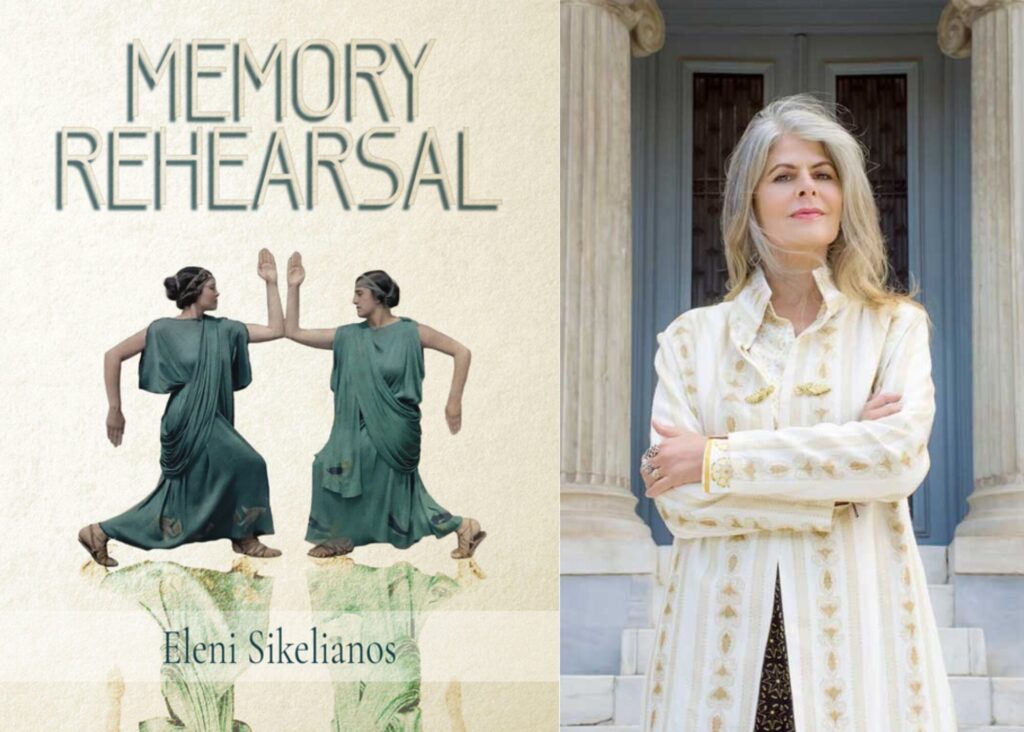
It can be hard to come to terms with ancestors, especially if they’re charismatic, secretive, and unconventional. Fodder for endless gossip, they feed family legends while failing to show up for reunions or else raising eyebrows when they do. Providence poet and translator Eleni Sikelianos, who teaches in the Literary Arts program at Brown University, hails from a family of such characters, and she has reckoned with them over many years, mining a rich vein of difficult material. In Memory Rehearsal, the third book in her trilogy of familial excavations, Sikelianos uncovers the public and private history of her great-grandmother, Eva Palmer Sikelianos (1874–1952), a wealthy and connected director, performer, and textile artist whose romantic entanglements with both men and women were tinged with an impassioned love of the the poetry, theater, and art of ancient Greece.
This is heady stuff, but Sikelianos winningly frames her quest to know this imposing ancestor—a biscuit heiress who eventually became related, through her marriage to a Greek man, to Isadora Duncan—in terms of her personal distance from her ancestor’s privileged world. Sikelianos grew up inside a household riven by addiction and mental illness, “living in trailers or wandering the fields near our housing block, panhandling in the park for snacks.” For a long time, her understanding of her family’s history was limited. “All I had on my great grandparents was a pile of rubble,” she writes. “Loose facts. Strangers’ stories. Scraps. That led nowhere, or that were so tangled I could trace them no more than a finger’s length before they snarled.” You might call this a mess, and Sikelianos herself does—but in the next breath, she points out a better possibility. A mess like this “is sometimes called a labyrinth.”
A labyrinth is not a good place to be stuck—just ask anyone who’s missed a key exit while attempting to drop off a friend at Logan Airport. But the metaphor, with its echoes of the ancient Greek myth of the Minotaur in his labyrinth, situates Sikelianos’s story squarely within her family’s heritage while offering the reader the hope that, just as in the story of Theseus using a ball of yarn to avoid being eaten by the Minotaur, Sikelianos might yet find a clever resolution to her feelings of familial loss and alienation.
Does this illustrious and mysterious great-grandmother hold a key to some overshadowed part of her identity or some other personal redemption? The question runs through the text. As I read, I couldn’t help thinking of my own ambivalent late-night investigations on a popular genealogy website, quietly excavating a family history while feeling all the while vaguely ashamed, as if I were doing something illicit. What was I really trying to find, peering at magnified images of ancient passenger manifests and draft cards?
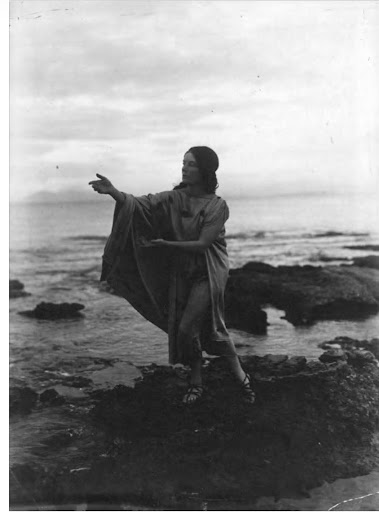
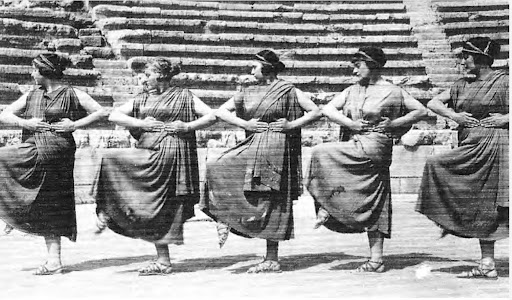
Photos reproduced with permission of the publisher.
To tell her story, Sikelianos borrows one of her great-grandmother’s skills by becoming something of a weaver herself. The story is a braided one, in which her own musings and reflections are interspersed with fragments of her great-grandmother’s writings as well as those of her illustrious great-grandfather, Angelos Sikelianos (1884-1951), who was once nominated for the Nobel Prize for his poetry. Together he and Eva staged the celebrated Delphic Festivals, revivals of the ancient Pythian games, between 1927 and 1930. Accompanying the text are many striking black-and-white photographs of Eva going deep into her performances, often wearing costumes she made herself.
For her source material, Sikelianos relies on her great-grandmother’s autobiography, published under the title Upward Panic in 1993, and Artemis Leontis’s biography, Eva Palmer Sikelianos: A Life in Ruins (2020). For additional context, she draws on the literary scholarship of Yopie Prins, a professor at the University of Michigan who specializes in the nineteenth-century reception of ancient Greece. Although Eva Palmer Sikelianos, who lived through the fin-de-siècle, would have first encountered this civilization in Victorian scholarship, what she did with her knowledge was thrillingly modern, Le Sacre du Printemps by way of Delphi.
This remarkable story, told in fragments of prose and poetry and laced with fascinating images, is also a trenchant reminder of the extent to which “family memories” are often not individual memories at all. Rather, they are the shared, and sometimes vexed, property of the family itself. Sikelianos is admirably honest about the many minefields here. She does not attempt to rectify contradictions in anyone’s account of her family’s history; she simply and gracefully lets those differences be.
This humility is also evident in the book’s form, which is as fragmented as the evidence Sikelianos gathers to write it. Open-ended, suggestive, and rich with image and anecdote, Memory Rehearsal is not—nor does it pretend to be—a definitive account of anything. “I was traveling backwards toward her in the dark,” she writes of her great-grandmother toward the book’s end, “and she was hurtling toward me in the dark, in time’s dark travel, like two concentrated figures who’d lost their human outlines.” Sikelianos confesses that, despite her best efforts, she was in the end unable to fully grasp the reality of her lost ancestor; the two, she confesses, simply “did not meet.” Memory Rehearsal is Sikelianos’s charming, fascinating, and melancholy record of this missed connection, “a story I had to piece together for myself.”
Diane Josefowicz is the author of several books of fiction and nonfiction; her most recent book is The Great Houses of Pill Hill, a novel just out from Soho Press. She also writes a monthly books newsletter, What’s That Noise? Learn more and subscribe at: www.dianejosefowicz.com.


Want to comment? Click!