





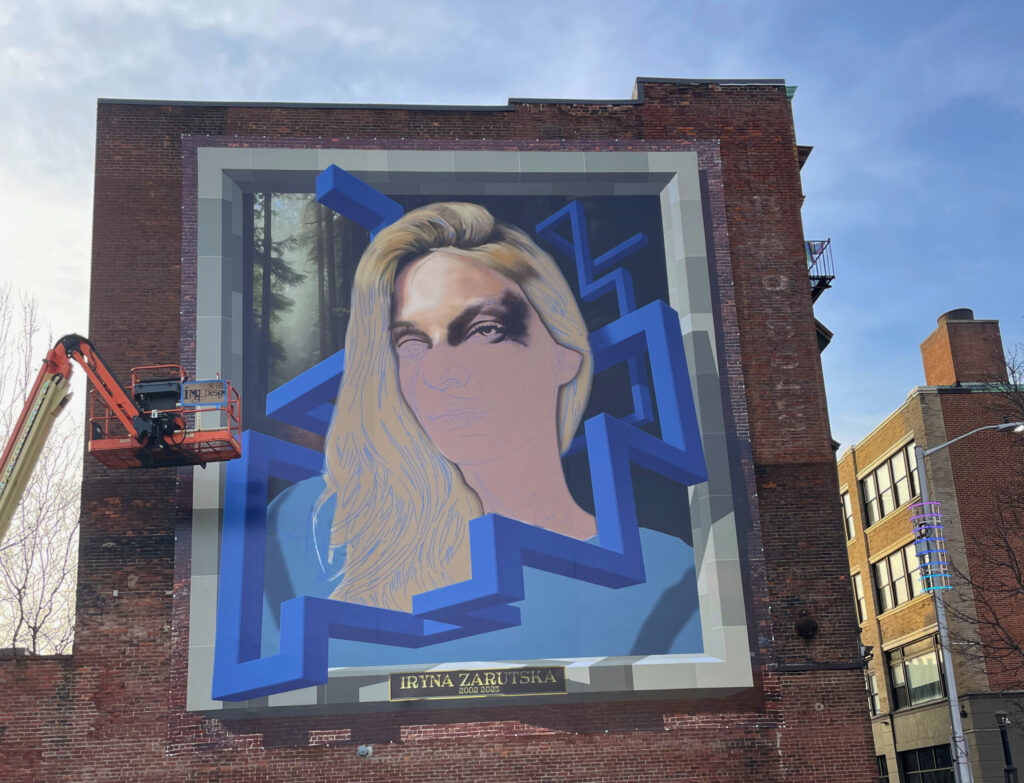
For more than a month, an unfinished mural dominated a block of downtown Providence.
Although the painted face on the side of a brick building on Snow Street was incomplete, a label at the bottom indicated the mural’s subject: Iryna Zarutska, a 23-year-old woman who was killed while riding in a light-rail car in Charlotte, North Carolina, last year.
The mural pained me for many reasons.
It pained me because it was a symbol of misinformation.
Recently, two people I know who are smart and keep up with the news said the mural memorialized a young woman murdered by an undocumented immigrant. But that isn’t true. The truth is that Iryna Zarutska was the immigrant – a refugee from Ukraine – and the suspect in her killing is an American, Decarlos Brown. He is in custody but currently is incapable of standing trial due to mental illness. The flood of misinformation coming from the President on down, even before it flows through the internet echo chamber, makes it hard nowadays to filter truth from inflammatory lies.
The mural pained me because of its strange origins.
In Rhode Island, we recently saw mass shootings at Brown University and Lynch Arena in Pawtucket. And yet a local artist was hired to memorialize a young woman who was murdered last year in Charlotte, North Carolina.
Why did billionaires and tech bros pick downtown Providence as a canvas for their political art franchise? This complicated story is well-reported in news outlets, including the Boston Art Review, which exposes where the money is coming from. But what is the image of Iryna Zarutska supposed to tell us? North Carolina passed Iryna’s Law in December that will make it more difficult to get bail, keep more people in prison, and speed up enforcement of the death penalty. Was that the message for Rhode Island?
The mural pained me because it represented a worthy cause – remembering innocent crime victims – that had been co-opted by bad actors.
Iryna, whose life was violently robbed and whose voice is forever stilled, left behind some photos that match the image of the blameless victim. I wish she could have put those photos in an album to show her grandchildren. She was blond and beautiful, and was the victim of a surprise attack on public transit, where anyone should be able to feel safe. If the victim had been an old woman, or an innocent young man, would there be murals funded by Elon Musk and Co.? No, because the narrative behind this use of public art is: “Protect Our Women, especially the white ones.”
This mural was not calling for an end to violence against women. The men who boast about protecting white womanhood will be nowhere when women need help. They won’t be there at the ER. They won’t be offering support in the police station. They require a perfect victim, and almost nobody is perfect. All they are offering is a protection racket. Even though I am old and can pass un-noticed in public, I remember – and I’m angry – for all the wrongs done to young women, and I hope times have changed for the better.
The mural pained me because it reflects so much of what is ailing our country today.
I reject the message sponsored by Eoghan McCabe, Elon Musk, and Andrew Tate broadcast to our cities inviting rage, fear, and despair. I reject the response of North Carolina that filling prison cells and speeding up executions will make us safe. I reject the widespread embrace of ICE deportations of our neighbors on the grounds that their lack of papers makes them dangerous criminals.
As of this week, the controversy around the downtown mural is officially over. The remnants of the mural were taken down on Tuesday, May 12.
But as this saga ends, I hope we don’t soon forget some of its lessons.
Among them: Public art is powerful.
As the great comic book writer, Stan Lee, once said, “With great power comes great responsibility.”
I would urge artists not to let money talk too loudly. Not for public art.
Art is a potent means of communication. Saying your art is “meta” or ironic is dishonest when the average viewer will just take it literally, as the money men intended.
I hope no one bothers the new, completed mural of Zarutska on Federal Hill, because that would just escalate the anger and divisiveness. I hope that by the time the paint begins to fade, that some of the emotions will have faded too, and someday a better message will replace it.
I hope that the family and friends of Iryna Zarutska will find some measure of comfort and justice, and that we will all be inspired to end hate and grow peace in our cities.
Nancy Green is a retired nurse who moved to Providence just before the Blizzard of ‘78. Her work involved home visits all over Greater Providence in public housing and triple-deckers, serving people from the diverse communities that make up our city. Her favorite slogan is ‘Hi, Neighbor’ and she works for justice and safety for all of us here.


Want to comment? Click!