



Maha | Rhode Island School of Design
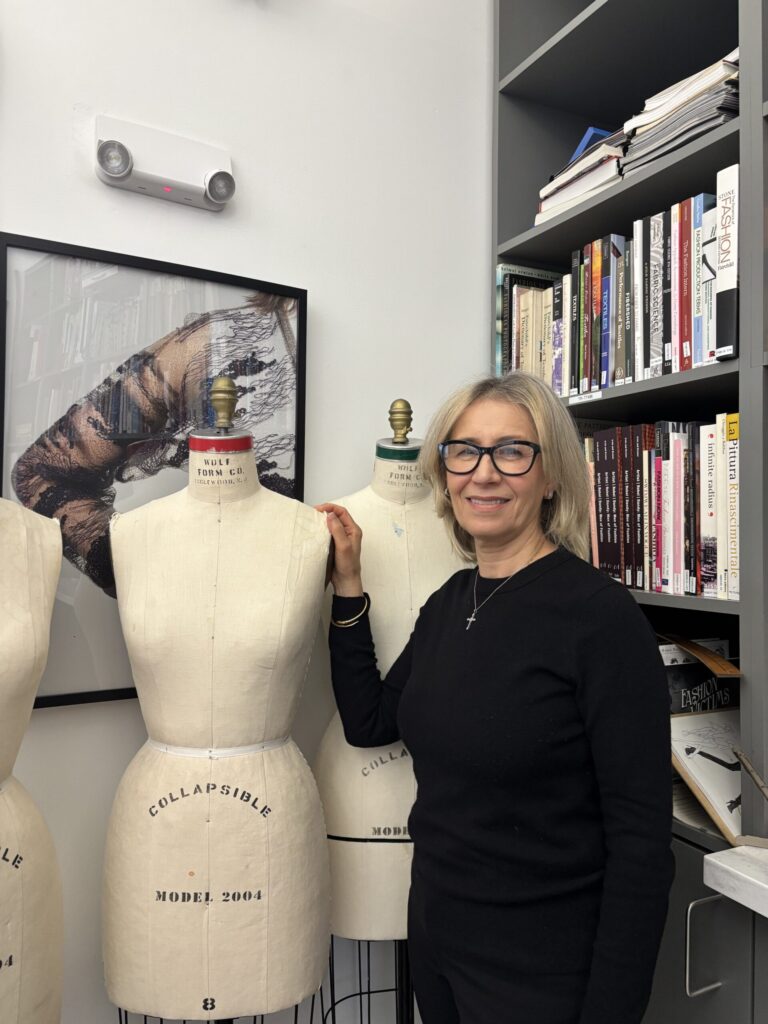
I’m a designer. I’ve been working at RISD for more than 20 years.
I grew up in the northeast of Syria. That’s the best land to grow wheat and cotton and barley, and my dad was in this business. Since I was a child, I’ve always liked to work with my hands. And my mother noticed too, the way I like to dress up. She was a very fashionable woman also, but I always challenged her. “No, I don’t like this. I like this.” My mother used to make clothes for us at home. And sometimes she would take me to the haute couture person that does her clothes. And I would ask them (if I could) take some scraps on the floor. I would bring them and use them for my doll.
I graduated from the business school, majored in business administration. After we moved to this country, I started taking classes at RISD. I got recognized straight away from my teachers, and they gave me an application to go to Paris to study haute couture. So I went there, and I came back, and the same teacher asked me to cover for her class. And then the department head here at the apparel department at RISD needed someone to cover for the tailoring class. She offered me the job. I said, “Okay, just one semester,” and I’ve been here since. To me, my students feel like my children. And we become friends after. I’m a tough teacher. I demand a lot, I challenge a lot, but in the end, students love it, because they learn a lot.
This collection now — I like it because it’s based on scraps, based on what is left over when I gave (students a project on) how to design and make their own custom made denim. When they cut the yardage of the fabric, I said, “Stop, don’t throw anything in the trash. Why don’t you put everything left for me in this bag?” They said, “What are you going to do with it?” I said, “You will see.” Then I came up with this collection. Besides some fabric donated from designers, or I got it from a job or in New York, that’s it. I used it to make this new collection. It’s 10 pieces, 10 looks.
Sustainability, to me, means equality in design, quality and fabric. When you choose quality and you think about the design more, that means people will wear it for a long time, and that’s what I always do: timeless pieces. And I don’t believe in fast fashion. I believe in slow fashion. I always wear what I designed a long time ago. I don’t throw them (away) unless I want to pass it on to someone else or I cannot wear it anymore. And I practice all of this to be a good example for my students, for others to follow. By practicing these elements or these concepts, we can really save the Earth.
Michelle Bi studies English and International & Public Affairs at Brown University. On campus, she writes for The Brown Daily Herald and is involved in social science research. She grew up in Ventura County, CA and enjoys playing guitar and crossword puzzles.


Want to comment? Click!