






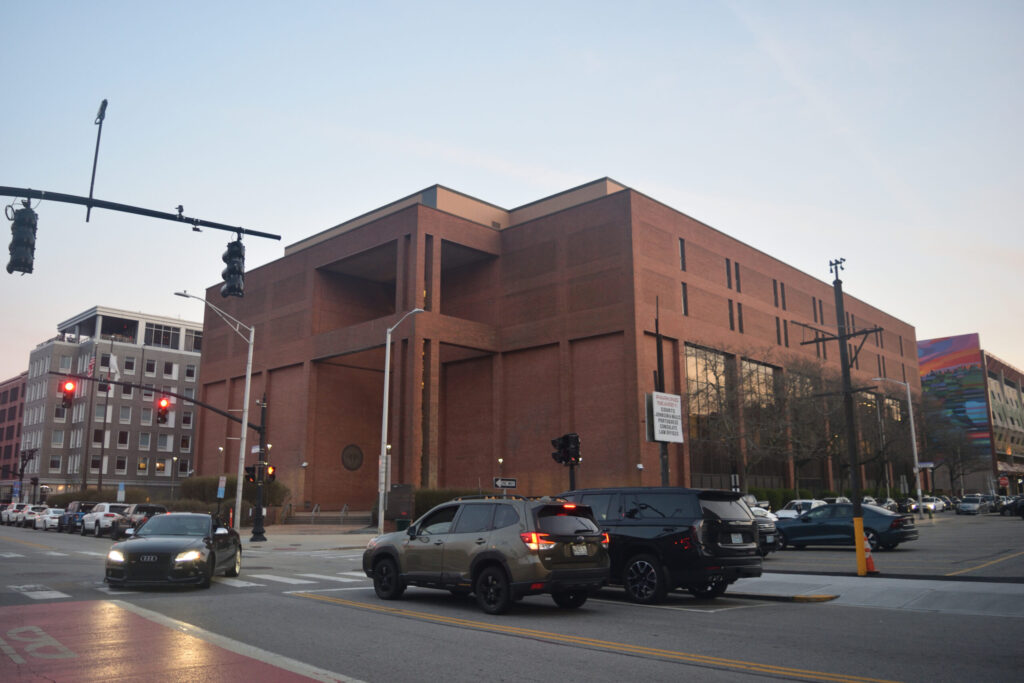
On the third floor of the Garrahy Courthouse in Providence, dozens of people gather outside of courtroom 3E. A mother sits on a beige metal bench breast-feeding her child when a sheriff booms out a list of names for people summoned to court. One person steps off the wall, and the sheriff tells him to either work out an agreement with his landlord or seek free legal advice from the Tenant Help Desk.
“We’re trying to figure out that day, ‘What’s the story here? Are there any defenses trying to talk to the opposing attorney to see if there’s a way that we can resolve it before it ends up in the courtroom?’ said Andy Dunphy, a legal fellow with the Rhode Island Center for Justice (CFJ). “It is what I would describe as controlled chaos occurring out there, and it is nonstop.”
Free legal counsel for tenants facing eviction has grown tremendously since the pandemic, supporting a coalition of legal services that now represent nearly half of all tenants facing eviction in the state. In Providence, the City government is planning to dedicate a one-time boost of $500,000 to eviction defense—but without long-term funding, these programs could find themselves on the curb.
More Tenants Receiving Pro Bono Legal Defense
There were 7,151 court eviction filings in Rhode Island in 2024—2% higher than the averages from 2016 to 2019 before the COVID-19 pandemic began. More than half of those were filed in Providence, Pawtucket and Central Falls.
“The landlords are almost always represented,” said Rhode Island Legal Services (RILS) Managing Attorney and Director Steve Flores. “The tenants are not.”
In 2023, Rhode Island Legal Services received a $3.1 million dollar grant from the State of Rhode Island to provide eviction defense to low-income tenants. That funding was re-upped in 2024 and carried through to 2025. CFJ was named as a subgrantee of the program.
“We have worked with the Center for Justice in that capacity as a subgrantee for a number of years now,” said Flores. “I think both organizations believe that working in coordination, we can do more.”
Since 2021, students from the Roger Williams University School of Law have also been staffing the tenant help desk. The boost in supply of free legal advice ran parallel to a rise in demand from tenants in need across the state. CFJ advised on a combined 61 housing intakes in 2018 and 2019. For the next three years, with increased capacity, CFJ supported an average of 447 cases each year. Cases jumped up to 1,878 in 2023, as eviction filings rose sharply. The City of Providence also stepped in to fund their work.
“The City has supported eviction defense through several funding streams, including a $300,000 Providence Housing Trust-funded pilot launched during the pandemic and continued through $100,000 CDBG-CV (CARES Act) funding and two $600,000 American Rescue Plan Act (ARPA) allocations,” said City of Providence Press Secretary Carl Austin Miller Grondin.
Together, RILS and CFJ counseled a combined 3,763 households from July 2024 to June 2025. These cases represented a total of 8,647 people facing eviction—more than a third of the clients impacted were children. In 2025, the coalition of pro-bono legal defenders represented or advised roughly half of the state’s tenants on their eviction proceedings.
“That’s a huge explosion, largely due to COVID rental assistance and eviction defense money,” said Jennifer Wood, executive director of CFJ. “Landlords are gonna roll differently if they know that on a randomized basis, there’s a 50% chance there might be a lawyer on the other side of the case.”
Tenant and Landlord Laws in Rhode Island
CFJ lawyers said the fundamental 1986 law on residential rentals leans towards legal protections for landlords, with very little recourse for tenants. In cases of non-payment, eviction proceedings operate on an accelerated timeline that can move the case to trial in 24 days. Other forms of civil litigation often take years for parties to respond, gather evidence and allow judges to rule on cases in court.
“The very quick notice period, combined with the no-fault standard for eviction, means that people can be asked to leave a home that they’ve spent their entire lives in on extremely short notice,” said Sam Cramer, a supervising attorney at CFJ. “I represented a guy who lived in the West End. He was evicted from a home that he was born in 70 years ago.”
Landlords point out that Rhode Island has stricter tenant protections in particular cases.
“Massachusetts allows a landlord to collect first, last, and security, which definitely adds a layer of protection for the landlord,” said Shannon Elizabeth Weinstein, a broker at RentProv Realty and spokesperson for the Rhode Island Coalition of Housing Providers. “Rhode Island only allows first and security.”
Over the past year, 70% of CFJ’s clients earned less than 30% of the household area median income, and the most frequent evictors corresponded with the income-restricted housing providers. In the past year, CFJ and RILS worked on 358 eviction cases brought by the Providence Housing Authority. The second-highest evictor of their caseload was the Pawtucket Housing Authority, with 89 cases. Over 2,000 different evicting parties appeared across their dockets.
CFJ Supervising Attorney Kristen Billings warns renters may try to force landlords to improve housing conditions by withholding rent, but this simply gives landlords a reason to evict tenants faster.
“It’s a harsh reality to be in there—to be standing with a mother who has 4 children, she’s doing it on her own and is trying to get a judge to understand that there are rats crawling over her children,” said Billings. “And the judge is saying, ‘But you don’t have the money.’”
If a landlord does not address problems with housing, tenants could complain to Providence’s code enforcement, but it often takes months for City officials to inspect a site, order a landlord to act and, if the property owner continues to ignore the order, eventually take the owner to court.
“So the landlord might be over in municipal court over at the police station in Providence for a series of hearings,” said Wood. “And meanwhile, over at District Court, you could be already evicted before that ever even has a result.”
A lawyer could inform a judge of a code issue affecting the same unit facing eviction, such as a broken heating system or leaking roof, but there is no guarantee a judge will support that argument. CFJ Staff Attorney Noah Aurelio said he’s attempted to get cases thrown out because landlords did not have a proper lead certificate when they filed an eviction.
“A lot of judges—especially a lot of judges in Providence, which is the busiest courthouse—a lot of them do not enforce it,” said Aurelio. “It is kind of pick and choose.”
Future Support for the Right To Counsel
In 2025, RILS received a $2.5 million dollar grant from the Department of Housing and Urban Development to continue eviction defense along with CFJ, but that money is limited.
“That allowed us to basically maintain scale and continue to provide the important work that we’ve been doing. […] The bad news is that that HUD grant expires at the end of the year,” said Flores, who said RILS also has partnered with the City of Providence for several years. “The fact that the City has decided to reissue that support is very good news for our clients.”
Despite the ongoing disagreements in City Hall over rent stabilization, Mayor Brett Smiley and the City Council united behind a plan to provide $500,000 for eviction defense. The one-time award would come from the sales of the old Asa Messer School building and the Humboldt Avenue Fire Station.
“Recognizing this as a successful and integral public service, we are now seeking to support directly in the City’s general fund budget to ensure the work continues sustainably,” said Grondin.
Future city funding would help support continued eviction defense for low-income tenants, but longer-term solutions are still in the air.
“It’s an effective strategy to help keep tenants in their homes [and] minimizing disruptive moves,” said Kristina Brown, Executive Director at Neighbors Welcome! RI. “It’s pretty amazing to see what can happen in terms of mediation and resolution of those landlord tenant disputes.”
For years, Rhode Island lawmakers have been proposing a legal right to counsel (RTC) for individuals facing eviction. Since 2017, five states and 21 municipalities have adopted RTC. This year, Senate Bill 2972 would have introduced a right to counsel in Rhode Island, but the bill was held for committee on April 28, 2026. Neighbors Welcome! RI testified in support of the bill because the program could save money for tenants as well as housing providers.
“One of the highest costs to landlords is tenant turnover,” said Brown. “If there’s a dispute that leads to eviction, there’s also a cost in that legal representation, and if you can have two lawyers meet together to mediate and expedite towards a resolution, you’re saving money across the board.”
Housing providers said there must be a balance for tenants and landlords in housing law.
“The Rhode Island Coalition of Housing Providers has stressed the importance of balanced housing legislation and policies that create positive landlord-tenant relationships,” said Weinstein. “Evictions negatively affect everyone involved, so we must pursue policies that yield favorable long-term solutions.”
Neighboring Connecticut launched a right to counsel program in 2022. Not only did the program help keep thousands of people sheltered, but the service saved Connecticut from spending $36.6 million on emergency shelter services. While Connecticut’s ARPA money will also dwindle, the state budgeted to continue the program through FY2027.
“The money that is spent on eviction defense is money that helps reduce costs in other areas. [….] all the costs that can be driven up if people are forced out into the streets, evicted, without adequate time to move.” said Flores. “That’s something that maybe people don’t think about right away when they think about this story.
At the courtroom in Providence this week, a judge heard dozens of cases: landlords claiming their tenants owed years of backrent, a woman asking for her sister’s case to be rescheduled while she was in the hospital, and CFJ lawyers submitting negotiated agreements on behalf of their clients. Within the legal system, with a level playing field, pro-bono lawyers believe the courthouse could provide more justice for all involved.
Eric Halvarson is a City News Reporter for The Providence Eye.
Want to comment? Click!