






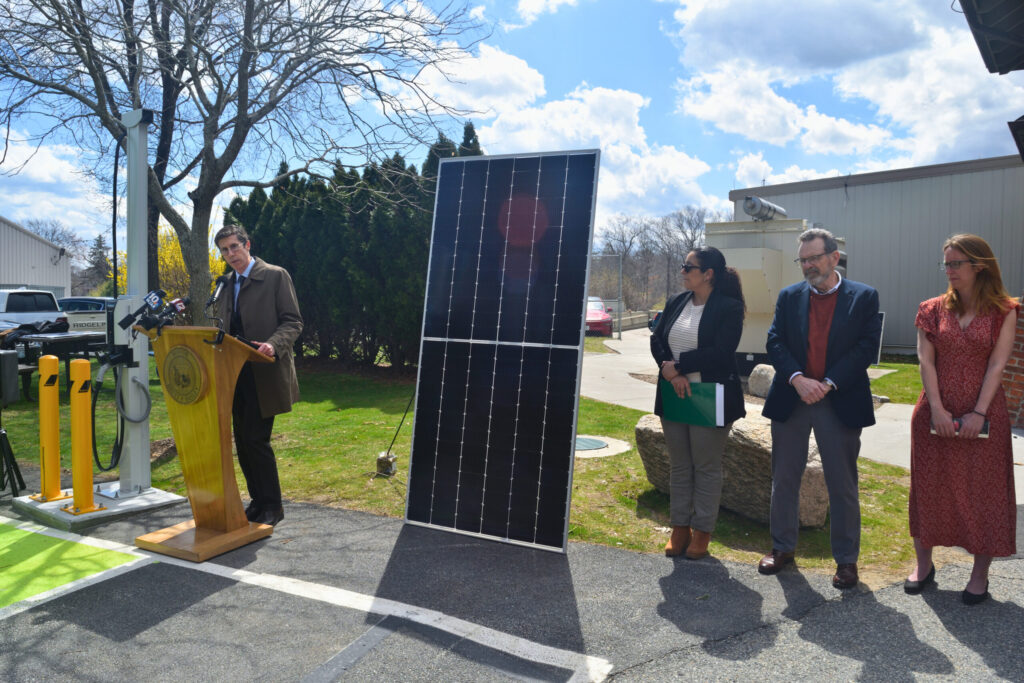
Officials project that Providence’s municipal utility costs will fall by nearly $2 million dollars this year while, at the same time, cutting emissions.
At a time when the Trump administration is fighting against renewables and energy prices are rising for consumers, how is the city government planning to reduce its energy costs and greenhouse gas emissions?
The answer is a combination of electrifying public buildings, renegotiating City energy contracts and using creative financial tools to install renewable energy infrastructure. As Biden-era climate incentives fall away, City Hall is pioneering a Green Revolving Fund to continue decarbonizing public infrastructure and meet Providence’s goal to stop using fossil fuels by 2040.
Utilities Budget Slashed. Where Do the Savings Come From?
Mayor Smiley’s budget took a cautious approach during an election year, without tax raises and only modest changes to City spending. Smiley proposed raising City employee salaries 4.4%, reflecting union contracts with staff like police and fire, and estimated an increase of 5.5% to pay for general services.
The largest change by far is a 23% reduction in utilities costs—the outcome of a multi-year effort to overhaul Providence’s energy system. After Providence adopted a Climate Justice plan in 2019, the City set a goal of reducing energy use by at least 50% and making all municipal buildings carbon neutral by 2040.
“Most of our energy savings come from energy efficiency improvements—the cheapest and cleanest source of energy is the energy that is not used,” said City Spokesperson Josh Estrella. “Savings will also come from the deployment of renewables [that] will do away with the delivery charges and allow us to lock in more favorable long term energy rates.”
In 2023, Providence passed the Building Energy Reporting Ordinance (BERO), which requires large municipal buildings and private properties to report their energy usage. Equipped with a catalog detailing the energy usage of all buildings larger than 10,000 square feet, City officials can identify ways to lower energy costs, benefitting both the environment and City bank accounts.
So far, Providence has completed energy efficiency projects in 60 public buildings, such as installing automatic lighting controls, building management systems and improving HVAC. In 22 buildings, officials replaced or are currently replacing old heating systems reliant on fossil fuels like natural gas and oil with fully electrified heat pumps able to efficiently run on renewable energy.
The result is a 7.7% reduction in energy use this past year, compared to the averages recorded from 2022-2024, according to Director of Energy Operations David Ruggiero.
The Department of Sustainability also leveraged the Rhode Island Energy Aggregation Program (REAP) through the RI League of Cities and Towns to purchase energy when market prices are low. The City identified savings with an updated energy and utility account management system called the Energy Intelligence Suite (EIS) from energy consultant PowerOptions.
“The EIS platform replaced a time-consuming manual invoice review process with streamlined utility bill data management and analytics, giving the city a clearer, real-time picture of its energy consumption and spending,” said PowerOptions Director of Marketing and Communications Sharon Palermo. “Armed with that data, Providence and PowerOptions worked together to develop a sustainability action plan that prioritizes initiatives by impact, and to time electricity and natural gas purchases strategically using weekly market updates.”
In early April, City officials revealed another innovative tool that will help shield Providence’s climate plan from federal changes to green energy policies.
Green Revolving Fund To Power Future Renewable Investment
“We don’t really have dedicated sources of funding for this type of work,” Sustainability Director Priscilla De La Cruz. “When the carbon neutral ordinance came into effect, I think that really inspired [us]. We needed to figure out how [to] restrict funding for this cause.”
The Green Revolving Fund will be seeded with an initial $3 million dollar City investment, if it receives City Council approval. The money will go towards installing renewable energy and completing more efficiency projects to take advantage of Biden-era financing that will soon expire. The incentives and tax credits from those completed projects will then be reinvested into future green energy projects.
“The Inflation Reduction Act created a direct pay mechanism under the [Investment Tax Credit], where we get up to 40% back for these projects. So that’s really that motive behind the Green Revolving Fund,” said De La Cruz. “We need to move fast and we need to move quickly in order to secure those ITC direct payments and put them towards the next projects.”
HR1, or Trump’s “Big, Beautiful Bill,” began to phase out major tax credits for renewables put in place under Biden. In order to qualify for these funds, wind and solar projects must be put into service by December 31, 2027. Estrella said the City has “$3.2 million on the table for incentives,” but not all of those projects are guaranteed yet.
Four solar projects are currently under development, and Smiley’s budget dedicates the revolving fund money towards improvements at recreation centers, the Roger Williams Park maintenance facility and the City’s newly purchased office building at 444 Westminster Street.
But the largest area for improvement are Providence Public Schools. More than half of the large buildings owned by the City of Providence are schools, and they are responsible for three-quarters of the local government’s greenhouse gas emissions. Since the state government reimburses up to 91% of school construction and major renovations costs, Providence’s plan to spend $1 billion on local school facilities can recoup significant costs of decarbonization.
“While these upgrades require upfront capital investment, they significantly reduce long term energy expenses,” said Mayor Brett Smiley. “They protect the city from volatile fossil fuel prices, which is more relevant today than ever, and lower deferred maintenance costs over time.”
The revolving fund model is used by other municipalities across the country, including in Vermont. Starting in 2019, South Burlington set aside $140,000 annually from a large solar project in the city to invest in their Energy Project Reserve Fund. A portion of savings from every project that uses more than $10,000 dollars of EPRF money is returned to the fund until the project is completely paid back. South Burlington has used the capital to install LED lighting in their police station, purchase electric vehicles and install a solar array on City Hall that brings $20,000 back into the fund each year.
“The ability to reinvest tax credits and rebates back into the fund has been beneficial, but the main income is still from the solar array,” according to a statement from Climate Action Manager Bettina Miguez and Energy Project Manager Lou Bresee. “However, the fund does have some risk exposure to changes in net metering rates by Vermont’s Public Utility Commission, which could affect the revenue from the original solar array.”
Despite having the EPRF, South Burlington still searches for grants and other funding sources for energy projects; but officials are considering using the fund to apply for loans to invest in more expensive projects in the future.
In Vermont’s capital of Montpelier, a volunteer-run Energy Advisory Committee established a fund in 2016. However, the town of 6,000 people struggled to invest enough money and measure sizable gains without paid staff to manage the effort.
“You have to have a big enough pot of money to do substantial projects,” said Kate Stephenson, former chair of the committee, who said the additional capital allows a municipality to spend more for the best energy investment. “That’s where the revolving fund has the potential to have a really great impact… The revolving loan fund doesn’t have to pay for the whole thing, but just sort of the incremental additional expense.”
Ruggiero agreed that renewable energy requires short-term investment, but in the long-term, he said relying on fossil fuels like gas is “much, much more expensive.”
“When you look at a 25 year life expectancy of a solar system, it’s going to pay for itself—with the tax credit—within seven years. Without the tax credit as currently configured? About 12 years,” said Ruggiero. “That gives you 12 years of locking in electricity: you’re not paying for that.”
In Mayor Smiley’s proposed budget, a third of the revolving fund money is dedicated to “safe harbor payments” for future solar projects. If the fund is approved, Providence can pay 10% of the contract price on the solar developments by July of 2026 in order to qualify for the sunsetting tax credits.
Ruggiero said the city will continue to take advantage of ITC programs that will remain for battery storage technology and ground-source heat pumps in line with the City’s new Decarbonization Roadmap. The plan outlines over $60 million dollars of recommended investments in city infrastructure, but by leveraging utility, state and federal incentives, officials estimate the changes could save the City a total of $12 million by 2040.
In March 2026, solar, wind, hydropower and bioenergy industries together produced more electricity than natural gas in the United States for the first time. Providence will try to contribute to that trend by using the Green Revolving Fund to invest in energy efficiency, electrification and local sources of renewable power.
Eric Halvarson is a City News Reporter at The Providence Eye.


Want to comment? Click!