




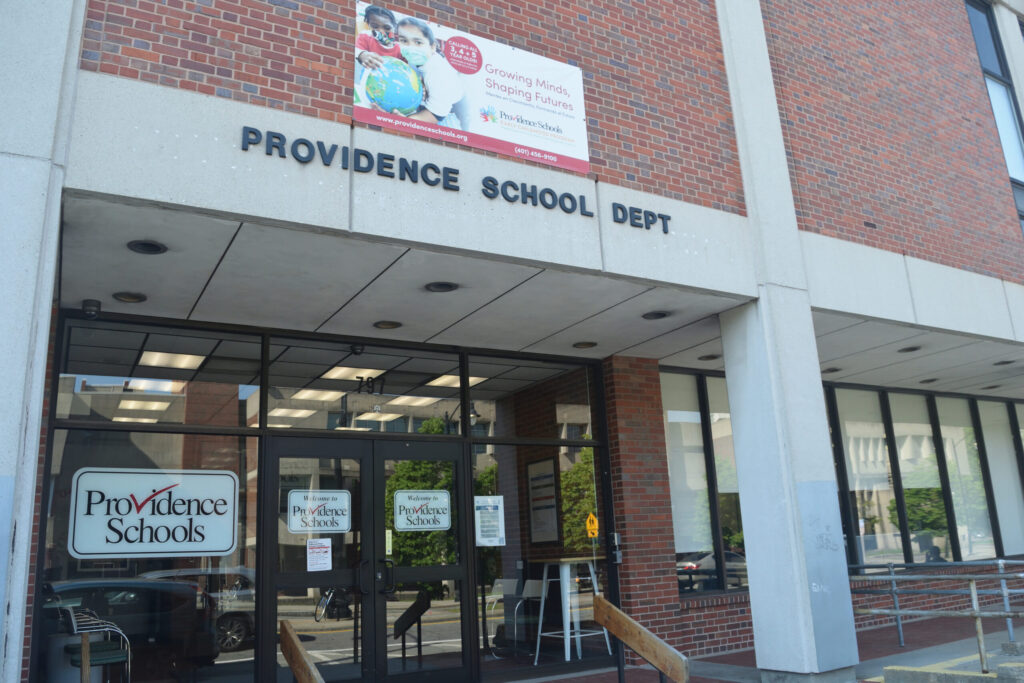
Providence parent Aubrey Johnson was anxious about the prospect of a sudden return of Providence Public School Department (PPSD) to local control.
“All these years and no one has come up with a plan for return,” said Johnson, who follows school issues closely as an active advocate for parents and member of the district-wide Parent Advisory Council. “They’re already butting heads, and it hasn’t even happened yet.”
Then, late last Wednesday afternoon, local return happened—plan or no plan.
On May 18, RIDE Commissioner Infante-Green signaled that the battle for control between the state and city was still far from over. She issued a new list of 15 conditions that the Mayor and School Board would need to meet over the next 13 months for her to even consider a return before July 1, 2027. And that was on top of her February list of required benchmarks,
Then, on May 20—in a stunning reversal—she announced that the six-year state takeover of Providence Schools will end effective July 1 of this year. Although Mayor Smiley called the change “a win for the city,” even some ardent proponents of local control were dismayed by the abruptness of the Commissioner’s decision. School Board President Ty’relle Stephens, who has fought long and hard to restore the Board’s authority over PPSD, said he would have preferred a transitional phase to the return, according to the Boston Globe.
That’s because the simple phrase “return to local control” obscures a long list of potential local disputes that will come with the shift of authority from state to local government. Under state control, one person, Commissioner Infante-Green, was in full control.
The Bad Old Days
Under local control, power and influence over PPSD is distributed among three municipal government entities: the Mayor, the Providence School Board and City Council. Not to mention a broad array of other officials and advocates with agendas of their own. Counterproductive conflicts among these parties originally led to the takeover in September of 2019.
Earlier that year, a district-wide schools assessment from Johns Hopkins University described deficiencies in almost every area of PPSD, including crumbling facilities; widespread misery among parents, teachers and administrators; haphazard academic instruction and poor educational outcomes. These conditions had persisted over decades.
At the core of all this chronic failure, the Johns Hopkins researchers cited a rigid teachers’ contract and an ineffective web of authority, governance and behind-the-scenes influence among the Mayor, the School Board, the City Council, the Providence Teachers Union (PTU) and officials at PPSD.
It was a recipe for fruitless conflict and rapid turnover of Superintendents. No individual or official body seemed able to assert leadership and take sustained, effective action for improvement. Leaders ducked responsibility and pointed their fingers at others.
The RIDE takeover swept that tangle aside. All authority was conferred on one person, RI Education Commissioner Angelica Infante-Green. Local officials could endorse her actions or attack them, but they had no power to influence them.
What Has RIDE Left Behind?
Unlimited authority didn’t generate the spectacular academic improvements promised back in 2019 and 2020. Providence students, like public school students across the country, suffered huge learning losses due to the COVID pandemic. RIDE can claim credit for restoring student achievement to pre-COVID and pre-takeover levels, but the district still falls far below national averages. Overall test scores are advancing, but at a glacial pace. Stanford University’s Trends in Academic Performance scorecard for Providence, says “Test scores in Providence have been changing at a rate of +0.04 grade levels/year since 2022.”
RIDE and other optimists point to less visible initiatives, including more services for PPSD’s large percentage of multilingual learners, expanded Career and Technical Education and the use of “high quality” curricula and learning materials throughout the district. If sustained, these investments may yield measurable results in future years.
Putting academic outcomes aside, did six years of State control prepare Providence to do a better job of managing its public schools? The Commissioner herself expresses grave doubts. Her public pronouncements and official documents make clear that she very much fears and expects “a return to old practices.”
Her draft order on return, released last Wednesday, says “the Commissioner hereby states her firm conviction that the progress made by PPSD while it was under state control will not continue, and in fact student achievement in the District will regress…” unless Providence officials comply with yet another list of very detailed demands. Her insistence on “mandatory refresher training” on ethics, third party legal review of School Board decisions and the hiring of a full-time “Coordinator of Board Services” show how much confidence Infante-Green has in local school governance.
RIDE certainly has not modeled or nurtured the collaborative culture and habits Providence leaders will need to work together for students, at least not publicly. Instead, Infante-Green has engaged in bitter and public tit-for-tat disputes with Mayor Smiley, members of the Providence School Board and Providence legislators over if, when, and how local control would ever be restored.
Behind these scenes of conflict, RIDE, the Mayor and the School Board have each established staff-level working groups and ad hoc committees in efforts to coordinate and organize elements of the return to local control. None have made much progress. Even participants couldn’t say which group, if any, was really setting the stage for return. In the end, Commissioner Infante-Green made that decision unilaterally.
So now the Mayor, the City Council and the School Board, as well as leaders at PPSD and PTU have about three months to figure out which of them is in charge of what, develop a management process, set educational strategy and rebuild local governance and oversight functions that haven’t been used in six years.
A meeting on May 18, prior to the Commissioner’s latest announcement, illustrated the steep challenges of reconstructing local control. The meeting, the fourth of five planned, was organized under the auspices of newly elected Ward 2 City Council member Jill Davidson, an educator and former PPSD parent. Davidson took this step to identify specific things the City Council could do to support a smooth transition to local control.
The attendees included Mayor Smiley’s Chief Operating Officer Courtney Hawkins and Chief of Policy and Resilience Sheila Dormoday, RIDE’s Deputy Commissioner Drew Echelson, PPSD’s Deputy Superintendent of Operations Zack Scott and School Board President Ty’relle Stephens. Aubrey Johnson and Melissa Hughes participated as parent representatives. Davidson and two staff members from the City Council guided the meeting.
After three prior meetings, the group was still deadlocked on its first issue: external approval of PPSD contracts for $10,000 or more. The 2019 Hopkins report identified burdensome and extremely slow municipal procurement processes as a major barrier to school success. During the takeover, PPSD has simply sent contracts requiring approval to RIDE for quick turnaround.
The Mayor’s team insisted that PPSD contracts now go through the city’s Board of Contract and Supply (BOCS), as required of all city departments under the City Charter. PPSD, RIDE and the School Board wanted to maintain the current system in the short term and ultimately amend the City Charter to give the School Board sole contract approval power.
Conversations had become heated at the prior meeting, according to Davidson, but the May 18 meeting discussion was calm. Hawkins and Dormody offered a number of proposals to expedite BOCS approvals for PPSD. Scott used city data to argue that these changes would not significantly reduce the additional PPSD paperwork and process burden. Echelson suggested that perhaps the Board of Supply and the School Board could meet jointly or otherwise merge the two processes.
President Stephens asked the team to consider whether proposed solutions really addressed the problems identified by the Hopkins report. The parties looked like they just might be inching toward a constructive resolution as the meeting ended. In closing, Davidson reminded participants that the criteria for decisions must be the best outcome for students. She set a final 90-minute session to see if that goal can be achieved.
Fears of a Train Wreck
The dispute over contract approval is not just about power. There are matters of law involved and fundamental questions of whether PPSD is essentially a city department or a special entity with its own oversight board and independent authority over schools. And then there’s what’s best for schools and students.
But it is also about power. Each party wants to maximize its control. The Mayor, Council Members and the School Board all have electoral mandates and constituents to whom they answer.
With luck and skillful facilitation, Councilmember Davidson might just succeed in helping the parties resolve the purchasing issue. But as a City Council Member, Davidson cannot mediate the long list of challenging decisions coming down the pike: a crushing revenue shortfall with layoffs looming, lots of decisions about whether and how to merge PPSD and city systems, a new Superintendent’s contract, a new PTU contract by September of 2027 and a host of other issues.
And the wider community will demand a say. Providence’s General Assembly delegation has already had an impact simply by threatening to override the takeover through legislation. The Providence Teacher’s Union just elected a new reform-minded slate of officers determined to exercise organizing power over educational policy. Parents participate inside the system at PTO’s and the district-wide Parent Advisory Council, and through advocacy organizations like Parents Leading for Educational Equity. Students step up to defend threatened schools and teachers and to advocate for an education that represents their lived experience through organizations like the Providence Student Union.
Many parents and other observers fear a train wreck when RIDE pulls back from control and leaves PPSD to local self-government. RIDE certainly seems to expect one—and wants to reserve its right to step back in if that happens.
The negotiation over purchase approvals was time-consuming and frustrating, but it just might solve one problem. Maybe it builds a bit of trust between the Mayor and the School Board. Possibly, it offers hope that Providence can, with good faith and patience, learn to create the schools our students deserve.
Jonathan Howard is Co-founder of Cause & Effect, Inc., a consulting company that provides strategic planning facilitation, fund development planning and board strengthening to mission-driven organizations. He is a long-time resident of Providence.


Want to comment? Click!