





Editor’s note: This article was originally published on Steve Ahlquist’s Substack on November 14. Reprinted with permission.
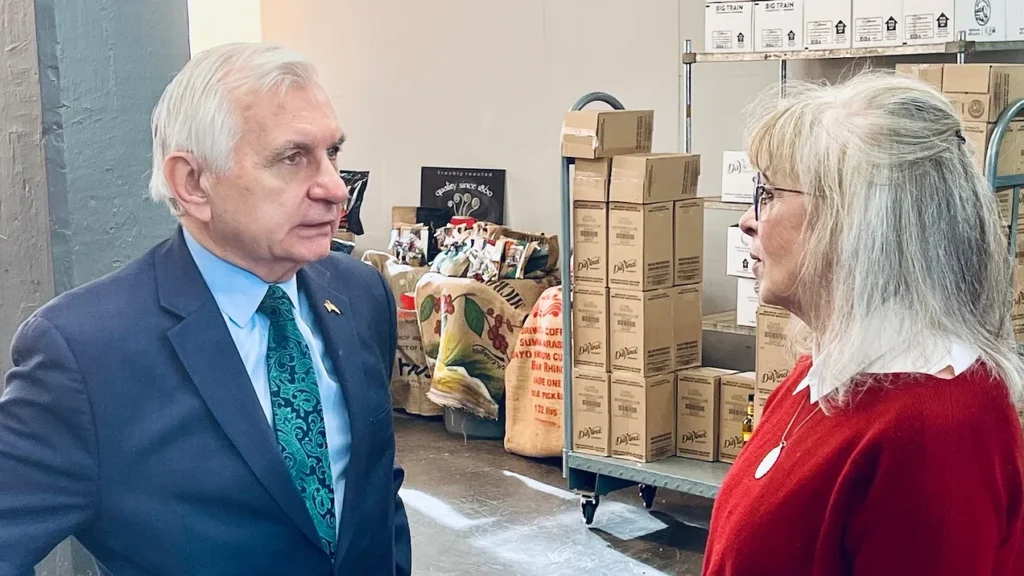
On Friday, United States Senator Jack Reed (D-R.I.) visited the great-smelling Mills Coffee Roasting Company on Broad Street in Providence to discuss his latest effort to help lower the price of coffee. Dating to 1860, Mills Coffee is one of the oldest family-owned roasters in the country. Sister and brother Susan and David Mills now run it.
“Mills Coffee has a storied family business,” said Senator Reed. “They have provided generations of Rhode Islanders with their coffee for well over a century, and they’ve seen lots of ups and downs in that time, but they’re experiencing something now that is unprecedented: President Trump is causing reckless, major price shocks to the coffee business. He’s slapping tariffs on all manner of goods, increasing costs, and putting Americans out of business.”
President Trump imposed 50 percent tariffs on Brazil, a country from which American imports around one-third of its coffee, after the country refused to drop criminal charges against far-right former Brazilian President Jair Bolsonaro, who has been convicted of attempting to overthrow Brazil’s government. The next two biggest coffee exporters to the United States, Vietnam and Colombia, have been hit with 20 percent and 10 percent tariffs, respectively.
“Trump has imposed a 50% surcharge on Brazilian goods because he wants to punish the independent Brazilian judiciary system for pursuing one of his political acolytes, Bolsonaro,” said Senator Reed. “This has nothing to do with international trade or economic policy. It’s a personal shot at a country because he doesn’t like what they’ve done to one of his amigos, for lack of a better term.”
Senator Reed continued:
“Who’s paying for it? We are. We get about one-third of our coffee from Brazil, so this is not a trivial impact. When the president bases trade policy on chaotic self-interest and self-aggrandizement, as in ‘you can’t do that to my buddy,’ that’s absurd, and it hurts Americans. Costs go up and ripple out.
“And it’s not just Brazil. Trump has imposed blanket tariffs on every country, including exporters of coffee such as Vietnam and Indonesia. It makes very little sense, and these prices are hammering American businesses. Susan shared with me that the Trump tariffs are costing her company around $30,000 each month.”
The average U.S. price of a pound of ground coffee is now $9.14 – 41 percent higher than the year before, according to U.S. government data.
“That’s a lot of money, and it’s going to have to be passed on,” said Senator Reed. “There’s just no way a small business can absorb that kind of money. Households are feeling the pain too. Coffee is something practically everyone uses every day.”
Coffee production is not an industry that the U.S. can reasonably onshore, and the U.S. is the largest importer of coffee in the world. Ninety-nine percent of all coffee consumed in the United States is imported, according to the National Coffee Association (NCA), because there are very few places where it can grow domestically. NCA’s latest economic report shows that the total economic impact of the coffee industry in the United States in 2022 was $343.2 billion. It found that the coffee industry is responsible for more than 2.2 million U.S. jobs and generates over $100 billion in annual wages.

“That’s why I sponsored the No Coffee Tax Act in the Senate, which would reverse the Trump tariffs imposed on coffee imports,” said Senator Reed. “Our bipartisan bill would repeal these tariffs and prevent the administration from implementing new ones. I also voted last month to end the president’s tariffs on Brazil because again, they’re nonsensical. They’re based not on economic calculations, but on personal grievance, and that’s not the way to run a country.”
Senator Reed continued:
“Despite the president’s attestation that foreign companies and foreign countries pay the tariffs, they’re only paying approximately 9% of the tariffs. American businesses and consumers are shouldering the other 91%. When his administration claimed we’re bringing $30 billion a month in tariffs, it means that American households are paying $27 billion a month to the Treasury. It’s a tax on Americans, and we’re struggling under many other burdens imposed by the Trump regime. We’re seeing the price of health insurance increase dramatically.
“Treasury Secretary Bessent said we’re going to adjust some of these tariffs, but tariff policy under the Trump administration changes every 10 or 15 minutes, so what he said today will probably be forgotten tomorrow. So we have to keep the heat on and we’re going to do our best to ensure that the Trump administration follows through and actually lowers tariffs on coffee and many other products that are necessary for our households. President Trump has to wake up, smell the coffee, and start listening to the American people.”
Senator Reed says there is bipartisan momentum for the No Coffee Tax Act, which is led by Catherine Cortez Masto (D-NV) and Rand Paul (R-KY).
“We started in 1860. I know I don’t look that old, but that’s how far back it goes. I have a great-grandfather, grandfather, father, my brother, myself, and most of our children have been involved too,” said Susan Mills, who runs the Mills Coffee Roasting Company with her brother David. “People who work here have worked here for many years because they’re all like family. Coffee is both a supply chain and a village. We work directly with growers because it takes a year to cultivate and harvest a crop of coffee, and they need to contract with someone they know can actually buy the coffee. That’s the best way for them to do it. When you sign up directly, you enter into a contract – they can secure financing, allowing everything to run smoothly.”
Mills continued:.
“Then, it comes with tariffs that can be imposed at a moment’s notice. Coffee was bought eight months ago on a contract, or maybe even a year before that. We budgeted for it; we know what we’re going to do, who our customers are, and we have a lot of great customers here in Rhode Island. They like to know what their price will be. We like stability. The coffee market has experienced volatility even before we began with the big, beautiful bill and all the tariffs. We were already at a historic high. We were waiting for it to come down because it’s like a rollercoaster. As the prices began to decline, they started instituting tariffs of 10%, 15%, 20%, and then 50% on the largest coffee producer.
“I was hit with a $12,000 tariff because the coffee was loaded a day later than it should have been, and when it arrived at the port, $12,000 was immediately due. That added $12,000 to the cost. That’s not in my budget. That’s what finally got me to reach out for help because taxation without representation is how we became the coffee business. That’s how it all started, when we dumped the tea into the harbor that began the American Revolution.
“The president was looking at a hundred percent tariff on coffee from Colombia. I had already paid significantly more than I had ever paid before. It was approximately $185,000. That would’ve meant $185,000 tariff. How do I do this?
“The tariffs do not belong on an agricultural product. It’s decimating our entire village, from grower to trader to the coffee in the warehouses. There is no coffee in the warehouses because people are afraid to buy it. We’re so scared to buy it because it’s like Russian roulette. It’s an awful price, but we might be able to get that by, but it could be double. With Brazil, the tariff is going to be half of the actual cost, and Brazil is the largest producer of coffee, while America is the biggest buyer.
“I’m an American manufacturer. If we’re supposed to be reinvigorating American manufacturing, it’s not helping me, that’s for sure. And it’s not helping anyone in my chain.”
I asked how quickly the bill can be passed.
“We’re not getting a lot of cooperation from our Republican colleagues, so it’s going to be difficult to get to the floor,” said Senator Reed. “As you are aware, the Supreme Court has heard arguments regarding the legality of these tariffs. They could render a decision in the next weeks, and if they legalize the tariffs, then we’re going to have to press harder, but we’ll have much more backing from Republicans because I think some are holding back and waiting for the court.”


Want to comment? Click!