




In his 2009 essay “The Losers’ Club,” the Pulitzer-winning novelist Michael Chabon made a surprising connection: Writers’ careers are full of failure. So is fatherhood. “A father,” Chabon wrote, “is a man who fails every day.”
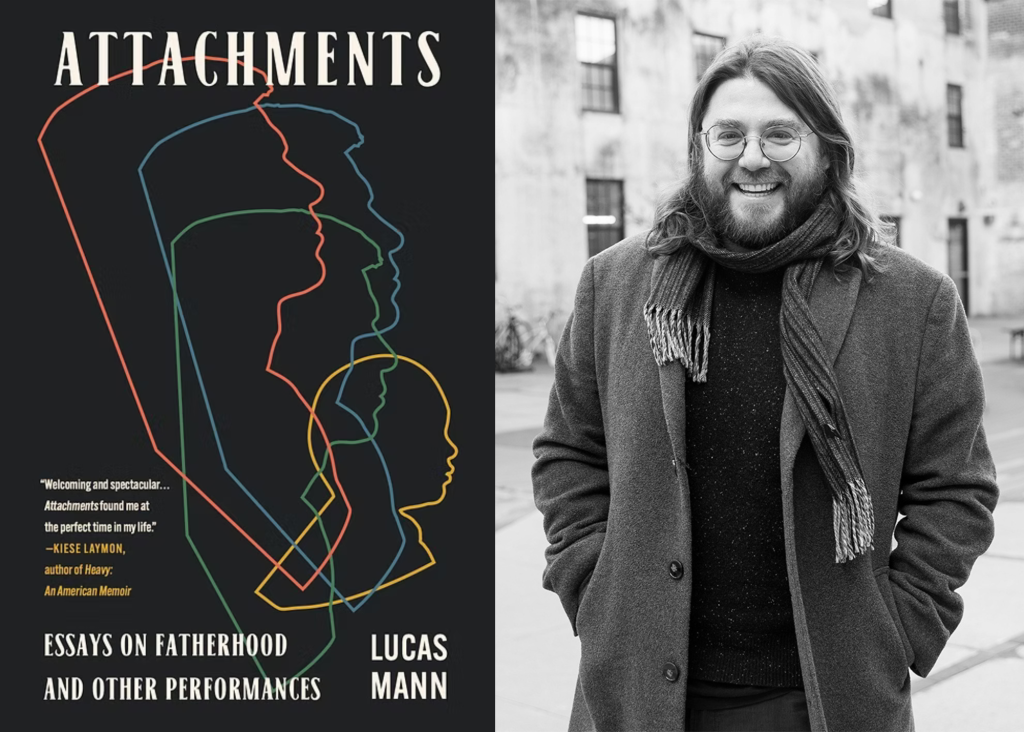
Chabon’s insight came back to me while I was reading Attachments: Essays on Fatherhood and Other Performances, a recent collection by Lucas Mann, a Providence writer who is also the co-owner, with his wife Ottavia De Luca, of Riffraff Bookstore + Bar in Olneyville. In twelve sharply observed personal essays at the intersection of popular culture and parenthood, Mann reports on his experiences—often humorous, sometimes heartbreaking—as a new father, using tropes drawn from popular culture to make sense of it all.
Mann’s subjects range from the troubling contradictions of children’s media, to the differently troubling internet subculture of fathers who, shaken up by a baby’s arrival, disappear online, becoming dorky purveyors of dad jokes, to a tour-de-force meditation on Brad Pitt and disordered eating.
In the opening essay, “Tiny, spectacular futures,” Mann imagines the life of his young daughter, providing a kind of a coming-attractions reel with scary scenarios thrown in. The format creates an instant connection: What parent hasn’t succumbed to unreachable dreams and pointless worries at 3 am? Mann’s visions are mostly sweet and wishful, such as the one in which his daughter is thirty and living happily at home, enjoying peaceful evenings with her parents, and even the dog still “moves around our feet, forty years old now, slow and gassy but content.” At the same time, Mann is too self-aware to make everything honey. The essay closes with a snapshot-in-words of his imagined adult daughter jumping into a lake. “No part of her body resists the jump. She doesn’t bother to brace herself as her feet hit the water.” He means her to seem free, and she does—at least, she is not timid—but this mother’s heart quaked at unseen depths, and I worried that she’d forgotten to wear sunblock.
In another essay, “On Boredom and Vigilance and Addiction,” Mann and his wife set aside a handful of consecutive days to potty-train their daughter. The method requires the child to be undressed and closely watched, so as to be shepherded to the potty in just the nick of time. Warned that training will be hard, Mann and his wife are urged to “try to find the joy in the closeness and unfiltered attention that modern society usually robs from us.” Mann starts to feel stressed, realizing that while he is keeping an eagle eye on his daughter, watching for signs of needing to go, he will in those moments be unable to look at his phone.

I howled here, in recognition. “I couldn’t imagine myself like that,” he writes of being phoneless, “the same way that I couldn’t imagine my daughter ever pulling down her jeggings and taking a clean piss in the appropriate location.” So much is packed into this vulnerable assessment. Perhaps every dependency, whether on parents or phones, is a kind of attachment, relinquished only with reluctance, and not without support. If Mann can’t put down his phone, who is he to ask anyone else, not least his tiny daughter, to learn to use the toilet?
Mann struggles just as openly and charmingly with other all-too-recognizable feelings, notably an uncertainty about his body and the space it takes up. In one of the book’s most harrowing passages, he remembers his father pressuring him to lose weight, a pressure that becomes a persistent source of self-loathing. During an argument, his father challenges him to put on a belt, “yelling that if I really didn’t feel like I’d become obese, put it on and see if any of the loops fit.” This is parenthood as domination, an insistence on the parent’s standard of acceptable size. “The worst part of the memory is that I did it,” Mann recalls. “I put it on and sucked and clenched everything, and it did fit, and it took a few moments for me to realize how much sadder this was than if I’d walked away. I thought about it every day for months.”
Even as Mann tries to protect his daughter from being similarly burdened, from having feelings of inferiority connected to body shape and size, his disapproving father continues to show up in his imagination. Attempting to give his daughter a degree of self-acceptance, Mann cheers her on at mealtimes—but even in these moments, he is still criticizing himself. “Hooray, I say, hooray for my big eater, my best eater—leaping over that lowest bar,” he says ruefully, “of not making a toddler feel anything toward herself but love.”
To do a better job with your children than your own parents did with you — as modest as that goal sounds, it’s not easily attained. If it helps to have a guide, it’s hard to think of a better one than Mann. In one generous essay after another, he lays out the difficult terrain of parenthood, pointing out the loosened gravel and the lifted roots, all the while gesturing toward the interesting features in the landscape, the thousand tiny moments not to be missed. After a successful birthday party, as Mann quietly celebrates the milestone with his wife, he articulates just what, with all this frantic effort, they want to give to their daughter: “We told each other that we’d done great, that she was a happy person with a good life.”
For more information about Mann’s writing, visit lucasmann.com. If you haven’t already, check out riffraffpvd.com for local literary events and author readings.
Diane Josefowicz’s writing has appeared in the Boston Globe, Dame Magazine, LA Review of Books, and Conjunctions. Her next book, Guardians & Saints: Stories, is forthcoming in October from Cornerstone Press, and her second novel, The Great Houses of Pill Hill (Little Place of Departed Spirits) will be published by Soho Press in 2026. Sign up for her newsletter, “What’s That Noise?” at www.dianejosefowicz.com. She lives in Providence


Want to comment? Click!