






Meet the jumping worm, an invasive species bad for garden dirt
Until recently, most home gardeners were happy to find earth worms when they dug into a garden bed. Earthworms are generally seen as improving the structure and fertility of garden soil as they tunnel through the soil, consuming organic matter and leaving behind castings (worm manure) that are rich in nutrients, humus, and microorganisms.
Unfortunately, there is a not-so-new worm in town that provides none of these benefits and can actually do great damage to soil structure and fertility: the so-called Jumping Worm. These worms devour the top layer of soil, leaving behind crumbly soil that dries out quickly, is prone to erosion, and makes poor habitat for many plants and soil dwelling organisms — including bacteria, fungi, and other invertebrates.

What Are Jumping Worms and How Did They Get Here?
The name jumping worms refers to several similar-looking species of invasives (Amynthas spp.) that originated in East Asia. They likely arrived in North America as hitchhikers on imported plant materials. They have been in the US since the late 1800s, but pretty much remained underground until recently when their numbers and range have increased dramatically. The reasons for the recent rapid spread are not completely understood, although it may be due to climate change, as well as human activities which unwittingly spread the worms (e.g., gardening, landscaping, fishing, hiking). They are now found in more than half of US states, including many areas in Providence and Rhode Island.
How Do Jumping Worms Impact A Garden?
Unlike other earthworms that burrow deep into the soil, jumping worms tend to live in the top three to four inches of soil and in leaf litter and mulch. They are voracious eaters and can quickly deplete nutrients found in soil and organic matter. While other earthworms distribute their high nutrient-value castings throughout the soil, jumping worms excrete their castings on the soil surface, where the nutrients are unavailable to plants. The castings are fairly hard, and they frequently erode away in the rain.
The combination of hard castings and aggressive churning of the soil results in a dry, crumbly soil structure, with large air pockets, which can impact the ability of plants to produce and anchor roots, absorb water, and extract nutrients. The disturbed soil has been described as resembling ground meat or coffee grounds (see picture). It erodes easily, dries out quickly, and generally makes poor habitat for many plants, fungi and other soil organisms.
Marsha Miller, a long-time Providence gardener said,” The soil in my garden looks like taco meat. I dig and large worms show up within three inches of the surface. Not like an earthworm. It’s pretty disappointing. I’m worried about how I can keep my plants healthy with the arrival of, or should I say, this infestation of Asian Jumping Worms.”
Once jumping worms come to inhabit a garden, they rapidly increase in numbers, no mating required, as they reproduce asexually. Adult worms can have many offspring, and while the adults will die off after the first few hard frosts, the tiny egg cocoons they leave behind (which are virtually impossible to see with the naked eye) will survive the winter, emerging in the spring to start the destructive cycle again.
Jumping worms can have a profoundly negative effect on forests and woodlands, as well as gardens and crop lands. A thick layer of leaf litter and organic matter (sometimes called the “duff” layer) is essential to healthy forest soil. Native forest plants and trees have evolved to rely on this duff layer for the successful germination and growth of their seeds. After jumping worms have altered forest soil, native species may start to diminish while invasives move in and outcompete native species. This alteration of the forest floor and decline in forest health also harms wildlife that depend on native plants and trees, like ground nesting birds, amphibians and invertebrates.
What Do They Look Like?
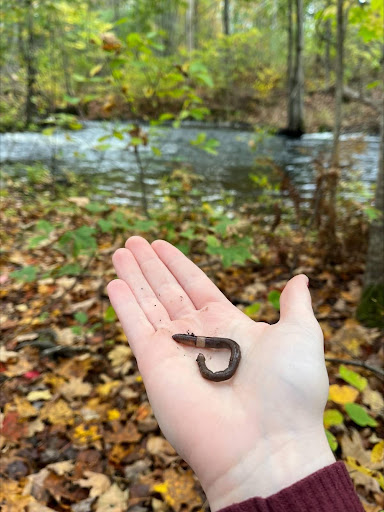
Jumping worms are most easily identified by their behavior. They move across soil or pavement in a snake-like fashion and when you touch them or pick them up, these worms will thrash around wildly. This behavior has given rise to the names jumping worms, crazy worms and snake worms.
Adult jumping worms can also be distinguished from other earth worms in Rhode Island by a milky white or pinkish band, called a clitellum, that fully encircles one end of their body (see photo above). Other common earthworms have a saddle-shaped band towards one end of their body, but the band does not entirely circle the body and is closer in color to the rest of the worm’s body. The clitellum of all species holds the worm’s egg cocoons. Adult jumping worms can also be quite large, up to eight (8) inches in length, although size can vary.
Jumping worms in Rhode Island do not attain adulthood until sometime in July or August. Before then, juvenile jumping worms, which lack the white clitellum, are difficult to identify. Young jumping worms can best be identified by their thrashing behavior when they are touched or handled. Another way to identify the presence of jumping worms is by noticing dry, granular soil in your garden beds devoid of any organic mulch you may have applied (see photo below).
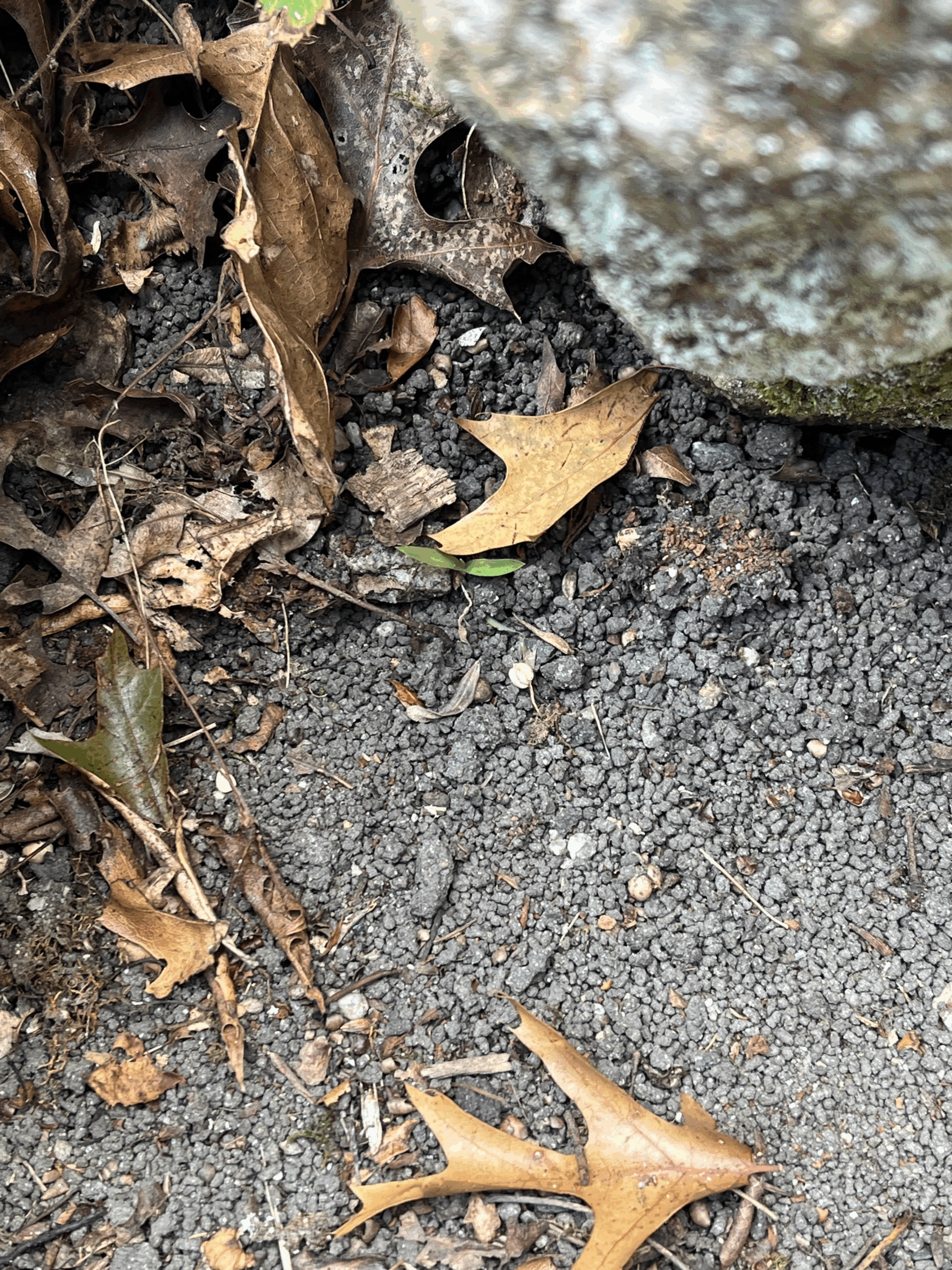
I have had jumping worms in my garden for several years and first discovered their presence when I noticed that the chopped leaves that I had used as mulch had completely disappeared in late August and, on closer inspection, saw that my once healthy-looking soil had taken on the characteristic dry, granular properties left behind by jumping worms. A little digging revealed a number of the dreaded worms.
If you suspect that you may have jumping worms, you can try this test: Mix 1/3 cup of dry mustard in a gallon of water and slowly pour this over your soil (it will not harm your plants). The mustard solution should drive any worms to the surface, where you can inspect and remove them if they appear to be jumping worms.
How to Prevent an Infestation
Management and eradication of jumping worms is difficult at present. The best strategy is to prevent jumping worms from taking hold in the first place. The main step in prevention is to take care with the plants, soil, compost and mulch that you bring on to your property. Purchase soil, compost and mulch from reputable dealers. If you are buying bulk compost or mulch, ask the dealer if the product has been heated to 131 degrees F for at least 15 days, which is the industry standard for killing weed seeds and pathogens and will certainly kill jumping worm cocoons which do not survive temperatures above 104°F.
Cocoons can also be present in bagged soil, compost and mulch. To play it safe with bagged products, you may want to solarize them by placing the bags in the hot sun for three (3) days, with a piece of cardboard or other insulating material underneath them to prevent cooling from the ground below them. If you want to be extra careful, you can use a soil thermometer to ensure that the product has reached a temperature of 104 degrees F.
When purchasing plants or accepting plants from friends, check for any signs of jumping worms. Starting from seed or buying bare root plants is safest. Alternatively, you can carefully wash off all of the soil around any new plants before planting in your garden.
What To Do If You Have The Worms?
No Currently Recommended Chemical Treatments
There are unfortunately no safe and effective chemical treatments that have been authorized by the EPA for use against jumping worms. But scientists, including citizen scientists, are investigating various agents that show some promise for controlling, if not outright eradicating, jumping worms. Some of these chemical treatments, which were discussed in a recent webinar hosted by the Maine Department of Agriculture, Conservation and Forestry, include: (i) tea seed meal, a soil conditioner and fertilizer; (ii) a fungal agent marketed as Botaniguard, and (iii) a product derived from the soap bark tree and marketed as Monterrey Nematode Control. Separately, Dr. Josef Gorres of the University of Vermont is researching the effectiveness of sodium lauryl sulfate, a common ingredient in soaps and shampoos, for controlling jumping worms.
None of these agents has been registered as a vermicide with the EPA and it should be noted that there are potential adverse effects associated with them, particularly if not applied properly. For example, tea seed meal can harm certain aquatic organisms so should not be used near any bodies of water. Botaniguard can kill honey bees and certain other pollinators and beneficial organisms. And, Monterrey Nematode Control, used to kill parasitic nematodes, may also kill beneficial nematodes and possibly other beneficial organisms. Similarly, sodium lauryl sulfate may harm beneficial organisms and can damage the plants you are trying to protect if not applied in appropriate concentrations. For these reasons, it is recommended that homeowners wait until we have more definitive guidance on the safety and effectiveness of these and other chemical agents before using them in their gardens. In the meantime, you can keep abreast of the latest research results by consulting various university and state agricultural/extension websites.
Scientists and homeowners have also tried adding biochar and diatomaceous earth to the soil to manage jumping worms. While the abrasive properties of these materials may cause some harm to jumping worms, research has not found that they provide any significant reduction of jumping worm populations. These materials can also harm beneficial organisms, so it is best to not use these and other products that haven’t been fully tested to prevent damage to your plants or backyard.
Recommended Management Practices
If you find that you have jumping worms in your garden, there are steps you can take now to minimize their numbers and spread.
- Pick up any jumping worms you find and put them in a bucket of soapy water or place them in a plastic bag in the sun. You can use the mustard pour method described above to bring worms to the surface for hand-harvest.
- Thoroughly clean all of your tools after gardening in infested areas. Also clean your shoes thoroughly as jumping worm cocoons can hitch a ride on the soles of your shoes to infect new areas of your garden or other properties. Some forests now have boot brushes at trailheads to prevent the entry or exit of jumping worm cocoons via hikers’ boots.
- Use caution when moving plants around your property or when sharing with friends. If doing either, it is best to carefully remove all soil from the plant roots before planting elsewhere on your property or sharing with a friend.
- Do not send your leaves or other yard waste to municipal processing plants; compost these materials in your own yard.
- Never dispose of jumping worms or infected soil in or near woodlands or forests.
- You may want to rethink the kinds of mulch you use or perhaps stop mulching in areas known to have jumping worms. Jumping worms have been seen to eat most types of mulch, including wood chips, and you want to avoid feeding them. I have recently tried both salt marsh hay and buckwheat hulls as mulch on parts of my gardens (as opposed to chopped leaves or shredded bark mulch) and while the worms may be dining on these materials, they are apparently doing so at a much slower rate; these mulching materials are still present in my garden more than a year after I applied them.
- Compost, too, can feed the worms, but it also can help support plants. Consider using compost tea and/or organic fertilizers to provide additional nutrition to supplement for what the worms take away.
- If you have a garden bed without perennial plants, like a raised garden bed, you could try solarizing the entire bed to kill the worms and cocoons. To do this, remove any weeds or plants growing in the bed, or trim them close to the ground. Level out the soil and wet it down thoroughly. Then lay clear plastic sheeting over the bed, burying the edges in the ground or using rocks or other heavy items to hold the edges down. Ensure that solarization takes place in direct sunlight. You need a soil temperature of 104 degrees F for at least three (3) days to effectively kill the worms and egg cocoons. Depending on the number of sunny days and outdoor temperatures, the process can take a few weeks to a month or more. This measure is most effective at killing the egg cocoons, as the worms may burrow down to cooler soil or wiggle out from under the plastic.
Don’t Panic. Jumping worms will not turn your gardens into a wasteland. I have had them for a number of years and have managed to maintain a fairly healthy garden. And, hopefully, ongoing scientific research will yield more effective solutions to manage these worms in our gardens, farms and forest lands.
Additionally, a group of scientists, including Dr. Gorres, are in the process of forming a working group, The Healthy Soil Collaborative, which plans to have a website out soon that will provide ongoing information on jumping worms.
Catherine Schneider is an avid East Side gardener and previously, a practicing lawyer and science writer. Before that, she was an assistant editor for Farm Wife News (at the time, the publisher refused repeated requests of the female editors to change the name to Farm WOMEN’S News, but it’s now known as Country Woman).


Want to comment? Click!