


The protests in Trump 2.0 have taken longer than many expected. But I joined my first protest in Providence in April, which was the largest demonstration the city had seen in years. Thousands of people gathered and marched from Hope High School to downtown for the “Hands Off” protest against President Trump and Elon Musk’s federal workers layoffs and cuts on essential humanitarian services. The police were unprepared for the size and scale of the protest—we filled the streets, forcing traffic to a halt.
That moment, powerful as it was, also revealed in a glaring absence: the crowd was overwhelmingly older and White. I overhead a few protesters asking, “Where are the young people? Where are the Black and Brown folks?” Though unspoken, the implication hung in the air: This is their fight—they have more at stake. Why aren’t they here?
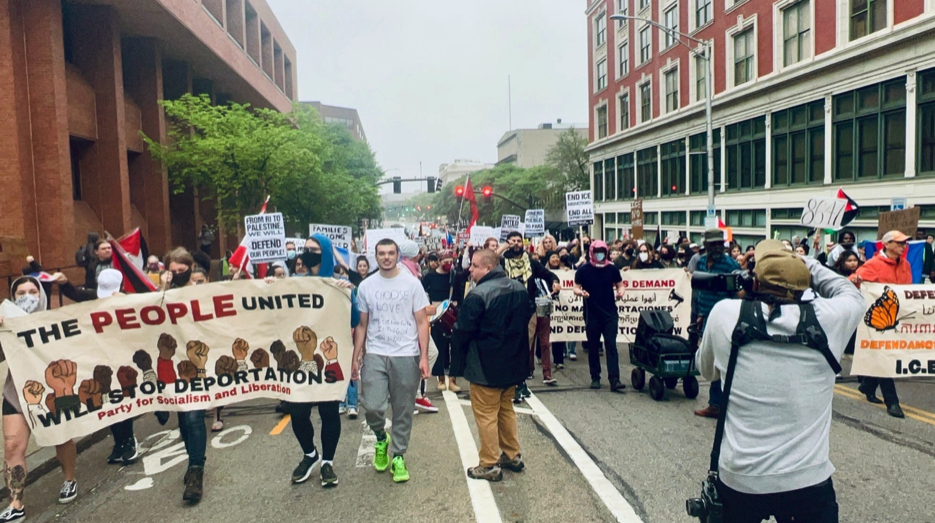
As ICE raids have since intensified, a new round of protesting has emerged across the country, and in Providence as well. Last month, I joined the groups marching downtown, starting on Empire Street, passing the Providence Performing Arts Center, and marching down Weybosset Street. We were marching in solidarity with Los Angeles, denouncing the ICE raids taking place against immigrants in peaceful communities.
This time, I couldn’t help but notice something different. Black and Brown communities came out. Young people came out. In fact, they were leading the protests. The crowd now came with strollers, drums, and were led with chants in Spanish and English. The streets were filled with cultural pride, with music, and waving Mexican, Guatemalan and Puerto Rican flags. We chanted sin miedo, without fear. I felt like we were beginning to show up as our full, unapologetic selves—Latino, immigrant, American.
And yet, after the protest, what dominated the coverage and broader narrative wasn’t the diverse turnout or the power of our presence—it was a heated debate about flags. There were constant attacks in conservative media, with commentators on Fox News dubbing the protest “an invasion,” while the architect of the White House immigration policy called Los Angeles “occupied territory.” Even some of our allies and supporters questioned the value of protesters waving Mexican flags for fear of alienating supporters. “American flags or nothing,” one former congressman wrote. The message is subtle but clear: “You’re too proud and too loud.”
Now some of the very people who asked us to show up seemed uncomfortable with how we showed up.
As an immigrant from El Salvador who’s lived in the U.S for over four decades, I have long known the painful feeling of being asked to show up, only to be expected to blend into the background. This is not new or unique to my experience. We’ve been asked by schools, businesses, and our places of work to make ourselves smaller and quieter–to be invisible. But this moment of resistance with so much at stake demands something bigger, something more inclusive, and something that will last. It asks us to bring our whole selves—our language, our music, our cultures, as well as our flags.
We are Americans. We are also Mexicanos, Salvadoreños, and Guatemaltecos. These identities are not in conflict—they are part of the complex tapestry that has always defined this as a great and welcoming country.
To be visible, to take up space, to create – that is part of the struggle. We are not just fighting for policy changes or immigrant rights; we are fighting to be seen, valued, and accepted as full participants in the American story. As one example, the Coalition for a Multilingual RI advocates for dual language schools that support full participation from the start for multilingual families—especially those whose children are entering the school system speaking a language other than English. Like those waving flags with pride, they are calling for inclusive, equitable engagement of multilingual families in Providence Public Schools and in our communities.
The traditional idea of the United States as a “melting pot” has not served us well. In the pursuit of the so-called “American Dream,” many were told to let go of their roots—language, culture, traditions—to succeed. The result? Assimilation at the cost of identity; and often, a sense of loss and disconnection. When he was giving a talk in Providence this past spring, Eboo Patel, founder of Interfaith America, asked us to see diversity as “a potluck, rather than a melting pot.”
So as we plan to organize for the future, we need to ask for something more honest and more complex: a vision of American identity that embraces multiplicity. This is a place in which success doesn’t require erasure. Where being bilingual is a strength. Where carrying your flag affirms your presence. And where communities draw inspiration from the richness of diverse cultures, traditions, and identities.
This is our version of patriotism. It’s embedded in a deeply rooted sense of belonging. And it’s a reimagining of what it means to make America great.
We want a future where our culture, our contributions, and our past shape possibilities. This is the more sustainable resistance because it offers a vision for the future.
We shouldn’t be asked to just blend in. Let’s join together. We will share our sazón. Even better, bring your own.
Aleida Benítez lives with her beautiful family and works in higher ed in Providence.


Want to comment? Click!