





At a backyard cookout this spring, Emily Kindschy did something she hadn’t done in several years: she took off her mask in a crowd. “We were standing at a distance, in the wind, so it felt safe,” she says. It felt good to be unmasked with friends, but she was also aware that a reinfection with the COVID-19 virus could significantly worsen her already disabling long COVID symptoms. When the crowd grew denser, she put her mask back on.
Kindschy, 32, is part of a small but significant group of Rhode Islanders who still take rigorous precautions against COVID-19. They wear high-quality masks, run HEPA filters, track COVID levels in the community via wastewater data, and test before meeting friends and family who live outside their “bubble.”
In a world that has generally abandoned COVID precautions, many folks who are “still coviding” feel isolated and misunderstood — or even stigmatized or harassed. However, they also report rich rewards of practicing community care and living in alignment with their values.
Masking is Community Care
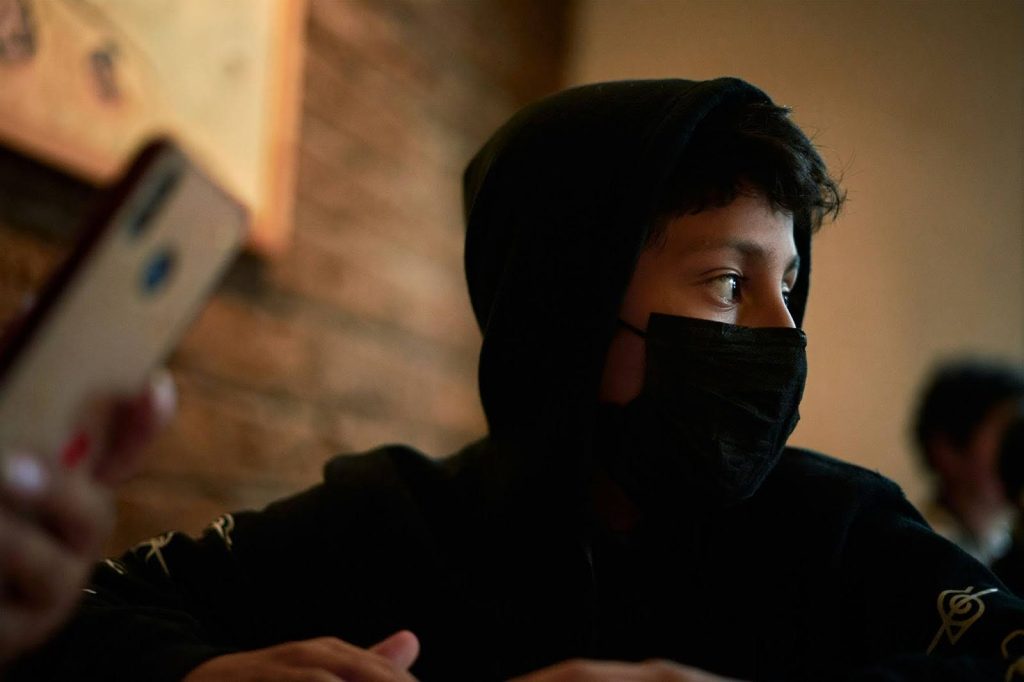
M.’s eyes crinkle over a black trifold mask that hides most of his face, but not his friendly manner. He recently had a COVID exposure while eating at his regular lunch spot — he’s masking inside his apartment to protect his roommates, who, like him, are at high risk of complications from a COVID infection.
“I mask to protect myself and others. I don’t want to hurt somebody by not doing something that I could easily do,” he says.
M. didn’t always wear high-quality masks. In fact, he contracted COVID four times before he committed to wearing N95 and K95 masks indoors in 2022.
“I was wiped out for half of almost every year since 2020,” he explains. Now, he gets sick much more rarely.
Masking is routine for C., age 34, of Providence, who — like Kindschy — suffers from long COVID. A blanket term for symptoms that linger for more than three months after a COVID infection, long COVID may affect up to 36% of people who have had the COVID-19 virus.
“I put my shoes on, I put my mask on, I leave the house,” C. says.
For some, long COVID symptoms resolve with time. For others, like C., long COVID becomes a chronic, debilitating condition that limits their energy, activities, and ability to work.
C. understands the importance of masking, but this doesn’t mean they enjoy it.
“No one likes wearing a mask. It’s uncomfortable,” C. says. But they know firsthand that every COVID infection increases risk of disability — or for them, further disability.
“When you don’t mask, you’re not only putting yourself at risk for long-term health consequences that keep you from living the kind of life you want to live — but also people around you,” they say.
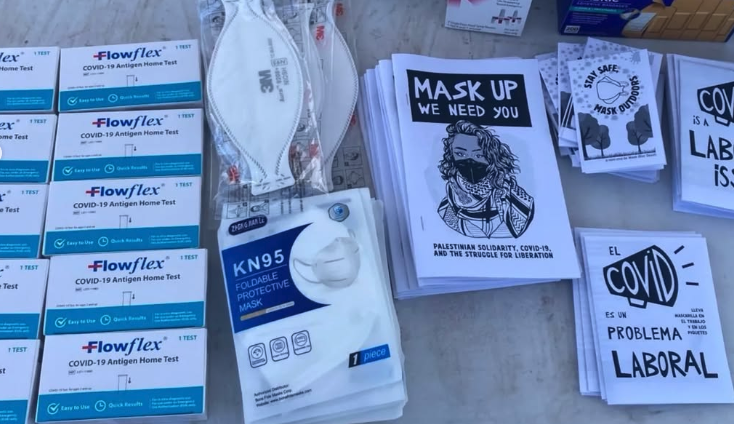
Community care is an important value for C.; in fact, they volunteer with the Rhode Island Mask Bloc, a local mutual aid organization that collects masks and tests and distributes them for free.
Kindschy also cites the importance of community care.
“I know every day that I mask, I am doing something to make a tangible difference in my community,” she says. “This is what I try to explain to people, particularly those who felt helpless after the election. Masking is a visible marker that I care about other people.”
Left behind
The pandemic hit while M., now 25, was still an undergraduate. Since then, he feels that it’s gotten progressively harder to be COVID-cautious in public.
“I feel like I get more criticism now,” he says. “Last week I went into the Cox store on North Main [Street in Providence] to return a router and a man who had entered before us shouted, ‘You don’t need to be wearing those masks!’ as he was leaving.”
As medical offices have lifted their mask mandates, they have also become a site of stress, and even conflict, for folks who are still coviding.
“I’ve had doctors say ‘You’re going to wear your mask?’ and I’ve said ‘You’re going to wear yours?’ and they say ‘No.’” M. reports.
These encounters leave M. feeling shaken and unsafe.
Staying safe at medical appointments is one of C.’s biggest frustrations.
“I can avoid a concert or a restaurant, but I can’t avoid going to the doctor — especially as a chronically ill person — and to have to explicitly request N95s or provide them for my docs, to have them question why I’m still masking, all of that just feels really absurd and puts work on me as a patient who is already dealing with a lot.”
Rhode Island does not regulate masking in medical offices. Brown Medicine, one of the largest healthcare providers in the state, does not have an official policy for doctors when it comes to masking, though they suggest that any patient who comes in with respiratory symptoms wear a mask in the waiting room, according to the front desk staff.
Raising Covid-Conscious Kids
Taylor, 36, of Providence, lives in a multigenerational household with his partner and their children. He has worked hard to build community with like minded COVID-cautious parents so that their kids can socialize safely.
“It’s not easy — you can’t just show up to a mommy-and-me at the library or go to daycare or come up to someone at the park, or go to in-person pre-school. That’s just not accessible for us. But it’s been completely worth it to build those communities.”
What began as a group of four like-minded families who connected through online COVID-conscious groups has grown into a tight-knit community built on trust, shared values, and shared practices around COVID precautions. The families use strategies like isolating and testing to make it possible to “join their bubbles,” so their kids can spend time together unmasked.
For Taylor’s family, COVID safety also means homeschooling their children — in community.
“Our homeschooling co-op includes kids with long COVID, kids with a parent who has long COVID, or who have a grandparent who is vulnerable, whose family has decided to prioritize protecting them.”
Their co-op’s secular, child-centered approach to homeschooling has given Taylor’s kids opportunities to flourish that they might not otherwise have had.
“The irony is that we never would have been able to afford to send our kid to a private or Montessori school in pre-pandemic times, but with homeschooling we can create more of that kind of educational experience for our kids,” says Taylor, who is currently enrolled in a Montessori training program.
Sylvia and Jane, of Wakefield, MA, have chosen to send their child to a conventional school, where, despite being the only kid in the third grade who wears a mask, they are thriving.
“It helps that our family never stopped masking,” says Sylvia, 44, who has been disabled by long COVID since 2023. “And it helps that our kid is the kind of kid they are.”
Sylvia also attributes their success to clear communication. At the beginning of the year, she and Jane explain to their child’s teachers and class that their family masks to protect Sylvia from the risk of further disability. Although, Sylvia observes, there are other advantages to masking.
“Our kiddo barely ever gets sick,” Sylvia says, “even when there are a lot of viruses going around.”
And long COVID isn’t only a risk for adults — contrary to popular belief, a recent meta analysis of 31 studies in the journal Pediatrics found that one in six kids experiences lingering symptoms after a COVID infection.
Lockdown and a legacy of trauma
“Many of us, especially healthcare workers, experienced trauma during the early pandemic,” explains Kindschy, who worked as a trauma therapist before she was disabled by long COVID. It is understandable, she says, that people have negative associations with COVID and would prefer to forget about masking.
Still, she says, it is hard to hear people use trauma to justify not masking — a simple action that could protect her and people like her from risk of further disability — and that, moreover, if adopted by more people, would make it possible for her to be included in public life.
“Trauma is not a life-sentence; you can get treatment for it. It should not be used as an excuse to marginalize disabled and vulnerable people.” She continues, “I’m begging for people to care about my life, and it’s just mind-boggling to me that they don’t.”
Reasons to remember
Forgetting about the pandemic not only comes at the cost of vulnerable and disabled people’s lives — it also means blocking out the remarkable outpouring of care and progressive social action that characterized the “lockdown” period of the early pandemic, Kindschy says.
“It is so wild to see how lockdown has been erased and warped. The level of connection that was happening was deep — and people have memory-holed it.”
In 2020, popular support for masking and mutual aid were strong. People cheered for frontline workers and rallied to protect the vulnerable. At the same time, a cascade of progressive policies at the national level changed the lives of many Rhode Islanders. Stimulus checks supported struggling people and infused the local economy with cash, and an increase in funds for SNAP reduced food insecurity. An eviction moratorium and expansion of tenants’ rights also changed lives. Expanded access to remote work shifted the way people thought about labor, while expanded access to Telehealth allowed disabled and housebound people to see doctors, some for the first time in years. Fewer people commuted and traveled, reducing pollution and improving the air quality index locally and throughout the world.
During lockdown, many people became civically engaged, some for the first time, participating in massive, impactful protests and talking about systemic oppression in Rhode Island and nationwide.
“There are two tracks when a horrific thing happens,” Kindschy explains. “People can get more callous and dissociated — or they can let themselves be broken open. When you’re dissociated you can’t be present with any of it. When you’re present you can be present with all of it.”
What is Kindschy’s hope for the future?
“That people let all of these horrific things change them,” she says. “The pandemic changed me irreparably. And I’m grateful for that.”
Rachel Swift is Rhode Island-born writer whose work explores the disruptive, devastating, and liberatory impact of chronic illness and disability on individuals and the collective. She holds a bachelor’s degree in gender studies and most of an MFA in fiction writing. You can follow her work on Substack.


Want to comment? Click!