





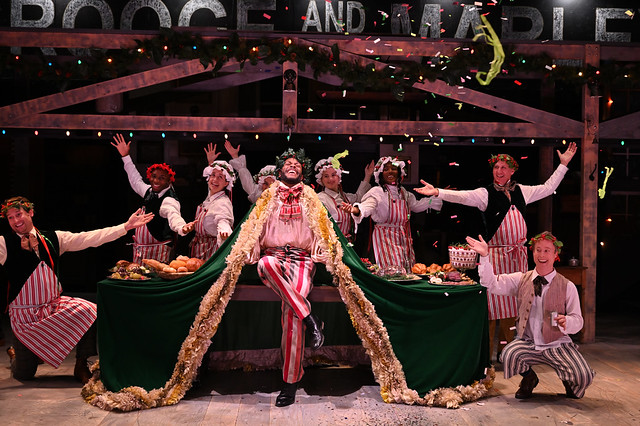
This year marks Trinity Rep’s 49th production of A Christmas Carol, and the creative team is conjuring something extraordinary. Co-directed by Richard and Sharon Jenkins, with original music by Richard Cumming and choreography by Sharon Jenkins, the 2025 staging runs November 6 through December 31 in the intimate Dowling Theater. Stephen Thorne returns as Ebenezer Scrooge, joined by a dynamic ensemble including Taavon Gamble, Mauro Hantman, Brown/Trinity MFA students, and guest artists Alison Russo, Gillian Williams, and Nate Dendy.
Dendy’s role in the production is twofold: on stage, he’s billed as the Narrator; behind the scenes, he has designed all the magical effects that bring the ghosts and visions of Dickens’s classic tale to life. When Nate Dendy steps onto the stage at Trinity Rep this holiday season, he’s not just performing, he’s conjuring. As both narrator and magic designer in the 2025 production of A Christmas Carol, Dendy transforms Dickens’s classic into a visceral experience where illusion becomes metaphor and redemption feels tangible.
“The magic is all practical and period-appropriate,” Dendy explains. “We’re not using projections or digital tricks. Everything is rooted in what could have existed in Dickens’s time.” That commitment to authenticity doesn’t limit the wonder, it enhances it. “When the Ghost of Christmas Past appears, I want the audience to feel what Scrooge feels: awe, confusion, maybe even fear. The magic isn’t just spectacle, it’s emotional.”
That emotional resonance is what makes A Christmas Carol so enduring, and so urgently relevant. Dickens wrote during a time of stark class divisions, and his portrayal of Scrooge, a wealthy man blind to the suffering around him, still speaks to modern disparities between the ultra-rich and the working poor. Bob Cratchit’s underpaid labor and precarious family life echo the realities of many workers today who face stagnant wages and limited protections.
Watching this year’s production, one can’t help but think of present-day circumstances: food assistance withheld, people in need used as political pawns, and a public discourse often devoid of empathy. Scrooge’s brash disregard for others feels eerily familiar. In such a climate, one might say the only antidote is magic, the kind that cracks open a miser’s heart and invites transformation.
The ghosts of Past, Present, and Yet to Come in A Christmas Carol serve as metaphors for memory, regret, and hope. In an age of climate crisis, systemic injustice, and digital alienation, the message that change is possible, but time is limited, feels urgent.
This year’s production amplifies that urgency through a set designed by Michael McGarty that sprawls across the entire stage, layered with crosswalks and hidden entrances allowing actors to sprint, vanish, and reappear as if conjured from thin air, all making the smaller space of the Dowling theatre, appear quite grand but still intimate. A clock on the wall becomes a central device, ingeniously manipulated by the Narrator, forward and backward in time, ushering the audience into a kind of theatrical twilight zone where memory and metaphor collide.
Dickens captured universal psychological truths that transcend time and technology: fear, joy and longing. A Christmas Carol isn’t just a seasonal tale; it’s a timeless call to conscience. Whether confronting corporate greed, advocating for children’s health and well being or seeking personal renewal, its message still rings true.
For Dendy, magic and theater are natural partners. “Both rely on timing, misdirection, and belief,” he says. “When done well, magic aligns the audience’s perception with the character’s reality. That’s when it becomes transformative.” His approach is steeped in tradition, but also deeply personal. His parents gave him his first magic set at age two. “Magic should never be about fooling people,” he says. “It should be about revealing something.” As Dendy puts it, “Good theater should leave you amazed, and maybe a little more human than when you walked in.”
A graduate of the Brown/Trinity Rep MFA program, Dendy’s return to Providence is both a homecoming and a creative evolution. “My first show here was The Fantasticks,” he recalls, “and I played the Mute; no lines, just magic.” That early role, directed by Amanda Dehnert and choreographed by Sharon Jenkins, set the stage for a career that now spans Broadway, Off-Broadway, television, and film. But it’s live performance, Dendy says, where the real magic happens.
That philosophy will take center stage again in February when Dendy premieres his original show, Nothing Up My Sleeve, at Round House Theatre in Maryland. The piece blends classic illusions with Dendy’s own creations, exploring the emotional lineage of magic itself. But for now, his focus is on Trinity Rep and using his conjuring skills, inviting audiences into a world where the impossible feels possible.
This production of A Christmas Carol is fast-paced, ensemble-driven, and full of heart. “We want people to leave gob smacked,” Dendy says, “not just by the tricks, but by the emotional journey. Scrooge is all of us. He’s someone who’s lost touch with his humanity and has to be jolted awake.” That jolt is what good theater, and good magic can deliver.
The production runs through Dec. 31, 2025. Tickets are on sale by phone at (401) 351-4242 and online at TrinityRep.com/Christmas.
Judith Clinton is a playwright, producer and author, whose work explores myth, and transformation. Her plays and stories reflect her belief that storytelling can both heal and ignite change. She is Co-Executive Director of the Rhode Island Theatre Makers Roundtable ritheatremakersroundtable.com.


Want to comment? Click!