




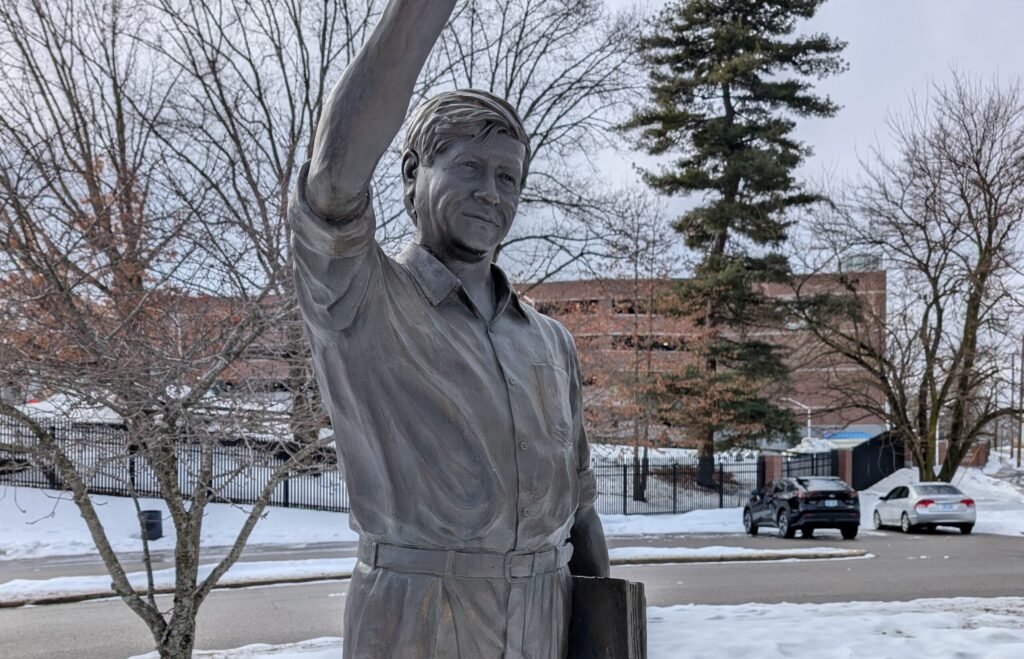
He stands calmly with a reassuring smile near the entrance to Davis Park, seemingly waving to the cars going by on Chalkstone Avenue, across from Nathaniel Greene Middle School. There’s no sign indicating that this bronze statue is a statue of Cesar Chavez. It is indeed, however, the same Mexican-American Cesar Chavez who famously fought and won labor rights for the United Farm Workers many decades ago.
A recent New York Times investigation has revealed that Chavez was more than a tireless hero who spent most of his adult life fighting the social injustices endured by the grape and lettuce pickers in California. It turns out that the briefcase Chavez is holding in this statue holds many secrets. He was also a serial rapist and abuser of women and girls.
I have a personal connection to the Providence Chavez statue: I was responsible for getting it installed in Davis Park in 2009. Now, I am calling for it to be taken down.
In 2008 I was named Superintendent of Providence Parks by Mayor David Cicilline. Prior to that I had served as the Deputy Superintendent since 1986. In the fall of 2008, Julio Cesar Aragon from the Cesar E. Chavez Committee of Rhode Island came to me in the Parks Department requesting that a statue of Chavez be installed in Davis Park.
At the time, the bronze statue of Chavez already existed and was temporarily on display in the State House. The statue apparently was an orphan; it was originally sculpted for another location somewhere else in the U.S. That installation fell through and the RI Committee had purchased the statue. The Committee wanted a permanent home to honor Chavez.
Councilman Terry Hassett, the Ward 4 councilor at the time, endorsed the Davis Park location, and provided some council funds for its installation. The Board of Park Commissioners blessed the idea. But the installation was delayed.
While Davis Park is a City of Providence public park, it sits on land owned by the federal government, specifically the US Department of Veterans Affairs (VA). The federal government had taken Davis Park, occupying 40-plus acres, by eminent domain in 1948 to build the Providence VA Medical Center. The Davis Park area you see today, occupied by ball fields and a basketball court, was leased to the City of Providence
When the VA got wind of the proposed installation of the Cesar Chavez statue on their land, I received a letter from its headquarters in Washington signaling its opposition to the installation. The agency said that it would not allow it. I called the VA person who signed the letter who indicated that Cesar Chavez was not a US citizen and “it was known that he was a communist.” I replied that Chavez was actually a US citizen, and like myself, a US Navy veteran. The VA administrator didn’t relent. After several months, I eventually had to enlist the aid of Senator Sheldon Whitehouse’s office to get VA permission to install the statue.
On a bitter rainy November day in 2009, a small group of Providence dignitaries, members of the Chavez Committee, and myself huddled in a rented tent at Davis Park to sing the praises of Cesar Chavez and unveil the statue.
Cesar Chavez received further official Providence admiration on April 15, 2023, when nearby Raymond Street was re-named “Cesar Chavez Memorial Way.” At that time, many dignitaries, including Mayor Smiley, Representative David Morales, and Councilors Althea Graves and Miguel Sanchez, praised Chavez. The remarks of Sanchez, a Mexican American, and as reported by the Providence Journal, seemed especially ironic on that sunny April day: “In a time when a lot of folks across the country are trying to erase history, it’s important that we fight back and promote Cesar Chavez…a legend in the Mexican American labor movement.”
Now in April 2026, many – including me – are stunned by the New York Times revelations about Cesar Chavez. Embarrassed, betrayed, sickened, bitter—these feelings barely describe what I feel about my role in getting the Cesar Chavez statue installed in Davis Park. I look back now on the initial refusal by the VA to allow the Chavez statue installation as perhaps the hand of God telling me to stay away from the statue installation.
What should Providence do now?
Providence has experience with exiling iconic statues. In 2020 after years of controversy, Providence removed the Christopher Columbus statue from “Columbus Square” at the intersection of Reservoir and Elmwood avenues. Leaders in Johnston —which has the highest number of residents who claim Italian American ancestry (43.7%) in Rhode Island—gladly took Columbus and installed him at the town’s Memorial Park. Columbus stands there today as a resting spot for the local bird population.
In the wake of the New York Times story, several cities have already acted quickly to remove their Chavez memorials. Denver removed his bust; San Fernando, CA, removed his statue; Bakersfield, CA, removed his mural. The list will likely grow in the weeks ahead.
Speaking as a resident of Providence, I can’t find a reason to keep the Cesar Chavez statue in Davis Park. His work for labor rights and for Mexican Americans perhaps can be honored in some way, but not with a statue or a street sign. The City of Providence should invite a broad discussion about how to tell the story of the injustices heaped on migrant workers and the work to provide justice for them. But the statue of Cesar Chavez has to be removed from Davis Park and the street sign taken down. Chavez’s labor rights work was saintly, but his monstrous and horrific abuse of women is beyond redemption.
One idea?
The Cesar Chavez bronze statue could be melted down. And the funds from the melted material could be re-purposed in another format perhaps to honor the migrants in this country who put food on our tables every day.
Bob McMahon is a former city planner and the former Superintendent of Providence Parks. In his retirement he provides volunteer facilities management for the San Miguel School and St Pius V Church in Providence. He and his wife Pam Kennedy – who live in Elmhurst – enjoy architectural history and family and neighborhood gatherings.


Want to comment? Click!