





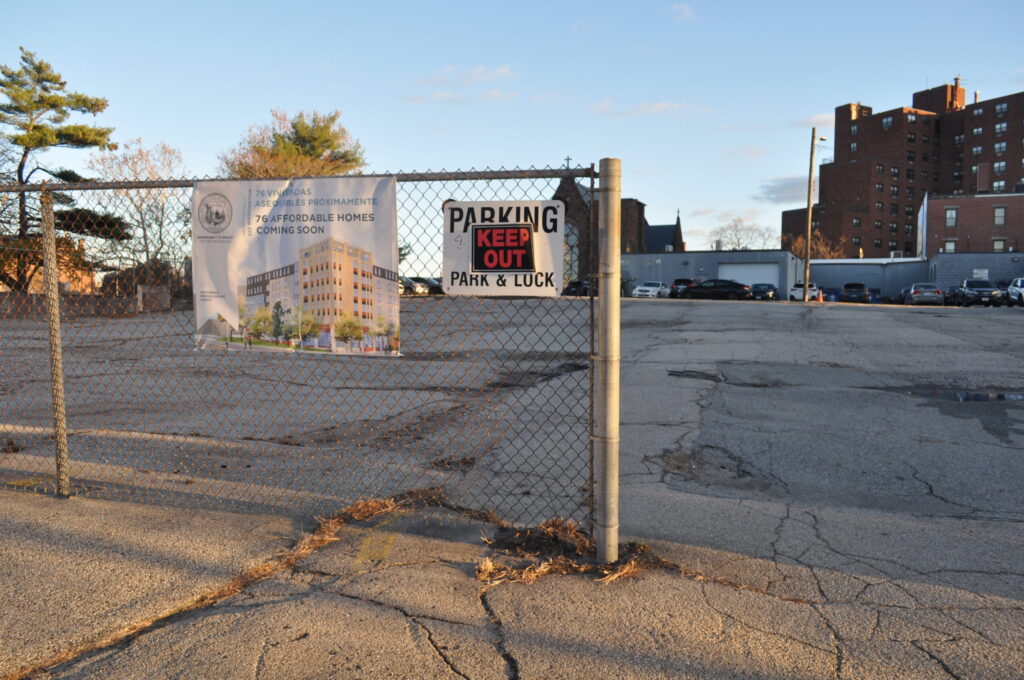
On October 30, the city purchased a $1.7 million dollar plot on Washington Street for another affordable housing project. Every unit in the new development by Lincoln Avenue Communities will be income-restricted. Sixty-eight of the units are reserved for households earning between 60 and 80 percent of the area median income and the remaining eight units are dedicated for those making below 30 percent of AMI. These apartments will join over 12,000 other income-restricted units in the city, all of which are subject to a complex set of supervisors long after the first lease is signed.
As Mayor Brett Smiley pushes for more production to address Providence’s high housing costs, a web of regulators is preparing to monitor each new income-restricted unit. Depending on the funding mechanisms for each project, a combination of state agencies, city officials and certified 3rd party vendors audit units to ensure compliance with affordability requirements in a city that desperately needs them.
Providence’s housing emergency one of the worst in the USA
This summer, the Providence City Council’s Housing Crisis Task Force declared the city is “in the middle of a housing emergency.” Between 2023 and 2024, Providence saw the highest increase in rental prices in the United States. The next year, rent increased at the second-highest rate in the country. According to research group HousingWorks RI’s 2025 Fact Book, 47% of renters and 31% of homeowners in Providence spend 30% or more of their income on housing. That’s over 27,000 households just in the capital city, but HousingWorks reports that the entire state is burdened by housing costs.
“This is the first time where, even if you’re earning over $100,000 a year, you can’t afford to affordably rent or buy anywhere in Rhode Island’s 39 cities and towns,” said Brenda Clement, the director of Housingworks RI. Clement said Providence’s low vacancy rate of 3% means a limited supply of housing, high demand and inflated prices. “Increasing supply [and] increasing affordability across the board, but particularly at lower wage incomes, is critical for Providence’s fiscal health.”
HousingWorks reports 37,415 households in the city are below 80% of the area median income, but Providence only has 12,442 homes reserved for low and moderate incomes. That’s approximately 16% of city’s housing stock. Availability is even worse for Rhode Island households at 30% AMI or below. A report by the National Low Income Housing Coalition found there is no available affordable housing for 53% of extremely low-income renters in the state.
Building More a Solution to Affordability?
To address the cost of renting and owning a home in the city, Mayor Brett Smiley made producing more housing a priority. The city issued 439 unit permits for new residential units in the fiscal year 2023, 678 in FY2024 and 857 permits in FY2025. Though the majority of these are not restricted to be affordable, the city believes increasing supply will help address the crisis.
“After many decades of low housing production in Rhode Island, we are seeing higher production than has happened in decades,” said Providence’s Director of Housing and Human Services Emily Freedman. “The housing progress report found that about 22% of what was getting permitted in the city was deed-restricted affordable. So that’s twice the state mandate.”
Financing Development
The first challenge for city leaders in building new income-restricted units is closing the financial gap between lower unit rental income and the developer’s cost to construct housing. The city’s tax office, the Providence Housing Trust, and the Providence Redevelopment Agency (PRA) might use low-income housing tax credits, low interest loans or purchasing city land to erase possible deficits for developers. Affordable housing nonprofits say they typically combine financial incentives from the federal government, the state and the city to square their budgets.
“We’re building homes that the market wouldn’t otherwise be able to produce. But for the subsidies, these wouldn’t exist,” said Melina Lodge, executive director of Housing Network of RI, the association of nonprofit housing developers in Rhode Island. “So that could be dollars, that could be municipal subsidy through zoning and density waivers and relief… A pretty typical project might have, you know, six, eight, ten different sources of funding that make it possible.”
Compliance
Each source of funding for affordable housing developments comes with its own compliance obligations. That means a single development may have multiple monitoring agencies. HUD, RIHousing and the city of Providence maintain staff that review these benchmarks.
“All of those incentives tend to come with ongoing compliance obligations, and along with those compliance obligations, the funder is typically serving as what’s called a monitoring agent ensuring that the affordable housing rules are being followed,” said Freedman, whose office has about four people who periodically review building standards and financial records for hundreds of units around the city. “We’ll review rent rolls. If we see concerns, we would do more intensive monitoring and might do our own income verification or ask to pull specific files.”
Nonprofit housing developer One Neighborhood Builders said each of their units with affordability restrictions is reviewed annually by Rhode Island Housing and the reporting deadline depends on the property. One Neighborhood Builders said there is a 120-day window for tenants to submit proof of current income, assets and disclose household members, which is then reviewed by RI Housing. Tenants face eviction if they do not submit paperwork.
In addition to city staff, Freedman said Providence contracts for monitoring services with FinePoint Associates for properties receiving special tax treatments. The city also works with the Community Land Trust of Rhode Island, one of half a dozen 3rd party agencies certified to monitor affordable housing projects by the state’s Executive Office of Housing.
“If somebody’s getting certain benefits based on units being affordable, then a monitoring agent is truly tracking that they’re doing what they’re supposed to do,” said Director of Housing Production and Preservation Peter Asen, who said violating affordability program requirements could lead to developers losing tax breaks. “You can have a big problem with those,” said Asen.
If tenants have concerns about violations of affordable housing requirements or habitability issues, Freedman recommends they call 311 and the city will schedule inspections or deploy code enforcement if necessary.
Meanwhile, housingsearchri.org maintains a list of subsidized housing throughout the state. Officials also recommend looking at the Rhode Island Rental Resource Guide for more information about affordably renting housing in the state.
Speaking on the land purchased for Lincoln Avenue Communities development, Mayor Smiley promised to continue tackling the housing crisis with an “all of the above” approach. However, Smiley made it clear he opposed using rent control or stabilization proposed by city council, tenant groups and mayoral race challenger David Morales. As Providence enters another winter in a housing emergency, strategies to keep residents sheltered remain at the center of city politics.
“The housing crisis is years in the making,” Smiley said at the press conference in October. “And it won’t be solved overnight.”
Eric Halvarson is a multimedia journalist focused on the political ecology shaping a new world in climate crisis. His work has been featured by Democracy Now!, Burnaway, the Appalachian Voice and ecoRI News. Hobbies include gardening, science-fiction, volleyball, dancing and holding onto a sense of wonder.


Want to comment? Click!