



If you’re even passively following local Rhode Island news, you’ve heard about the closure of Morley Field, a community park in the Woodlawn neighborhood of Pawtucket that was chained up and closed to residents in 2022. That park on Moshassuck Street sits along the Providence and Pawtucket line. Its future is jeopardized by a large-scale development project underway next to the closed park that poses a threat to community members in both Pawtucket and Providence, as well as the environment.
First a Park, Then a Proposed Parking Lot
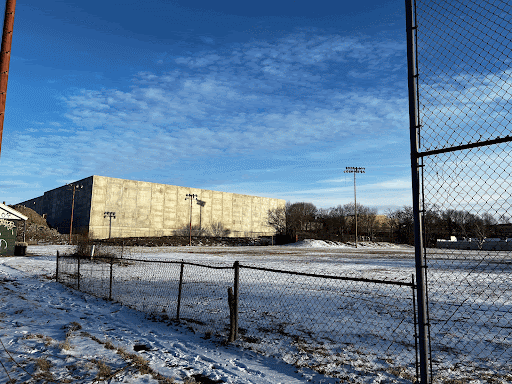
The site under development is 1 Moshassuck Street, an area historically used for fabric processing — specifically, the flocking, dyeing, and production of fabrics. Directly adjacent to 1 Moshassuck Street is 94 Moshassuck Street, or Morley Field, which has been a baseball field and park since the early 1980s. It was closed by city officials in 2022, with plans for it to become a parking lot for the proposed development at 1 Moshassuck.
Morley Field — a 5.3 acre green space nestled near Route I95 and the Moshassuck River — sits about a mile away from Lippitt Memorial Park, a tree-lined park off Hope Street that connects to the Blackstone Boulevard bike path.
Woodlawn is a diverse and young community, with nearly 60% Black or Hispanic residents and approximately 23% of residents under the age of 14. The median household income in Woodlawn is around $31,000. Morley Field is the neighborhood’s only park and was long used for baseball games and community gatherings.
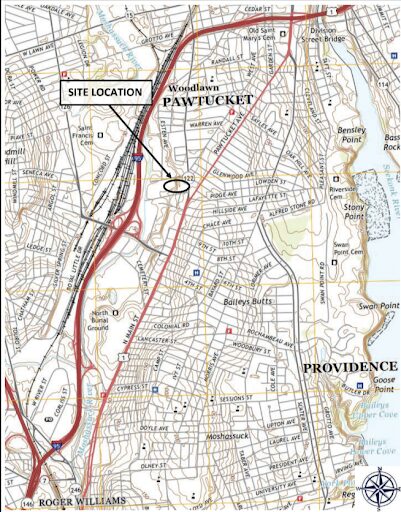
New York-based real estate company JK Equities acquired 1 Moshassuck Street in 2021 to build and eventually lease a “last-mile distribution facility” — essentially, a warehouse that stores finished goods before they’re packed to fulfill customer orders, primarily through e-commerce.
Then, in June 2022, Public Works Director David Clemente notified the Pawtucket City Council that Morley Field would close to the public due to materials found during the site investigation for JK Equities’ development project at 94 Moshassuck Street.
JK Equities further tightened its hold on Moshassuck Street in October 2022, when the Pawtucket City Council passed a resolution authorizing the sale of Morley Field to JK Equities. The business wanted the land to develop Morley Field into a parking area to serve abutting commercial operations at 1 Moshassuck Street.
Turns Out Pawtucket May Not Have the Right To Sell Morley Field
However, the acquisition and development of Morley Field stalled, as The City did not actually have the authority to sell the entire site for conversion to non-recreational use.
Morley Field includes two separate lots – 291 and 309. According to R.I. General Law 45-2-6, land given for a special use is not subject to disposal. Lot 291 falls into the category of “special use” since it was acquired with support from the Land and Water Conservation Fund
The City of Pawtucket now needs the Department of Environmental Management’s (DEM) approval to convert Lot 291 to non-recreational use. The DEM has requested that the National Park Service (NPS) approve the conversion, with the caveat that an acceptable replacement recreation site will be identified. The request has been pending approval since June 6, 2024.
So, Now What?
If you’re confused, you’re not alone. JK Equities, due to the delay in a response from the NPS, is seeking an extension to their request to develop lots 291 and 309 into a parking lot.
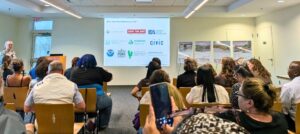
The question of an extension came to a head at a Pawtucket City Council Meeting on September 16, 2025. Despite JK Equities representative Jordan Karlik clearly stating at an August Council meeting that he had no plans to touch Morley Field, and though there were lots of angry public comments about the plan, the Pawtucket City Council was prepared to vote on a second extension for the project. The developer didn’t show up to the meeting, so the vote was tabled, enabling JK Equities to continue pursuing the development of this beloved community park and recreation space into a parking lot.
Despite public opposition to the development, the construction of a distribution center at 1 Moshassuck is underway, and JK Equities does not appear to be phased by community outcry regarding the possibility of paving over Morley Field for additional facility parking. What happens next (to Morley field, at least) depends on the National Park Service’s response and the RI DEM’s pending approval to move forward with the park’s redevelopment.
The Distribution Center is Being Built in an Environmental Justice Community
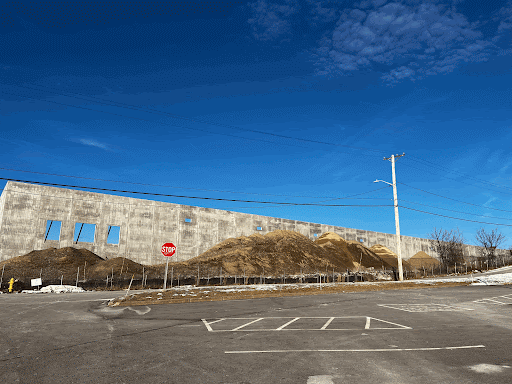
What is clear is that the Blackstone Distribution Center at 1 Moshassuck Street, is well underway. The 159,000-square-foot warehouse with office space broke ground in July of 2025.
The $42 million development initiative, funded through a mix of a construction loan, a City tax credit, and funds from Quonset Development Corporation’s RI Ready Program, is expected to take about 14 months to complete, according to JK Equities’ comments at the Pawtucket City Council meeting in August. The project has the potential to bring hundreds of jobs to Pawtucket, depending on who JK Equities identifies as a tenant for the building.
JK Equities has not yet disclosed whether a tenant for the warehouse has been identified. The real estate developer’s recent projects in cities like Chicago, Baltimore, and New York include residential units and retail space.
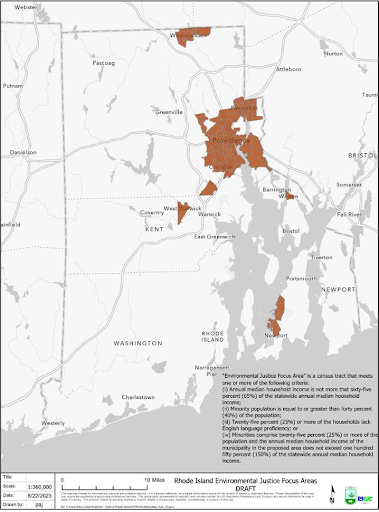
The surrounding neighborhoods of the sites on Moshassuck Street are majority Black or Hispanic, qualifying the sites as environmental justice areas by the RI DEM, per its environmental justice policy published in 2023. The Department’s definitions of ‘environmental justice’ and ‘fair treatment’ are worth sharing in the context of this ongoing development:
Environmental Justice (EJ) means the fair treatment and meaningful involvement of all people regardless of race, color, national origin, Tribal affiliation, disability, English language proficiency, or income with respect to access to the state’s natural resources and the development, implementation, and enforcement of environmental laws, regulations, and policies; “Fair Treatment” means no group of people should bear a disproportionate share of the negative environmental consequences resulting from industrial, governmental, and commercial operations or policies, and should have equal access and opportunity to enjoy clean air; clean water; safe and healthy foods; and an environment that is healthy, sustainable, climate-resilient, and free from levels of harmful pollution and chemical exposure.
Why Not Green Space?
The development of this area for commercial activity poses the question — why isn’t Pawtucket prioritizing the creation (or preservation) of green space, especially in this environmental justice community? Pawtucket’s 2025 Consolidated Plan specifically calls out the importance of green space, particularly for low and moderate-income areas. Suggested improvements include “bioswales and rain gardens, permeable pavement installations, expanded tree canopy in LMI (Low/Medium Income) neighborhoods, and green roofs on public buildings.”
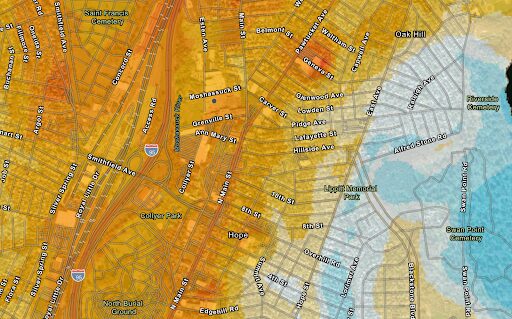
The development of an industrial site exacerbates the Woodlawn neighborhood’s need for green space and more tree canopy. Concrete streets, sidewalks, and parking lots with little tree cover can create “hot spots,” with higher temperatures than surrounding areas, particularly areas with a tree canopy.
These hot spots create harsh conditions for pedestrians and eventually lead to the “urban heat island effect”. This phenomenon, according to the U.S. Environmental Protection Agency, describes a measurable increase in ambient urban air temperatures resulting primarily from the replacement of vegetation with buildings, roads, and other heat-absorbing infrastructure. The heat island effect can contribute to heat-related deaths and demand more energy as individuals and businesses near heat islands try to keep their homes cool.
Heat mapping in Pawtucket and Providence Shows Little Tree Cover
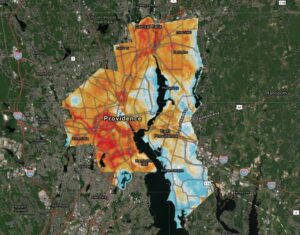
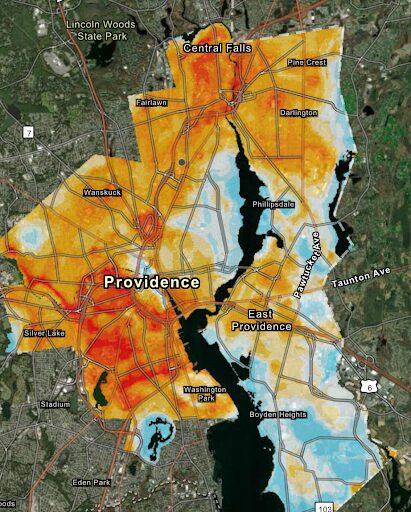
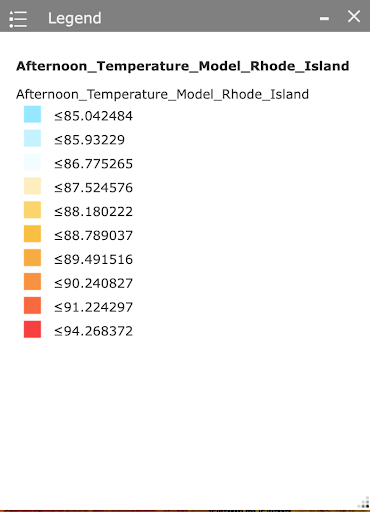
The CAPA heat watch program conducted a heat mapping study in Pawtucket, Providence, East Providence, and Central Falls in July 2020, taking 62,084 temperature measurements in each city across two days. The heat mapping data reveals that the sites on Moshassuck Street are some of the hottest in the area, although not quite as hot as some areas in South Providence and Central Falls. With no plans to increase the tree canopy, these areas will only get hotter. You can explore the data and read about the study’s methodology here.
Source: interactive version of CAPA mapping data
What about traffic?
Beyond the community’s concerns about the loss of green space and environmental injustice, a new distribution center on the Pawtucket-Providence divide could have significant effects on traffic and pedestrian safety in both cities. The distribution center will be situated on the busy corners of Moshassuck Street and Main Street, directly behind the R-line bus stop, and with easy access to I-95 via the Smithfield Street on-ramp in Providence. While it’s hard to anticipate the exact changes to traffic patterns until JK Equities identifies a tenant for the building, Councilwoman Sue AnderBois worries that any change to traffic patterns could counteract the work she’s accomplished with the Providence Streets Coalition in the North Main Street Corridor.
North Main Street has seen an increase in traffic safety measures after four fatalities on the road in just 18 months, and many prior crashes involving pedestrians, bikes, scooters, and individuals on mobility devices. The Providence Streets Coalition is trying to decrease the number of incidents through its Pedestrian Safety and Street Lighting initiatives. Efforts to upgrade and add lighting, new signs, and the elimination of all no-turn-on-red intersections have been in effort to slow people down and make North Main safer for pedestrians.
Looking ahead, the State will contribute $5 million in funding through the State Transportation Improvement Plan for long-term improvements to North Main Street. That’s why Councilwoman AnderBois spoke at the Pawtucket City Council meeting in August, opposing the development on Moshassuck St. She says that Providence’s North Main Street Task Force is working hard to make the roadway safer, not a corridor for more traffic.
Councilwoman AnderBois expressed that “A big concern that I have with this new facility is that it will just add more sprinter vans on our road, send all that traffic to and through Providence, as opposed to a use that would be a benefit to both sides.”
She continued, saying “We’re putting in all this time and emphasis on safety, and to have this new facility that adds a ton more traffic — or could potentially add a ton more traffic — to the roads. It’s just disconcerting and disheartening when we could be investing in economic development opportunities across our two cities in ways that are mutually beneficial.”
Increased traffic certainly brings up safety concerns for pedestrians, but it also means an increase in emissions and pollution. With the surge of warehouses being built across the country, states like New York and California have introduced legislation to address pollution from trucks, specifically those traveling to and from distribution centers. While there’s no indication that Rhode Island will adopt similar measures, most of Rhode Island’s emissions stem from transportation, according to the 2022 greenhouse gas inventory conducted by the DEM.
With the construction of a distribution center on Moshassuck Street well underway, residents of Providence and Pawtucket should be aware of the upcoming changes to their neighborhoods. While much of the development’s impact will be determined by the selected tenant, there is no question that the environmental and community impacts of this project will be significant.


Want to comment? Click!