





In his will, made shortly before he died in 1906, wealthy Providence resident George Lothrop Bradley set up a trust to create a hospital.
His motivation was personal: Emma Pendleton Bradley, his only child, was seven when she contracted encephalitis, an inflammation of the brain. Emma was one of the unlucky ones: she was left with numerous disabilities, including epilepsy, cognitive impairment, and cerebral palsy.
When Emma became sick, psychiatry and neurology were in their infancy, and pediatric services were not yet available. George Lothrop Bradley, together with his wife Helen McHenry Bradley, conducted a worldwide search for a cure or at least an effective treatment for her. The family could and did pay for around-the-clock care for her: in 1900, for example, they had six live-in servants, including a butler, a laundress, a ladies’ maid and a nurse. Emma showed no improvement, however, and in 1907, one year after her father died and twenty-one years after contracting the disease, Emma Bradley died.
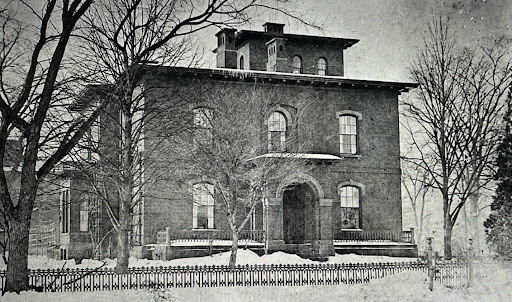
First Psychiatric Hospital for Children in the USA Established
The Bradleys wanted to ensure that other families would not share their family’s struggle. They made wills leaving their Eaton Street house and its twelve acres of land to become the Emma Pendleton Bradley Home for Convalescents and Invalids. It would be the nation’s first psychiatric hospital for children.
Eventually, the Eaton Street house and land was sold and with the proceeds, a larger parcel of woodland purchased to become the site of the Home in East Providence, on the river. Ground was broken in 1929, and two years later, in 1931, the Emma Pendleton Bradley Home for Convalescents and Invalids was officially dedicated and opened. In accordance with the terms of George Bradley’s will, families were only billed if they had the means to pay.
In the ensuing years, the institution’s name changed from Home to Hospital, but the Bradley Hospital retained the elements that were central to its original mission–to provide the young and vulnerable with the treatment and services they needed to succeed in later life. From the beginning, education was an important component of the residential treatment program.
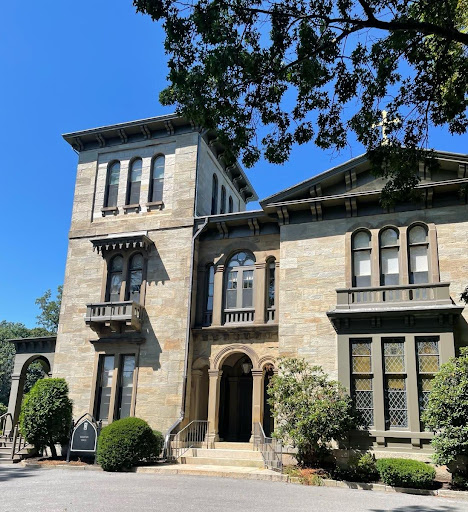
Bradley Schools Today
Since 2014, when it moved off the Bradley Hospital campus in Riverside, East Providence, there has been a school of the same name in Providence. It stands at 130 Broadway in the West End and serves students from middle school through age 21 “whose psychiatric and behavioral needs cannot be met in a public school setting.”(About Us — The Bradley Schools) Classes are small, and in addition to special education teachers, students are supported by many specialists, trained in current techniques and knowledgeable of recent research advances; they have access to a multisensory curriculum that blends traditional learning with technology. It is one of several Bradley Schools, serving 400 students in total. Referral to the Bradley schools to identify students is made strictly through local school districts.
Importantly, there are also “partnership classrooms” in numerous Rhode Island public-school districts, staffed by Bradley School model specialists: educators, psychologists, occupational and speech and language therapists.

Who was George Bradley?
For many reasons, George Lothrop Bradley (1848-1906) was a remarkable son of Providence. Memorializing his only child in such a public-spirited and generous manner and founding numerous metallurgy enterprises, he was extraordinary.
Born to wealthy lawyer (and briefly Rhode Island’s Chief Justice) Charles Smith Bradley, he was no stranger to family tragedy. His mother died when he was eight years old by which time two baby sisters had already died; and his first stepmother died when he was eighteen, as did his toddler step-sister.
Despite matriculating at Brown and Harvard, neither offered courses in metallurgical engineering, and he went to Germany to study at the Freiburg University School of Mines. After graduating in 1867, the knowledge he acquired was parlayed into Colorado and in South American mines, after which he made a series of investments in the new technology of the day.
His first new investment grew out of his friendship with Alexander Graham Bell, whose communication system for deaf mutes developed into the telephone. Bradley organized the New England Telephone Company (which became the Bell Company) in 1876, and another in New York the following year. His shares in the company rose over time from one dollar per share to over $800, and, as an understated obituary account of Bradley notes, he “realized a goodly profit.”
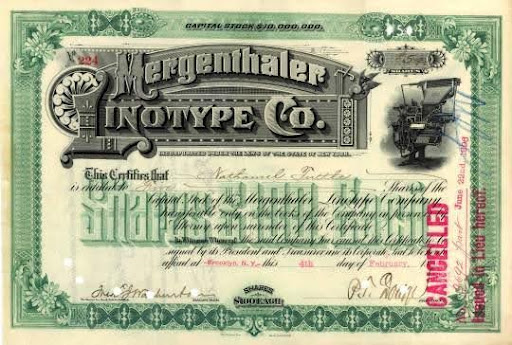
His next venture was the Mergenthaler Linotype company—a method of streamlining typesetting—which he helped finance.
He then invested in a scheme to build a 560-plus mile inland waterway up the east coast of Florida, now called the Atlantic Intracoastal Waterway. He was the primary financier and later president of the company which was partly subsidized by land grants from the State of Florida. By building the canal and a railroad, and draining marshy land, the waterway fostered the enormous growth of Florida both for winter visitors and agriculture. And made George Bradley even richer.
When Bradley died of pneumonia in 1906, he left an enormous sum, $250,000, (about $59,000,000 in today’s dollars) in trust for Emma’s continued support, saying that the income should be used “in the most ample and generous manner.”
While a portion of the trust fund was distributed to a number of nieces and nephews upon his wife’s death, much of his fortune went to create the Bradley Hospital and Schools, by which the name of his only daughter, Emma Pendleton Bradley, lives on.
Jane Lancaster, PhD is a historian and former public school teacher (in the UK). She has lived in Providence for a very long time, taught at Brown and RISD and knows quite a lot about the state’s history, but still doesn’t sound much like a Rhode Islander. (Though her friends in England think she has an American accent).


Want to comment? Click!