





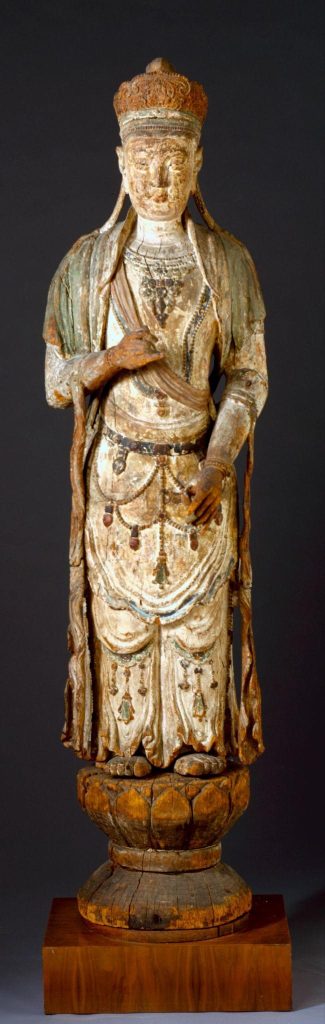
This past November, Ingrid Neuman, senior conservator at the RISD Museum, wheeled a twelfth-century Japanese wooden Bodhisattva Avalokiteshvara into Hasbro Children’s Hospital for a CAT scan. Conservators have repaired the ancient figure, a revered Buddhist symbol, over centuries — Neuman’s examination would reveal exactly where and how they had carried out those repairs.
When the RISD Museum acquires a new sculpture, it’s almost never ready for immediate display. Over time, sculptures accumulate dirt and often chip, show wear, or even break. Some arrive with broken parts or past repair attempts that complicate restoration. Preparing these pieces for public exhibition falls to the museum’s conservation team. Through a meticulous process that integrates chemistry, art history, and craftsmanship, conservators work to stabilize and restore each object. “To preserve items for another generation – that’s our job,” says Neuman, who specializes in sculpture and three-dimensional art conservation. Conservation is, by necessity, an invisible art form; however, this undetected effort often extends to the labor itself, with little public recognition of the expertise that goes into art conservation.
Neuman’s background in organic chemistry is essential to her work. Sculptures are vulnerable to a host of natural forces over time such as ultraviolet radiation, pollution, humidity, and fluctuations in temperature – all of which can degrade original materials. Pieces with organic materials like wood and ivory, along with metals such as bronze or iron, are particularly prone to these “agents of deterioration” and can experience accelerated degradation if not properly maintained, says Neuman.
“An ancient bronze breaker from China wants to corrode. It wants to go back to its original copper ore,” says Neuman. “We’re trying to keep it from doing that.” Corrosion is a natural chemical reaction that occurs when metals like bronze are exposed to oxygen, moisture, or pollutants over time. This reaction, called oxidation, causes the metal to slowly break down. Left unchecked, this chemical process can eat away at the surface of a sculpture, weakening its integrity and obscuring its details.
Conserving pieces isn’t always straightforward, especially when conservators don’t know the original materials of an artwork upon its arrival at the museum. To get a clearer understanding, they rely on advanced tools like elemental analysis, x-ray imaging, and microscope scans to determine the composition of the piece and uncover any past preservation efforts. “We borrow a lot of techniques from dentists and doctors,” says Neuman. “There’s a lot of overlap with the medical field.” With limited in-house instrumentation at the RISD Museum, Neuman often relies on nearby hospitals such as Hasbro’s and research institutions for specialized evaluations.
Understanding a sculpture’s composition and preservation history is crucial, as it directly informs the selection of repair materials. “You can’t make the decisions unless you understand the material,” says Neuman. She emphasizes, “I approach everything by material.”
Conservators intentionally choose repair materials that are visually similar to the original but chemically distinct, ensuring that their work can be easily differentiated from the artist’s upon chemical evaluation. “We don’t like to use the same materials as the artist,” Neuman says. “We’re not trying to be the artist, or be better than the artist, or confuse people.” The ease with which any added materials can be removed is also a crucial consideration for conservators, as they must ensure that any restoration work can be undone without damaging the original piece. This is especially important if a mistake is made during the conservation process or if the restoration needs to be reversed in the future.
For this reason, conservators use inpainting – a technique used to fill in missing parts of an artwork – with materials that can be easily distinguished and removed. For example, Neuman says conservators often use acrylic paint when filling in an oil painting. Acrylic is water-based and chemically different from oil paint, allowing it to be safely removed using solvents like isopropyl alcohol, which does not affect the underlying oil.
Beyond fillers and paints, Neuman emphasizes the importance of reversibility and the chemical properties of adhesives. “There’s so many glues in the world. A zillion,” she says. “Everyone uses epoxy or Gorilla Glue, but we never use them because they’re too strong.”
If conservators use a glue that is stronger than the sculpture’s original material, any physical stress on the object could result in new fractures, rather than breaking along existing lines. To avoid this risk, Neuman avoids commercially available glues, as they may not be diluted or fresh enough for delicate sculpture repair. Instead, she prepares her own adhesives in the lab, including wheat starch paste and Funori, a traditional Japanese adhesive made from seaweed — both of which are gentle yet effective enough for conservation work.
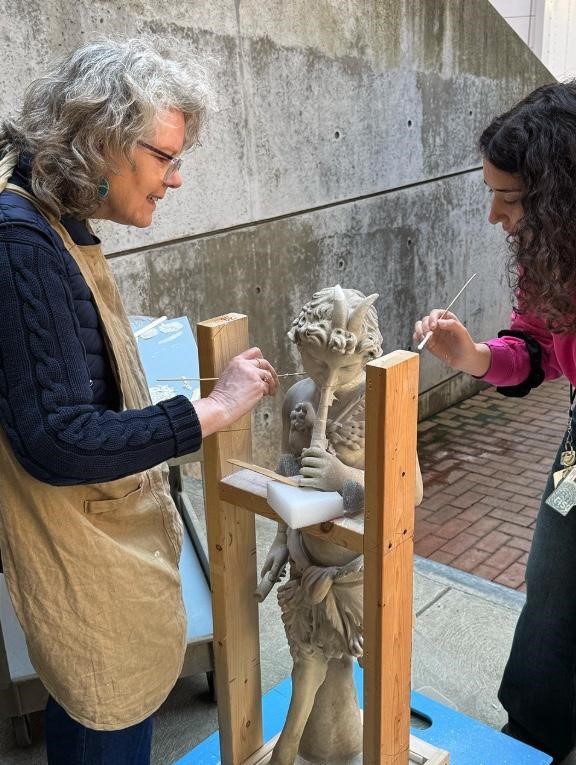
While conservators intentionally make their repairs distinguishable from the original through their selection of materials, their work must remain invisible to the viewer. “We’re trying to honor the wishes of the artist,” says Neuman. This means conservators must address each deformity with painstaking precision and care. Inpainting demands an especially detailed approach. “It takes a really long time,” Neuman says. “You have to use a very tiny brush, with only a few hairs in it, and you have to be really good at color matching.”
One of the challenges of inpainting is a color perception phenomenon called metamerism, where colors that match under one light source may look different under another, making it difficult to achieve seamless repairs. “They teach you to use daylight, but if you bring it into a gallery that has tungsten or halogen light, it’s going to look different. It’s not going to match,” Neuman says. To navigate this, she moves the piece back and forth on wheeled carts between her sunlit lab and the gallery space to ensure the colors match under different lighting conditions.
Once the restoration is complete, detailed documentation is essential, Neuman says. Photographs of the piece before, during, and after the process, along with written records, are uploaded to the museum’s database for future conservators’ reference. “It’s important to leave a record,” Neuman says.
However, the recognition of a conservator’s work rarely extends beyond the backrooms of the museum. Their contributions often go unacknowledged in the gallery. At the RISD museum, curators sign their names on every display label, but conservators remain unseen.
“I would say the conservators’ work is very silent, like it never happened,” says Neuman. “I always thought — on some of these pieces that have been conserved pretty heavily — why couldn’t the conservator’s voice also be there?”
Neuman says conservators are trained to embrace the belief that “you should never be able to see the work if you’re a good conservator.” As a result, they have long occupied an invisible space, positioned between the artist and the viewer.
“I don’t know if that makes the most sense and if that’s really doing the piece justice, or the visitors,” she says. “They don’t know anything about what goes on to take care of these things.” Especially at an art school like RISD, she believes the process and labor of conservation could be educational if shared with students and the public.
Kristine Yang is a senior at Brown University, where she is studying Applied Mathematics and Biology. Originally from Falmouth, MA, she is interested in writing about local and regional issues, as well as exploring scientific journalism and the intersection of different scientific fields.


Want to comment? Click!