






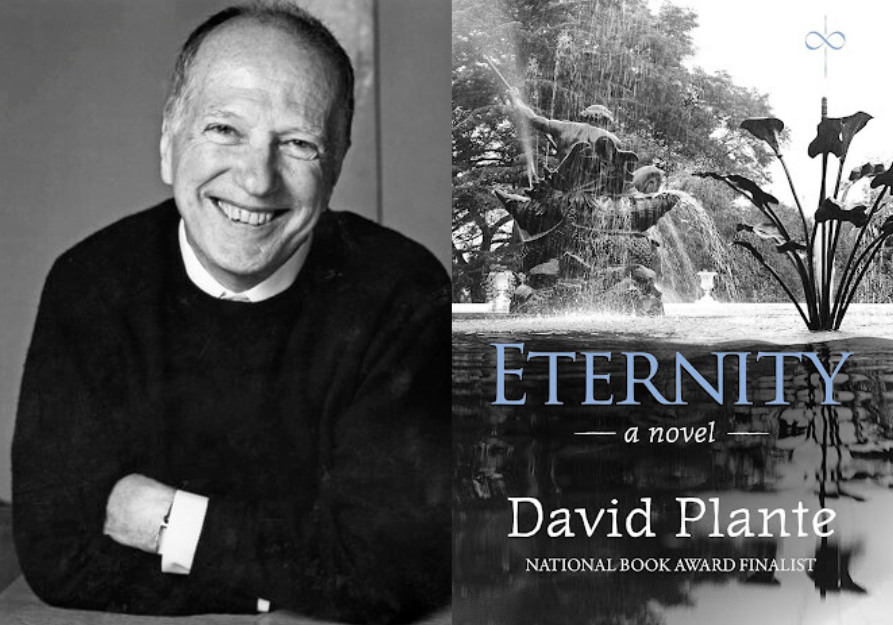
At just over two hundred pages, Eternity, the latest novel by Providence-born writer David Plante, is hardly an overstuffed book, but the world it depicts brims with disquiet. Ted Beauchemin, the novel’s middle-aged protagonist, is someone for whom home is always just hoving into view and just as suddenly retreating, leaving him bereft of essential psychological ballast, specifically the reassuring feeling that he’s not, as he fears, utterly alone.
This spare, allusive novel extends Plante’s delicate and long-running engagement with his origins. Born in Providence in 1940, Plante grew up within a tightly knit French-speaking parish, attending Lasalle Academy and Boston College; later, he studied as well as the Université catholique de Louvain. Despite Plante’s peripatetic life — he has also lived in New York, London, Moscow, Saint Petersburg, and now, in Lucca, Italy — he has infused his work with bittersweet details recognizable to anyone who knows Providence. He excels especially at conveying the aching emotional tone of the place in winter, with its relentless march of brief, gray days intermittently enlivened only by episodes of fast-falling heavy snow.
Plante is perhaps best known for his Francoeur Trilogy of novels—The Family, The Woods, and The Country—which altogether present a sweeping family saga centered on a French-Canadian immigrant family. The first of these, The Family, was a finalist for the National Book Award in 1979. Serving for many years as a professor in the MFA program at Columbia University, Plante was also — full disclosure — a faculty reader of my thesis which, like his Francoeur books, was an immigrant family saga set in Rhode Island. During my defense, Plante put me at ease immediately, smiling as he correctly identified the real-life Providence inspiration for one of the novel’s landmarks, Unaconicut Hill. (If you know, you know.)
I should not have been surprised: Plante is a magician of recognition. He also understands the loneliness of its opposite, feeling unseen even by oneself. This dialectic — between recognition and loneliness — fuels the conflict in Eternity from the book’s first pages.
The book finds the protagonist approaching forty, living as an expatriate in London. Ted is a French-Catholic from Revere, Massachusetts who returns home stateside to settle his deceased parents’ estate. It is a lonely interlude: “He knew [the town] from the past, from when he had once walked along the same street in the town of clapboard houses with lawns and decorative shrubs, there where he grew up with his American longing to go away, an especially American longing when you were alone at dusk walking along an American street, and no lights lit the dusk.”
Among his parents’ belongings he finds a grainy photograph of himself as a boy of seven, preparing for his First Communion. He is dressed in a blindingly white short suit with matching knee socks and shoes, his hair combed carefully, holding a prayer book. (A similar snapshot appears in the book, deepening the reader’s connection with Ted while recalling the homey photographs studding the novels of W. G. Sebald.) Now a bereaved adult hurrying to finish his grim task, Ted scolds himself for sentimentality and puts the photograph in the trash, a tiny act of self-abandonment that will have far-reaching consequences.

Ted returns to London and throws himself into the busy social round that he enjoys with his wife, the “light-spirited” Hilary, with whom he enjoys many pleasures, including the particular pleasure of living in London, “where he would live all the life he had left to live,” as he puts it, upon his return. “This is London,” he exults, “this is my London.”
Yet, shadows dog their bliss. Hilary finds Ted hard to reach. His Americanness, she thinks, is the source of the distance: “To her he appeared to come from a country she knew nothing about, born and brought up in a house in a town in a country that was his own, and there was constant dark in the country.” There is so much sympathy between these two, yet they are distinct individuals who are, necessarily, not in complete accord. So although, for instance, Hilary is easily comforted by Ted, she is aware that “there is something in the comfort that made her wonder a little — made her wonder about Ted.” The same is true for Ted, who wonders about Hilary. But this wondering does not lead to action; they’re simply having too much fun together.
Until Ted returns from the States, that is. Attending a garden party thrown by another ex-pat and her husband, Ted is waylaid by a bedridden little boy, the son of the hosts, who is too sick to join the fun. The boy excitedly tells Ted that he’s about to make his First Communion. His excitement stirs Ted’s memory, still fresh, of himself in that photograph he’d thrown away just days before, across an ocean. It becomes clear that Ted, in London, is deeply estranged from the version of himself he encountered in the empty house in Revere.
Wrenchingly, the little boy dies. His death throws his American Catholic mother, Jessica, into crisis. Drawn into her grief, which mirrors what he can’t feel for the lost child within, Ted grows alienated from the life he has painstakingly created for himself in London, threatening his relationship with Hilary. His entanglement with Jessica fuels the rest of the novel, which follows Ted’s crisis of several faiths — narrowly, his faith in his marriage, but also his faith in his other choices, which have tended to avoid what he most needs to confront. He contends as well with his lapsed Catholicism, the faith of his childhood from which he has become distant in his expatriate life.
This is not a preachy or religious book, but a questioning exploration of a character’s sincere struggle to locate himself within, or at least in relation to, a traditional religious framework he long believed himself to have outgrown. No spoilers here — except to say that Ted resolves his crisis of estrangement by finding a way to live with it. For Ted, religious faith just is an occasion for continuous crisis. He believes and he does not. Suspended in this agonized state, he discovers precisely the same crucifying agony at the center of Catholicism. To be agonized is to arrive at the alienating heart of the matter — for Ted, an inhospitable home place.
+++
David Plante grew up in Providence, Rhode Island, within a French-Canadian parish palisaded by its language, a dialect that dates back to the first French colonists, in the early seventeenth century, in La Nouvelle France—or what was then most of North America. Plante has been inspired to write novels rooted in La Nouvelle France, most notably in The Family, which was nominated for the National Book Award. He has recently published two memoirs Worlds Apart and Becoming a Londoner. His renowned Difficult Women, a nonfiction work that profiles Jean Rhys, Sonia Orwell, and Germaine Greer, was reissued by New York Review Books in 2017. Plante has dual nationality, American and British, and resides in Lucca, Italy.
+
Diane Josefowicz’s writing has appeared in the Boston Globe, Dame Magazine, LA Review of Books, and Conjunctions. Her debut novel, Ready, Set, Oh, published by Flexible Press, tells the story of two families coming together in Providence, Rhode Island during the 1967 Summer of Love. Her next book, Guardians & Saints: Stories, is forthcoming in October from Cornerstone Press. Sign up for her newsletter, “What’s That Noise?” at www.dianejosefowicz.com. She lives in Providence.


Want to comment? Click!