






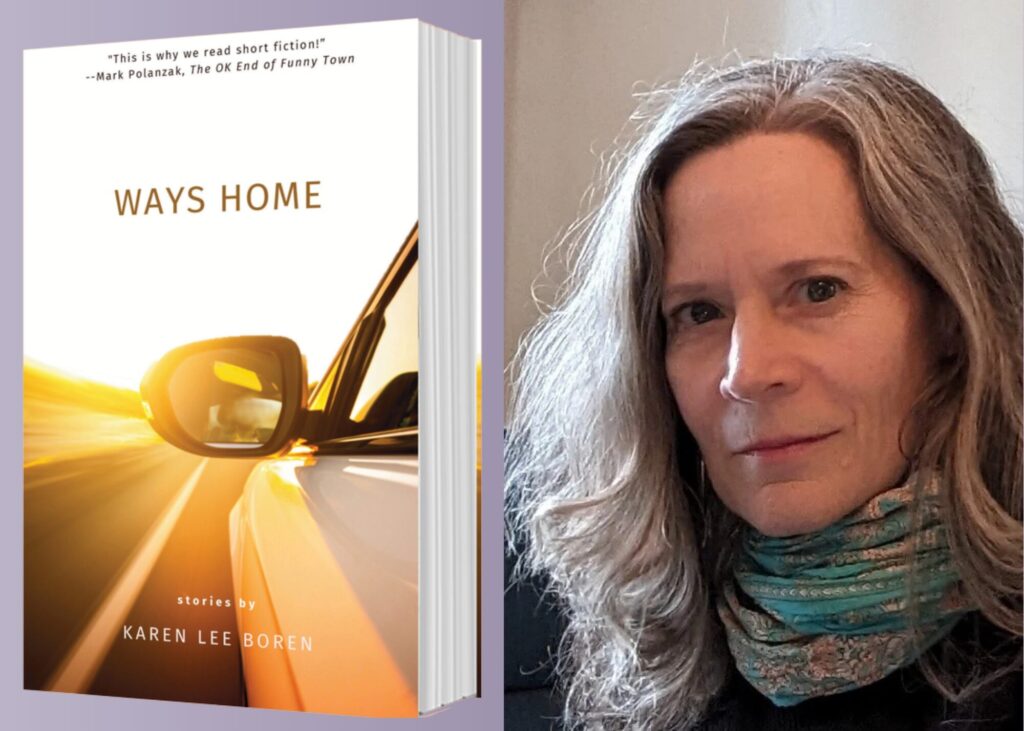
Speaking with The Alembic after the publication of her first book, Girls in Peril (2006), the Providence writer Karen Lee Boren described adolescence “as a time when young people, often unwillingly, must recognize their separateness as individuals despite their intense connections to their friends.” In her latest story collection, Ways Home, Boren, who is also a professor of creative writing at Rhode Island College, continues to explore the fraught separations that shape the lives of young adults.
For the characters in these new stories, however, the essential problem is not so much how to escape as how to come back, symbolically, after leaving—how to honor the loves of childhood without losing independence. Ways Home is divided into three parts, each corresponding to a different way of making this return trip: “Scenic Routes,” “Tollways,” “Fast Lane.” These titles correspond to the length of the stories each part contains, with the shortest stories—some just a handful of pages—reserved for the final section.
In Boren’s stories, as in life, scenic routes occasion long and involved adventures. In one long story, a girl named Joleen contends with decades of teasing inspired by the success of Dolly Parton’s “Jolene”; in another, a woman in her thirties attempts, after a period of dithering, to return home to Chicago by train and is fatefully delayed; in a third, a group of friends collectively confronts their complicity in a deadly accident from years before.
The stories in the middle section, “Tollways,” tax the reader in various ways; one is written in verse, a formal innovation that may stretch the patience of those accustomed to the rhythms of prose; two other stories are impressively tall tales, in which characters change in ways that strain credibility. The stories in the final section are quite short, some no more than a few pages, and these sketches don’t deepen the collection’s theme of home-going so much as they riff on it, offering not ways home but ideas of going, pedal-to-the-metal, that elide the essential, if time-consuming, work of getting there.
Perhaps because Boren grew up in Milwaukee, on the western shore of Lake Michigan, open water calls to Boren’s characters, who respond with pleasure and fear. In one typical example, a woman reminds herself of the dangers posed by a huge lake, of being surprised by its powerful currents: “Even at its most temperate [the lake] leaves your skin raw with cold, and the gentle pull of the current can fool you into swimming farther from shore than you should. A cramped calf has done in more than one strong swimmer.” The central character in “Breakneck,” a pregnant woman whose partner has left her with a mysterious suitcase, also lives near the water. Oakland Beach, “shell pocked and gravelly,” will be familiar to local readers, and though Boren does not idealize the place, she does offer glimpses of its gray-on-gray beauty, noting “the smoky plumes of an osprey high in the clouded sky,” “the charcoal skins of migrating seals [and] the flint-colored rocks they loll on.”
In “Dancing Around It,” the collection’s most accomplished story, a teenage dancer and her friends have been asked by a teacher to get “in touch with our inner history.” In response the narrator attempts to capture the lived experience of her grandmother, about whom she at first can say only two things: Busia is “fat,” which poses a specific threat to her as a dancer, and she is “really, really Polish,” a quality that relates to the first in an important way, one that is revealed as the story unfolds. Struggling to complete this unwelcome homework, the dancer remembers Busia’s house dress, “big as a tent and weathered from years of washing,” and how she played with the hem as Busia stood at the stove making soup. “I can’t see any way to transfer this memory into a dance,” the girl admits.
Then her friends take off. Gazing into a mirror, she is troubled by solitude. “I can’t see anything but my own reflection,” she complains. The space created by their absence is soon filled by more expansive thoughts of her grandmother. “I may not know much about her,” she says, “but I know Busia was more than a dirty old Polish woman like those who rove Little Poland hawking oplatek wafers in the bakeries at Christmastime. She had a whole life.” Yet this insight does not wholly free the young woman from her self-preoccupation. She meets her father for coffee, which he takes with cream while she doctors hers with Sweet ‘n Low. The point is clear: Family life is still too rich to nourish her, but she will accept an ersatz sweetness that doesn’t threaten her with a resemblance to those she both loves and flees.
In her handling of detail Boren is routinely, effortlessly transcendent. In “By Any Other,” the story that opens the collection, a gang of boys bikes furiously downhill past a girl they’ve been tormenting, and “the luscious breeze of their descent cools her own flushed cheeks.” Be still my heart: The adult world has come for this young person, and as much as she hates it, something about it nevertheless spells her deliverance. Later the same girl befriends another student who attends carefully to her hair, using “Kool Aid and Final Net to create wild sculptures that leave her pillow burnished.” Lines like these, and Boren offers plenty of them, made me sit up straight in admiration.
When Boren’s attention falters, however, the prose lapses into cliché—one character takes another “under her wing”; a bar predictably called Harley’s is epitomized by the clientele’s equally predictable wardrobes, “studded leather jackets and tattoos everywhere.” Boren’s wilding boys “screech like owls,” a simile that sent me off on a distracting ornithological tangent: Do all owls screech? (Don’t some of them hoot?) In prose of this caliber, such weak points seem not exactly flaws but places where additional development might yet occur, where a story might take on flesh and grow substantial, given time. Even in its rare missteps, the collection as a whole makes an argument for unrushed development. Perhaps it is Boren’s long experience as a teacher of creative writing that makes her so exquisitely alert to these passages in life and art.
Certainly she understands the stakes. By the end of “Dancing Around It,” the teen dancer comes to see her grandmother’s size differently, not as a failure of self-discipline but as the result of a carefully cultivated stillness—a key talent, she now sees, for an immigrant making her way in an unfamiliar place where moving around too much, or in the wrong way, could mean losing everything. This is growth, but will it suffice? Boren gives an answer in the form of a little girl, who arrives as a kind of coda, skipping stones across another of Boren’s huge and powerful lakes. The narrator cheers her on, “certain that propelling the stones forward, even just a little, is a lot.”
+
Diane Josefowicz’s writing has appeared in The Boston Globe, the LA Review of Books, Dame, Conjunctions, and elsewhere. Her fifth book, Guardians & Saints: Stories, will be published next month by Cornerstone Press. She lives in Providence with her family. Learn more at www.dianejosefowicz.com.
About the book:
Ways Home: Stories by Karen Lee Boren
Publisher: Flexible Press
Publication date: August 8, 2025
ISBN: 979-8991492867
Paperback, $19.00


Want to comment? Click!