





Today, a historic opportunity dangles in front of the whole country: to be the first nation to kick oil once and for all.
Any nation that fully decarbonizes its energy grid will unshackle itself from a volatile global fuel economy in which violence in a place like the Strait of Hormuz can topple economic dominos and leave families unable to pay bills. Whoever accomplishes this first will claim leadership and reap enormous benefits in the areas of climate resilience, job creation, and political prestige. And in the U.S., Rhode Island is in a position to lead the way.
Let’s set the table.
Providence – and Rhode Island, in general – have challenges.
First, our economy and job market are weak. The Bureau of Labor Statistics shows every county in Rhode Island reporting lower wages than the national average, and Rhode Island performs worse than the national average on all six of the Bureau’s measures of employment. We compare especially poorly to our wealthy neighboring states.
Second, the state has a lot of “brown field” sites – land that have been blighted by historic industrial use that’s never been remedied.
Third, we have notoriously bad energy utilities, with blisteringly high bills, low energy generation, and the second heaviest reliance on carbon fuels in the nation.
But we have wonderful qualities as well.
Providence is the “creative capital,” with an adaptive and innovative spirit, and easy access to pools of talent in the neighboring cities of New York, Boston, Hartford, and Worcester.
We also have truly excellent land use. We are the second most densely populated state, and yet RI maintains nearly half the state natural and forested. This far exceeds the national average and ranks us highly even against sprawling rural states larger than most countries
Furthermore, we have the lowest energy consumption per capita of the entire country. The entire state’s energy needs are remarkably small.
This is our history. And, as luck would have it, a technological revolution is fast approaching: next-generation nuclear reactors.
In recent years, Microsoft, Amazon, Google and Facebook have all announced plans to purchase nuclear power to meet their surging demand for electricity. Many are purchasing or financing the development of a new breed of reactors that sport incredible new features: compact form factors as small as a shipping container, alternative fuels that eliminate the need to shut down to refuel, and alternative coolants that unchain the reactor from the rivers and oceans that typically cool them and allow them to operate in remote locations.
Also in the news: Japan, Germany, India and Italy have reversed their anti-nuclear stances, lifted moratoriums, ended bans, overhauled outdated policies and re-written legislation to kick start their nuclear sectors. They are doing this in service of meeting their electric demand and climate targets.
Five years ago, American utility companies estimated they would double the size of their nuclear output by 2050, and, with the explosive growth of AI and data centers driving energy consumption to mind boggling heights, the nuclear industry has updated their expected growth to more than double its output in the same time frame.
Amidst all of this, major players are looking for leaders to bankroll. The Department of Energy’s loan office has set up multiple programs to fund new nuclear projects, totaling in the neighborhood of a billion dollars and counting. Morgan Stanley and a slew of other financial luminaries estimate over eight trillion dollars in value in the global nuclear industry by 2050. A coalition of 14 banks such as Bank of America, Citi, and Barclays are pursuing investment in new nuclear projects.
As violence and destruction in the Middle East push gas prices ever higher, with no end in sight, the world is desperate to escape a doomed oil economy. A gold rush is on. And as the old proverb says, if you want to get rich during a gold rush, sell tools. This is Providence’s golden opportunity: become the manufacturing hub that supplies global demand for next-gen nuclear reactors.
Here’s what that would look like.
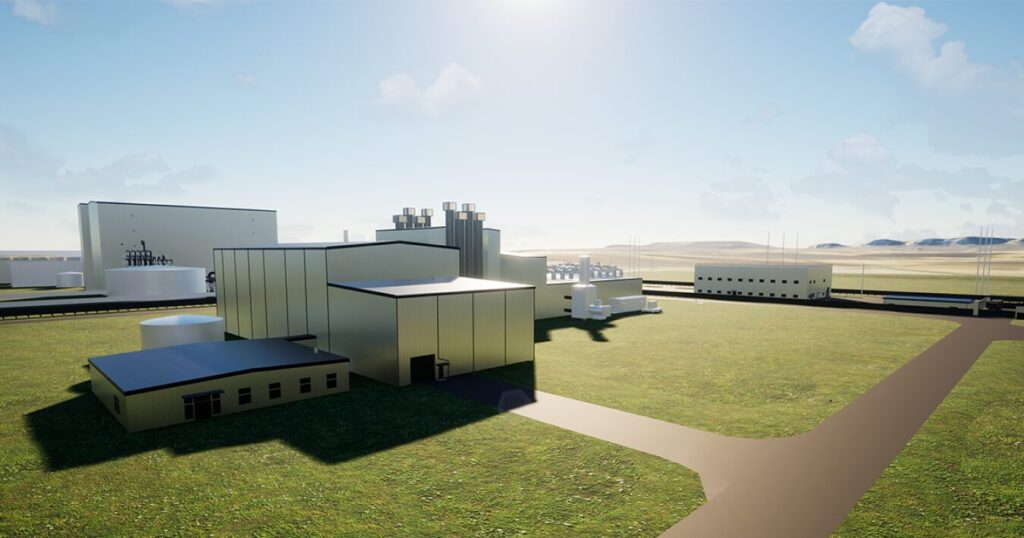
Unlike the power plants we have today, which are custom built for each location, next-gen nuclear will be built in factory and lab settings and shipped out where needed. Providence can designate a cluster of its disused industrial sites to host this manufacturing hub. In such a market, Providence-based businesses can partner with one or more next-gen reactor developers to produce these reactors en masse. The first of these units could be put online right here in the industrial outskirts of Providence. In fact, this could have the incidental benefit of serving as a de facto remediation project, since nuclear power projects are safer and cleaner than virtually any other industrial development.
Next-gen reactor designs are tiny, less than the size of a city block, and the energy density of these units is so high that it is not an exaggeration to say that four to six of these units would power the entire state of Rhode Island, plus a margin for growth in demand. And all of this can be done without disturbing any of the precious little and exceptionally well protected land we have in this state.
Furthermore, it pays to be “first of a kind.” If Rhode Island were to win the race to decarbonize using only a few of the next-gen reactors it manufactured itself, it could cement a reputation as the epicenter of a modernizing world economy.
If we do this right, Providence can serve as a global beacon. Thereafter the lion’s share of the overwhelming unmet demand for power brewing among tech giants and national governments will flow into Providence, where manufacturing these units for export will generate hundreds, if not thousands, of high-paying, high-quality, long-term jobs. Those jobs would be in blue collar sectors like construction and maintenance, as well as white-collar sectors like engineering and administration. Local economies will flourish.
But we wouldn’t stop there. The International Energy Agency, a leading authority on Climate Change mitigation, has set a 2050 deadline to go carbon free, and as that date swiftly approaches neighboring states will only grow more eager for carbon free electricity, but their larger and more complex economies and politics will leave them lagging behind Rhode Island, which – having already met their total energy needs – can continue to add units to its own grid and export more and more electricity to its neighbors. For a glimpse of this, look to Europe, where France makes well over one hundred billion dollars annually exporting surplus power from its nuclear sector to Germany, Italy, and Switzerland.
That is the vision: a massive influx of high paying jobs, staggering imported investment capital, untold exportable wealth and a clean, modernized future. All without any ecological disruption. That is what’s possible in a state that is small, scrappy, and adaptable. That is what’s possible in a city that is bold and creative. That is what’s possible in Providence.
Francis Anderson is a Senior Manager of Motion Graphics at the Nuclear Energy Institute, where they write, direct, and produce video content about energy technology, policy, and economics. They live in Cumberland with their partner and toddler and you can often find them playing music at local open mics and venues under the artist name Franny Keeps.
EDITOR’S NOTE:
Since this piece was first published, we have updated the author’s bio to indicate that they are employed by a nonprofit organization in the field they are writing about.
Although we spoke with the author before publication and received assurance that their organization does not profit from nuclear projects in RI (it is a trade organization that does not sell technology or provide financing or investment), we should have included that affiliation for the sake of transparency. We regret the error, and, going forward, we will seek to notify readers of authors’ relevant professional affiliations.


Want to comment? Click!