



One after another, Providence Schools students and parents stepped up to the mic at the City Council on June 11 to demand that the city increase its appropriation to public schools by $20 million in the coming school year. Their passion and anger at the inadequate funding of their schools was clearly audible, even if the ornate chamber’s miserable acoustics often made the words difficult to hear. In two minute-intervals, the students, parents and teachers filled more than an hour with their appeals.
“I never heard an adult tell me that school wasn’t important, that it didn’t matter,” said Zakiya Mian, a student at West Broadway Middle School. “But this is what it feels like: a group of adults telling us that our education just isn’t important enough.”
Zakiya was referring to the waves of financially driven school closures, program reductions, staff layoffs and related staff transfers that have severely affected every PPSD school and the roughly 19,000 student they serve over the last six months – and the high likelihood of even more devastating cutbacks to come next year if the city does not dramatically increase its appropriation for schools.
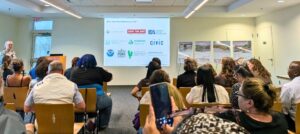
The large turnout of parents and teachers at the City Council was organized by Parents Leading for Educational Equity (PLEE) and the Alliance of Rhode Island Southeast Asians for Education (ARISE), which had launched their public campaign with a bilingual teach-in on the school budget at the Community College of RI on May 11.
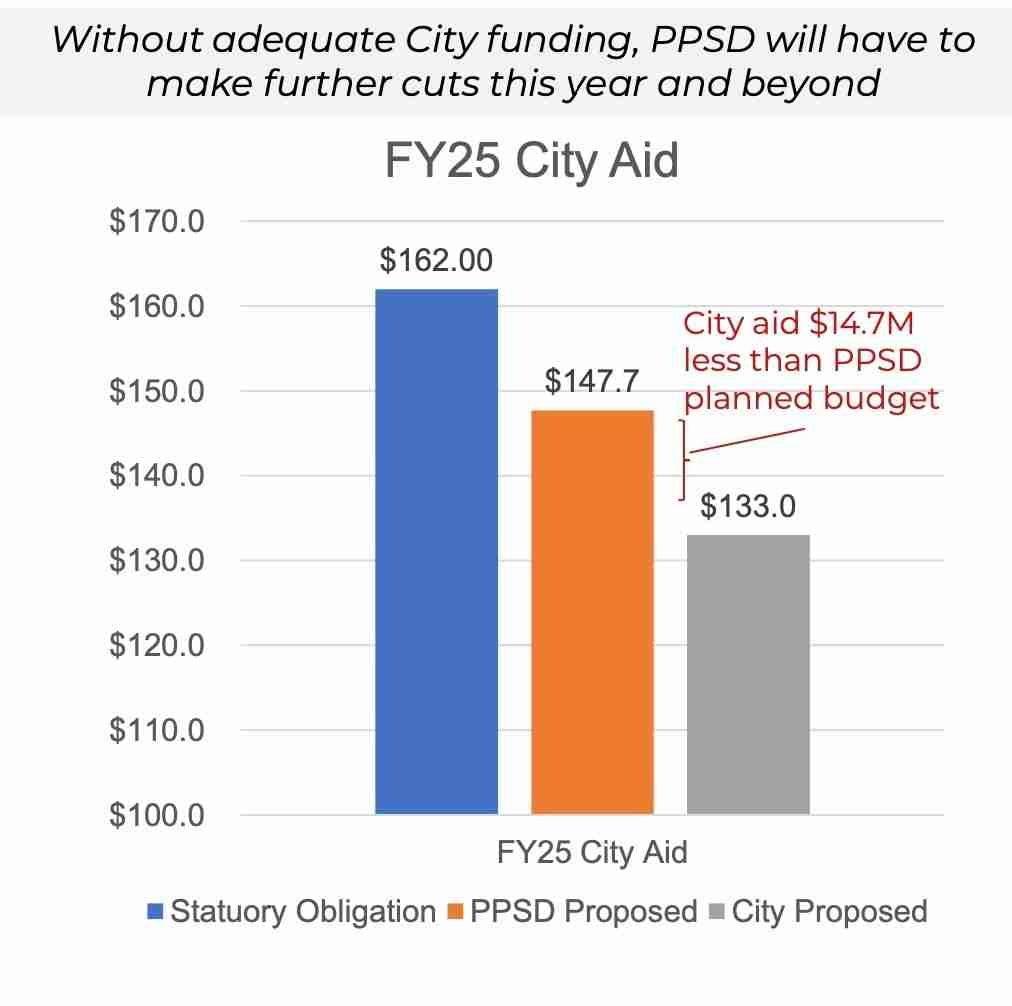
Their message: the City of Providence has chronically shortchanged its children by underfunding schools for a decade or longer. Their demand: increase the $133 million that Mayor Smiley was proposing to give schools by $20 million to preserved existing services and undo at least some of the damage already done.
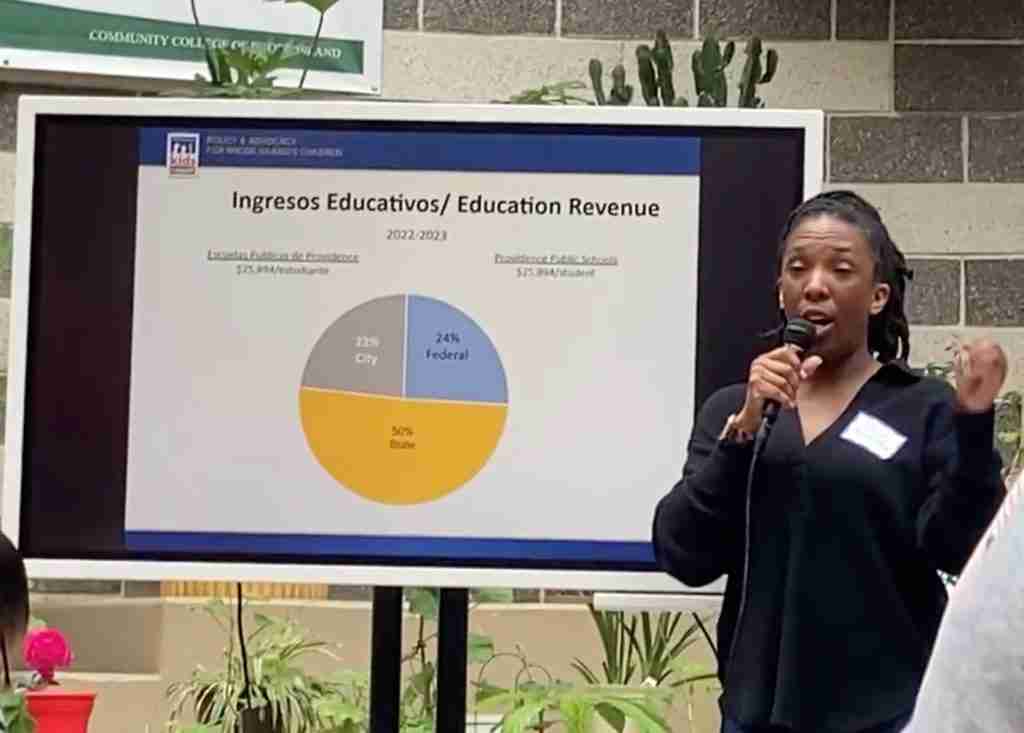
At the CCRI meeting, Paige Clausius-Parks, Executive Director at RI KIDS Count, outlined how we pay for our public education in the simplest possible language. But it’s still very complicated.
School budgets 101
Start with the “fiscal year,” which is 12 months long, but does not begin in January. “Fiscal Year 2025” begins this July 1 and ends on June 30, 2025. That way, the annual spending plan covers a whole school year from September to June. The city and state also use a fiscal year (FY) that begins on July 1 of each year. So right now, all Rhode Island state and city governments are finalizing their income and expense plans for FY25.
There are three critical sources of funding to public education: the state, the city, and the federal government. The state has always paid the largest share for Providence. Last year the state kicked in about $272 million. The city government also makes an annual appropriation that has traditionally been more or less half as much as the state’s – last year’s was $130 million. The city and state payments combined fund what PPSD calls the “local budget.” Funding from either source can rise or fall from one year to the next depending on how city and state leaders balance education with other priorities.
Then there’s federal funding which has long helped districts with grants based on the number of higher-need students. In the two years prior to the COVID pandemic shutdown in 2020, federal funding to Providence schools was about $50 million a year.
In 2020 and 2021, Congress responded to the COVID disruption of schools with three massive Elementary and Secondary Education Relief (ESSER) appropriations known as ESSER 1, 2 and 3. Altogether they totaled $190 billion. Allocations favored high-need districts like Providence.
Providence’s total education funding ballooned as federal funding jumped from $50m to $98 million (including ESSER and other federal programs) in the first year of ESSER funding (FY 2020). That boosted the total budget from $446 in combined state, city and federal funding for FY2020 to $508.5 million in FY2021. With $247 million in federal revenues, total PPSD spending soared to $665.7 million in fiscal year 2022, the peak year for ESSER.
Available federal funds dropped in FY 2023 and again in FY 2024. PPSD included just $78.1 million in federal money in its proposed budget for next year, the year it must spend all remaining ESSER funds. With no ESSER money, federal funding will almost certainly be even lower in future years.
The end of ESSER was written into the legislation. So was the use-or-lose final deadline for committing ESSER funds of September 30, 2024. Chronically cash-starved urban school districts everywhere were now struggling to spend the shower of federal money before they came to the “fiscal cliff” in September of 2024.
In a letter to the City Council prior to their budget meeting on the 11th, PPSD Deputy Superintendent claimed that the district used ESSER funding exactly as the federal government expected, specifically for:
- Re-opening in-person school rapidly after the shutdown in March of 2020.
- Accelerated learning through summer and spring break programs.
- An extended school day for students and additional time for teacher professional development.
- Hiring school-based social workers and behavior interventionists to address students’ dire social-emotional needs in the wake of COVID.
Still, these investments are now being reversed as ESSER ends. PPSD’s budget for next year provides for 92 fewer teachers, 21 fewer teacher assistants and completely eliminating school-based behavior interventionist positions, a reduction of 36 more staff. Nearly 300 PPSD positions out of 3,300 will be cut, an overall reduction in staff of 9%. Notices of displacement and non-renewal of contracts have already gone out.
City pressured to fill the “gap”
Budgets for future years are always based on assumptions, or even informed guesses, as to what actual income and expenses will turn out to be. The PPSD made all those painful cuts based on a budget that assumed the city would contribute $147.7 million to schools next year.
That was hardly a realistic assumption. The city has level-funded education for years. PPSD and RIDE have been in a battle over the city’s fair share ever since Mayor Smiley took office. Last year, the city provided $130 million. For next year, Mayor Smiley included just $133 million in the city spending plan sent to the City Council this spring.
The difference left a $14 million gap between the two proposed budgets. It was up to the City Council to resolve the difference. Either the city would pay more, or PPSD would need to make more dramatic cuts.
PPSD Superintendent Javier Montañez called the Mayor out in a YouTube video in the week preceding the City Council budget meeting. “The Mayor’s proposed budget shortchanges Providence schools by more than 27 million dollars… This is after years of chronic underfunding by the city…”
The Mayor shot back. “A YouTube video released at 10 at night is not how adults should negotiate over funding,” Smiley told Target 12 ““They have to manage their budget just like I have to manage my budget,” he said. “We’re doing the most we can to get them additional funding.”
A last-minute change in the state aid formula shortly before the Council meeting increased the net state contribution by $3 million. Zack Scott at PPSD told the Council that the gap still stood at $11.2 million.
The $20 million increase that school families were asking the Council to provide would have been enough to fill the gap, fend off additional cuts and perhaps restore some of the teachers or social workers already let go.
But it would not reverse a 10-year trend of continuing disinvestment from the city, John Papay told the Council on June 11. Papay is the parent of three children in Providence Schools and an Associate Professor of Education and Economics at Brown’s Annenberg Center. Although careful to separate his engagement in Providence Schools from his work at Annenberg, Papay does bring his research and analysis skills to his advocacy for school funding.
Papay focused on the historic facts: the city’s budget has grown 30% since 2015. But its total financial commitment to education has gone up just 6.5% over that 10 years and that includes money PPSD must send straight on to charter schools. Papay said that the actual amount left for district schools has fallen by 11%.
Papay dismissed claims that the city can’t afford to pay for schools. “We should be clear – the city budget simply reflects different priorities. The city has consistently found funding for other public policy goals. I’ll provide one example. This year, the proposed budget increase for public safety is $16 million, for schools $3 million. Since the start of this administration, general fund dollars for public safety have increased $35 million; schools $3 million. Over the past decade, funding for police has gone up by 60%, while funding for public education increased by 6.5%.”
Papay pointed out that Warwick, with half as many students, invests far more in education than Providence does – $190 million for FY25.

The City Council listened to the urgent public comment on the budget and adjourned without further action. After the meeting, Councilman John Gonsalves shared that Council members were negotiating with the Mayor to find more money for schools. Given that anything gained for schools would need to be taken out of another city department, he cautioned, a $20 million increase was unlikely.
The next day, Ramona Santos-Torres, Executive Director at PLEE and two PPSD parents, Peter Chung, whose child goes to ML King Elementary and Hilary Lewis, a parent of two children at Vartan Gregorian Elementary, met with The Providence Eye via Zoom to review the Council meeting.
The informal coordinating group, which also includes John Papay, has been following and fighting the FY25 budget cuts since they were first previewed by Zack Scott at the citywide Parent Advisory Council last November.
“The problem is complicated,” said Lewis. “An increase in special ed needs, the growth in multilingual learners, the flat funding from Providence. There’s not one driver.”
Finding leverage has been frustrating. “We emailed every official. The city tells us ‘go yell at the state. Officials are running in circles pointing fingers.”
As we spoke on Zoom, the City Council announced that they had negotiated a $2.5 million increase in the city appropriation with the Mayor, from $133 million to $135.5 million. With that change, the city budget is on track to be adopted before the end of June, leaving the difference for PPSD to cover.
“That’s huge!” said Santos-Torres. “I’m so proud of the parents who came with babies last night, the students who came. Without them, we’d get nothing.”
But it still leaves a $9.2 million gap. PPSD spokesperson Jay Wegimont responded to the increase. “While this proposed increase does not cover the gap in funding needed, it is a step in the right direction for the students of Providence. We are also appreciative of the community members who continue to advocate for adequate funding for our schools.
Beyond warning of “further cuts” if that gap is not covered, Wegimont declined to specify what might be on the chopping block. To give some sense of the scope of potential additional damage, the $9.2 million still not funded would pay the salaries and benefits of more than 100 teachers. The average budget for an entire elementary school is $5.5 million. The average high school budget is $10.6 million.
The end of ESSER didn’t cause this crisis. ESSER temporarily masked the damage done by years of underfunding for urban schools. ESSER funding was intended to repair damage from a one-time traumatic event, the COVID pandemic. But for many Providence students, COVID was just one traumatic event among many. They needed extra help before COVID and they need it now. But as it stands, they only face more damage to their educations next year.
Maybe the temporary influx of student support made possible by ESSER was a brief glimpse of what adequate education funding could achieve.
Josh Estrella, spokesperson for the Mayor, avoided specific commitments to future school funding. “The Mayor is committed to improving the education system for our students and ensuring that the City contributes to funding our school district. The funding levels will be determined by each future year’s city budget.”
Still, even a small increase is a win. “I hope this is one round for us,” said Santos-Torres of the increase. “We need to get the city contribution up, the state funding up. We have to be back at it next year. I’m excited not to lose momentum.”
Corrections: This article has been modified from the original publication to reflect the fact that Hilary Lewis has two children at Vartan Gregorian, not three. Also, while “conspiracy” was a quote, we felt that “informal coordinating group” was a more accurate description of those on the Zoom call.
Jonathan Howard is Co-founder of Cause & Effect, Inc., a consulting company that provides strategic planning facilitation, fund development planning and board strengthening to mission-driven organizations. He is a long- time resident of Providence.


Want to comment? Click!