

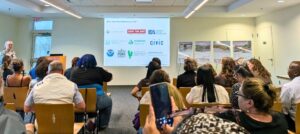


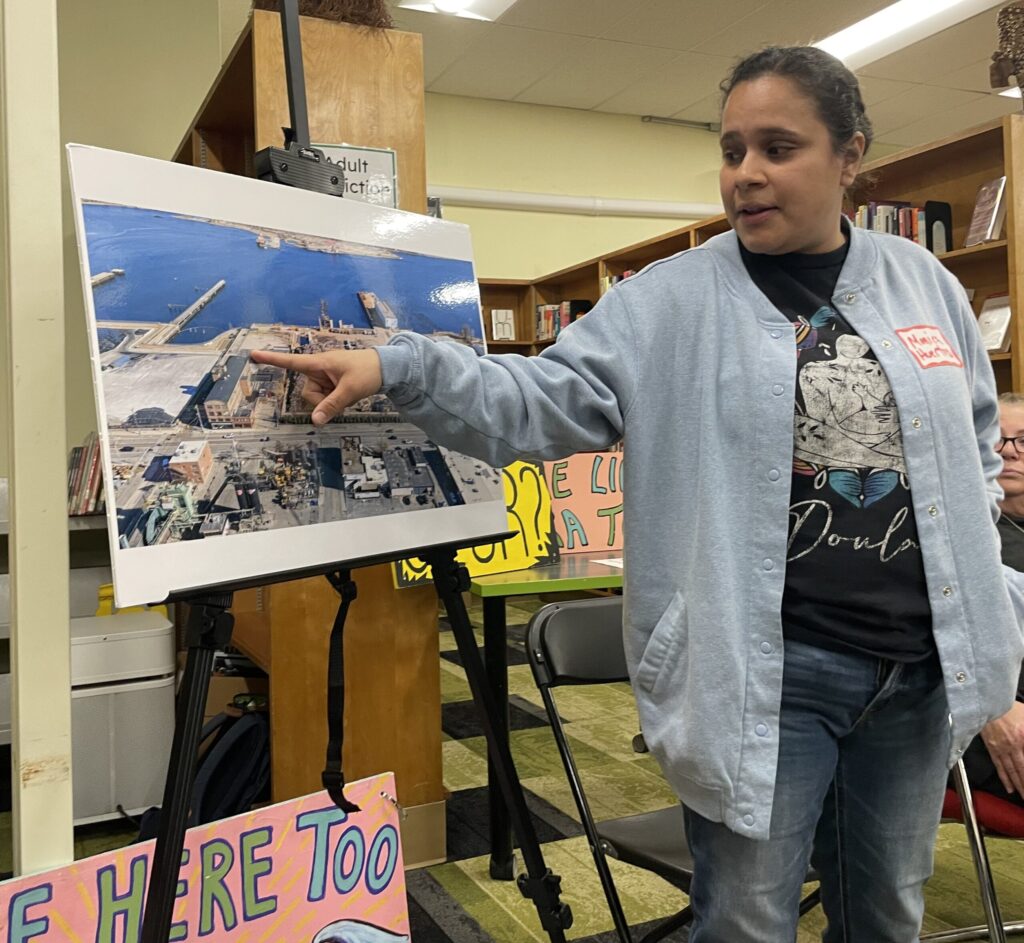
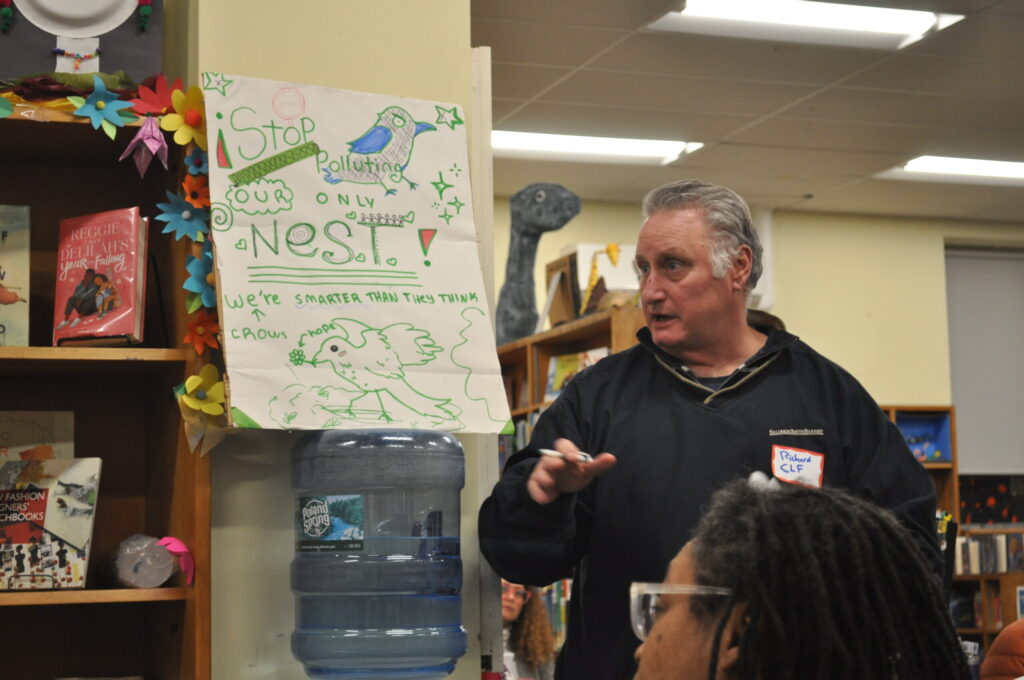
Signs that read “Air Quality Inequality Zone” and “Aire Limpo Para Todos” decorated Washington Park’s Community Library on Monday, November 24. More than 50 residents and city officials packed in between the bookshelves to discuss the latest development in the battle to make Public Street a public park.
Sims Metal Management, a scrap metal processor with a long environmental record, acquired properties between their operation on the Narragansett Bay and Public Street. Neighborhood groups fear the company’s expansion is encroaching on the only coastal access right of way in South Providence.
A New Vision for Public Street
In 2021, Rhode Island’s Coastal Management Resource Council designated Public Street a right-of-way, which it defines as “a parcel of land over which the public has the right to pass on foot or, if appropriate, by vehicle, in order to access the tidal waters of Rhode Island.” Ever since, the City’s Department of Sustainability has been working with local groups to transform the sliver of public land into a multifunctional green space.
“Residents have access to the Providence River down Public Street,” said Office of Sustainability Deputy Director Kevin Proft. “But anybody that’s visited Public Street right now knows that it’s not all that enjoyable to be down at the dead end there.”
The City held assemblies to gather community input and contracted design studios to create plans for Public Street between Allens Avenue and the waterfront. The schematics include a walkway, park benches, and native plants squeezed into a 25 foot wide, almost 200 foot long section abutting the water. In the wider streetscape closer to Allens Avenue, trees and planter barriers protect a pedestrian path from the paved roadway.
The construction is funded by the City of Providence, the Narragansett Bay Estuary Program, the Rhode Island Infrastructure Bank grant and a Watershed Implementation Grant from the EPA’s Southeast New England Program. According to Proft, the project aims to provide welcoming access to the waterfront while improving stormwater management and accommodating the operations of abutting businesses. The latter goal might be a steep one.
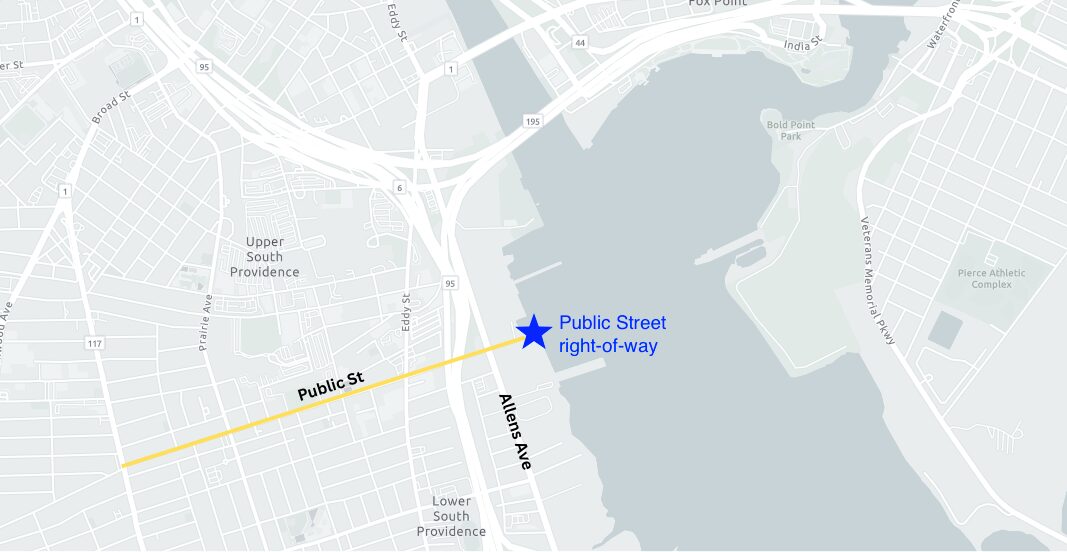
Map via CRMC’s right-of-way mapping tool. Annotations in color by The Providence Eye.
Public Street: Waterfront Park or Industrial Transit Route?
Sims Metal operates a motor vehicle shredding facility on Johnston’s Green Earth Drive, where they earned the unfortunate honor of receiving the largest ever penalty from the state for allegedly violating Rhode Island’s Clean Air Act by releasing emissions linked to cancer and severe respiratory illnesses. Processed materials from that operation are then brought to the company’s location on Allens Avenue, which was the site of a 20 car fire in 2019. This episode is one of the many long-standing examples of environmental injustice in Providence, where low-income people of color often live with polluting industries in their backyards.
According to Proft, Sims Metal now owns all three properties on the southern side of Public Street but does not plan to store scrap in those lots. However, the business is considering using the sites to change their transportation flows. Rather than turning directly into four-lane traffic on Allens Avenue, delivery trucks could maneuver onto the smaller Public Street, which sits at an intersection with a traffic light, allowing for an easier turn onto Allens Ave.
“We have to find a way to coordinate the circulation around Allens Avenue and Public Street that is beneficial for public safety and pedestrian crossings,” said Joe Mulligan, Providence Director of Planning and Development. “There is an opportunity here on Public Street to provide both uses, to have some way where their vehicles are exiting or entering at that controlled intersection as a matter of public safety and separating pedestrian use.”
Voices in the crowd protested that large truck access would infringe on the proposed green space. Sustainability Commission member Chandelle Wilson spoke up in opposition to the idea of sharing that roadway with Sims Metal.
“You’re talking about the potential of increasing smog, pollutant-producing vehicles, heavy duty vehicles, right next to a pedestrian right-of-way,” said Wilson, whose family lives on Public Street farther inland. “That just doesn’t make sense as a public health [and] safety concern.”
Wilson said her daughter went to the hospital multiple times in the last two years when fires occurred at scrap metal facilities and a biofuel storage unit along the port. In 2024, air quality monitors managed by Breathe Providence found a July blaze at Rhode Island Recycled Metals pushed particulate matter levels to nearly 10 times the annual average at measuring sites from Allens Avenue all the way to Pawtucket. Breathe Providence lead researcher Meredith Hastings said a stream of large trucks on Public Street would make air quality problems even worse.
“Having more direct correspondence between residents and the diesel trucks is not a good idea,” said Hastings. She points to EPA research demonstrating how proximity to roadway pollution contributes to reduced lung function, asthma, cardiovascular disease, and premature death. “Just because they own the property, they should be allowed to run their trucks through the public access point? [It] doesn’t seem to make any sense to me.”
Truck Traffic Exacerbates Residents’ Health Problems
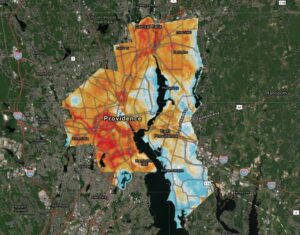
Truck traffic is already a problem in Washington Park. In order to drive onto I-95 South, trucks leaving port facilities on Allens Avenue could drive two miles north before using the on-ramp at Point Street. However, most drive through residential neighborhoods to join the southbound highway at Thurbers Ave. Research from Breathe Providence suggests the loud and dangerous trucks elevate levels of carbon monoxide and carbon dioxide in the neighborhood.
To Hastings, the debate between using Public Street for residential waterfront access and industrial vehicles represents the area’s fight for environmental justice in miniature.
“There has to be this recognition and reckoning with the fact that there are people who live near the port,” said Hastings. “There’s already a need to try to prevent pollution from impacting the residents or reduce the harm if those emissions really have to be happening.”
Proft said the waterfront construction won’t be completed until late 2026 or early 2027, but that isn’t stopping South Providence residents from using the right-of-way as it is now.
Local artists with the Providence Commemoration Lab installed windsocks and a shade structure on the small unpaved parcel this summer. They held a gathering that proved representative of both the potential for local waterfront access and the dangers of living portside. People gathered on Public Street to eat popsicles and listen to jazz, but a mist from Sims Metal floated over attendees.
“One of my children did wake up with terrible asthma the next day because we spent the whole afternoon down there. But it’s one of those things that we have to deal with in Southside and Washington Park,” said Monica Huertas, executive director of the People’s Port Authority. “It’s always in trouble, but now it’s at a particularly troublesome time, that little tiny strip of dirt that we have there.”
Eric Halvarson is a multimedia journalist based in Providence, Rhode Island.


Want to comment? Click!