




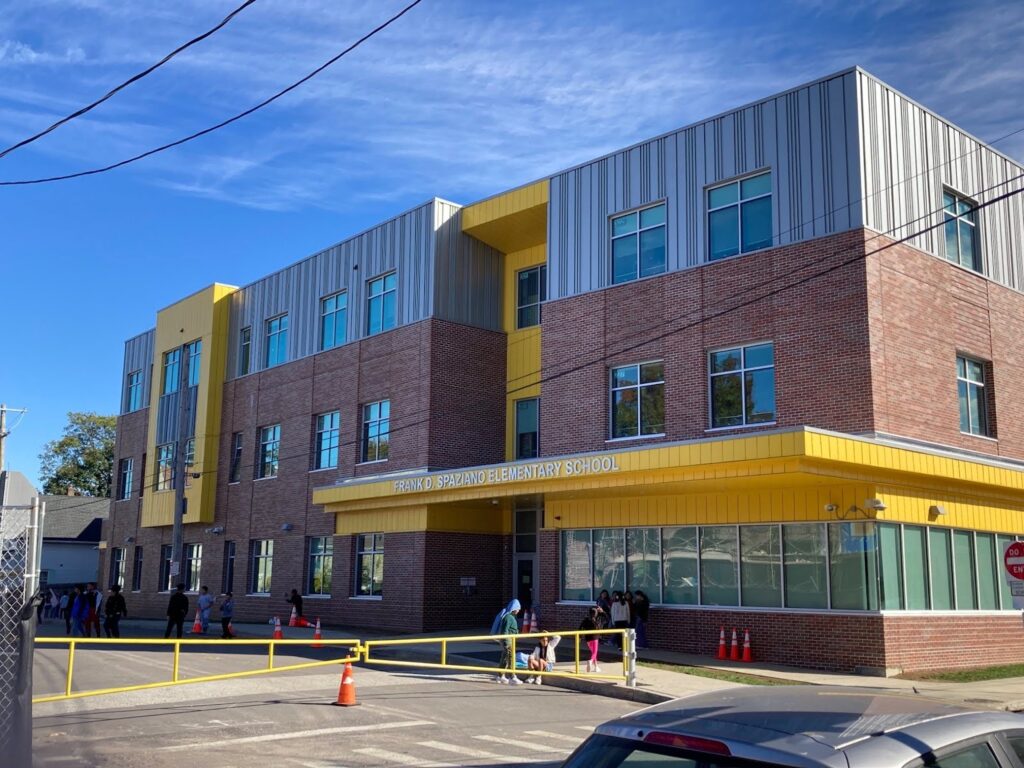
Providence is halfway through a decade-long capital improvement plan to replace or renovate its aging and long-neglected stock of public school buildings to “new or like-new” conditions. Generations of current and past Providence Public School Department (PPSD) students and families know that a major district-wide school upgrade is long overdue.
But few know the scale, scope or impact of one of the costliest public construction programs in the history of Providence. The roughly $1 billion price tag exceeds the cost of moving Rt. I-95 in 2009.
When the current project began in 2019, 22,000 PPSD students attended 24 elementary schools, seven large middle schools for grades 6-8, and seven large high schools, plus a few smaller high schools and high school programs housed in larger schools or other spaces.
When it ends in 2030, according to a recent PPSD presentation, the district will have 17,000 students in nine standalone pre-kindergarten through fifth grade (PK-5) elementary schools, two remaining grade 6-8 middle schools plus 10 brand-new pre-Kingergarten through eighth grade (PK-8) schools. The city’s eight high schools will get “like new” renovations or new construction, but won’t be reconfigured.
“The plan changes a lot”
Despite dozens, if not hundreds, of presentations made at innumerable meetings of various public bodies since at least 2017, a comprehensive view of the whole plan has been very hard to piece together. PPSD has deflected numerous requests for a current “master plan” to yet another PowerPoint that tells some, but not all, of the story. However, PPSD did recently post a full list of projects on their web site.
In fairness, the players, the plan, and the budget have all changed many times since the capital plan was first launched in 2018. It will change again before the dust settles. Regardless of such changes, PPSD and the Rhode Island Department of Education (RIDE), which took control of PPSD in 2019, have consistently highlighted three related and transformative outcomes to be completed by 2030:
- The district will have “newer and fewer” buildings at the end of the plan, from 39 schools in 38 buildings with an average age of 60+ years to a currently planned 29 schools in 33 buildings, at least 16 of them new or “like-new.” (some schools will occupy more than one building)
- The district’s newer and fewer schools will have fewer students, too – PPSD projects an enrollment of less than 17,000 compared to 22,000 in 2019.
- The district will move most of its younger students to 9 new pre-kindergarten through eighth grade (preK-8) buildings and one preK-8 campus in two adjacent buildings, merging or eliminating most freestanding elementary and middle schools.
Expanding the vision – and the budget
Voters approved the first school construction bond in November of 2018, before the RIDE takeover began. The Elorza administration’s original “Phase 1” plan spread that money across most of the district’s 38 buildings to address critical health and safety deficiencies such as leaky roofs, broken windows and insecure doors. That investment wasn’t even close to the $500 million a 2017 engineering assessment said our schools needed.
Then, in November of 2019, our schools were taken over by the Rhode Island Department of Education (RIDE) under their new Commissioner, Angelica Infante-Green. She seized on the construction plan as a major element in her plan to overhaul chronically struggling Providence schools.
Project managers amended the Phase I plan and developed an additional $140 million Phase 2 plan that focused on newer and fewer Pre-kindergarten through 8th grade (PK-8) schools.
Whether or not Providence voters understood this change in plans, they approved the additional $140 million bond for Phase 2 in November of 2020. School bonds have been easy for Providence politicians and voters to support due to a state construction reimbursement formula that favors communities with higher rates of poverty. Under normal rules, Providence receives roughly 80% reimbursement of construction costs. With temporary incentive bonuses, such as the state’s “newer and fewer” bonus, Providence’s school costs will qualify for as much as 91% for projects that began before June 30, 2024.
Voters agreed to add more bond funding in 2022 ($125 million for Phase 3) and again in 2024 ($400 million for Phase 4). Over four years, the plan’s vision had grown from $160 million for “warm, safe, and dry” schools to more than $826 million to ensure every student a “new or like-new” building by 2030. Each “phase” has a corresponding list of specific school projects.
Is a smaller district inevitable?
The RIDE/PPSD newer and fewer building plan assumes that PPSD enrollment will drop to 17,000 students by 2030. PPSD enrollment fell from 24,000 at its peak in 2105, to 19,212 this school year. The drop in PPSD enrollment has led to the closure of four schools over the last few years. More PPSD buildings will empty as new and merged schools come online through the capital plan.
However, the total number of all Providence public school students, including students enrolled in charter schools, was higher in 2025 than in 2020 and has increased in each of the last two years. The decline in PPSD enrollment is directly related to greatly increased enrollment of Providence students in charter school seats approved by RIDE. RIDE even projected a slight increase in total PPSD enrollment for the current school year.
| School year ending | 2020 | 2024 | 2025 |
| PPSD enrolled | 22,535 | 19, 625 | 19,212 |
| Charter enrolled | 4,246 | 7,474 | 8,107 |
| Total students | 26,791 | 27,099 | 27,319 |
Source: RIDE student data shift tables for. 2020, 2024, 2025 and 2026
Zack Scott, PPSD Deputy Superintendent for Operations says he stands by the projection of 17,000 enrolled students in 2017. He clarified that the district will have enough seats for 20,700 in 2030 under current plans, enough to accommodate an unexpected increase in PPSD enrollment. If enrollment does fall to 17,000, he said in an email, “PPSD will need to make future decisions around further school consolidations.”
Scott also noted that charter enrollments don’t always match predictions. “We closely monitor charter approval at RIDE year to year. We need to make sure we don’t have too few or too many seats.”
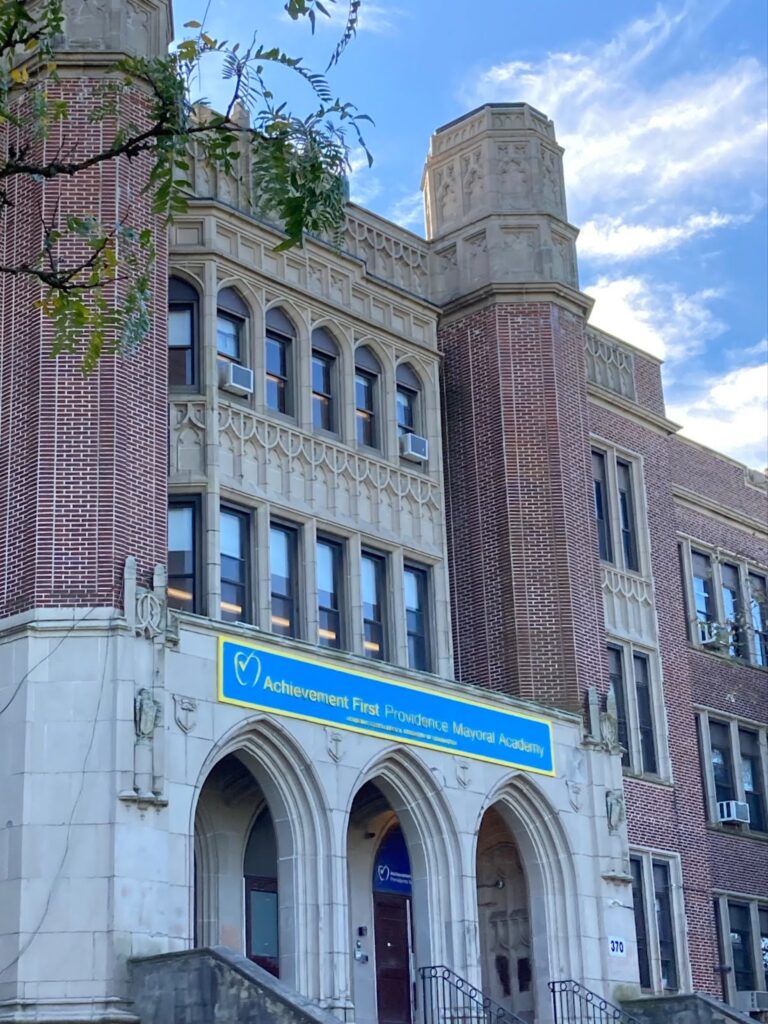
RIDE has consistently increased the number of charter seats authorized, mainly for urban students in Providence, Central Falls and Pawtucket. At the same time, as overseer of PPSD, they have been working to reduce the number of district seats available. Charters may be good or bad, but they are not inevitable. Shrinking the district is a choice, not an irreversible phenomenon.
Is newer necessary?
In a city that prides itself on historic preservation, the sleek, ultra-modern and highly rectangular renderings of most of the planned new school buildings have raised some hackles. The demolition of stately old school buildings from the 1920s and 1930s has been even more contentious.
Project leaders argue that the PK-8 building model requires new construction to put small children close to ground level, to provide a balance of separation and safe sharing of common spaces among different age groups and to accommodate flexible learning spaces needed for dual language instruction and other “21st century learning needs.”
Detractors, such as the Providence Preservation Society (PPS) assert that project managers have skirted the laws requiring review of impacts on historic buildings and that they have not made good-faith efforts to reuse, rather than replace, existing school buildings even when renovations might cost less and yield higher quality. Some critics say that project managers have grossly exaggerated the costs of renovations in order to justify new construction.
The issue came to a head this past summer over the demolition of the Gilbert Stuart Middle School on Princeton Avenue in the Elmwood neighborhood. Many neighbors vocally but unsuccessfully opposed the demolition. The exterior walls began to come down this week. In a few years, PPSD will open a new PK-8 school on the site.
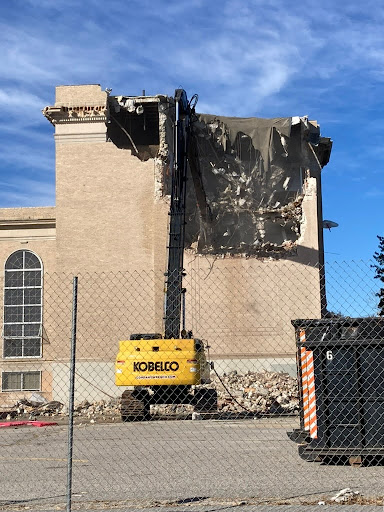
The Mt. Pleasant community was somewhat more successful at preserving the grand facade at Mt. Pleasant High School, but the south wing of the building will be entirely replaced with new construction.
Some question the quality of new construction. The old buildings have (or had) huge auditoriums and oak-paneled libraries. The new buildings will have “cafetoriums” and “media centers.” Sen. Sam Bell says the library at Mt. Pleasant will have only 12 shelves for books, according to Monday’s Providence Journal.
In any case, it’s not clear whether the promise to put all students in “new or like-new” schools by 2030 will happen. Zack Scott says that some buildings, like Webster Ave., Reservoir Ave., and Sackett Street Elementary Schools, will not get capital funded makeovers.
In a September memo to School Board members, PPSD leaders wrote that “Limited resources require clear prioritization among approved projects as current projects require increases in budget to meet programmatic needs.” Evidently the uncommitted funds from the Phase 4 bond are less than the total needed to complete the plan.
Word is now spreading among city and school officials that the city may propose yet another school bond issue for the 2026 ballot.
Are PK-8 schools better?
Experts have noted the emotional challenge of moving 11- or 12-year old students from small classroom communities in elementary school to often large and impersonal “mini high schools.” Data confirms a “middle school slump” in academic outcomes. Providence parents raised similar concerns with middle schools when RIDE created its “Turnaround Action Plan” for Providence Schools in 2020.
However, parents didn’t demand PK-8 schools as the solution to their concerns. Many parents worry that older kids may bully young children in a PK-8 building. On its website, PPSD makes the case for PK-8 and addresses those safety concerns. Still, the national research on K-8 schools is dated, inconclusive and relatively thin.
Whatever the merits of PK-8 schools, only half of Providence students will attend them when the plan is complete. The other half will stay in old-model elementary and middle schools when the plan is complete.
The newer and fewer incentives clearly were part of the decision to build PK-8 schools. Combining two school buildings also generally leaves an empty school behind, as happened at Carl Lauro Elementary. It will happen again when Lima Elementary vacates its half of the Leviton building and moves to the new preK-8 building on the Gilbert Stuart Middle School site.
Those empty schools are highly sought after by charter schools, which have more authorized seats for students than buildings to put them in. Earlier this year, the City Council refused to let the city lease the Lauro building to Excel Academy as resistance to further charter expansion in Providence strengthens.
Whose plan is this?
In Rhode Island, school construction is generally managed by each city and town in coordination with the local school district and school board. The city has engaged Downes Construction as its “owner’s representative.” Joe DeSantis at Downes has been the city’s lead on school construction since 2020.
RIDE’s School Building Authority reviews and approves every step of the process from concept through design and construction before eventually authorizing the crucial reimbursements that make projects feasible.
RIDE’s extensive regulatory requirements and financial incentives already give RIDE an outsized role in what new schools in Rhode Island will look like. Here in Providence, where RIDE also controls PPSD, RIDE not only approves the plans, but also plays a huge part in creating them in the first place.
In the absence of an empowered School Board, a little-known body called the Providence School Building Committee (SBC) seems to be standing in as the official community representative for the capital improvement plan. The SBC is a multi-party body with Mayoral, City Council, School Board, PPSD and community representatives as well as a delegate from RIDE.
Although the SBC has public comment on its agenda, members of the public have rarely found their way to SBC meetings, which are held at 4pm on Thursdays at the PPSD central office building. The SBC failed to even file minutes of its meetings online for more than a year until a community member brought the lapse to their attention this summer.
Who made the decision? Who approved it? With so many players, many observers, including elected officials, find it hard to say,
Who is this plan for?
School Board President Ty’relle Stephens recently questioned the fundamental premises of the capital improvement plan. In a letter to the City Council’s Health, Opportunity, Prosperity and Education Committee, Stephens said that the building plan is structured in a way that “suggests that RIDE is pursuing a strategy what will ultimately reduce the size of our school system.” He pointed to planned PK-9 schools that will have fewer total seats than the two schools being merged.
After recent changes, Stephens now says he supports the school building plan.
At first, fellow School Board member Corey Jones was skeptical of the idea that the building plan is actually intended to shrink PPSD and grow charter schools, but, he says, “The parts line up to match the pattern.” He says PPSD is doing good work, “but the trend seems to be for charters.”
The capital improvement plan is much too big to be all about any one agenda. Providence students need better schools and parents and teachers naturally look forward to their first day in a brand-new school. New spaces will support innovations in STEAM, in dual language instruction and in career and technical education. New buildings will have lower energy and maintenance costs and even solar power at some future time. The PK-8 model may (or may not) prove to be the answer to social-emotional and academic problems at middle schools.
Still, RIDE’s policy of expanding charter approvals that drain students and revenues from a school district it oversees raises a question of conflicting purposes in the building plan. By keeping discussions focused on the specifics of individual school plans, PPSD and RIDE have avoided allowing the Providence community and our elected representatives a real chance to learn about, discuss and decide on the most lasting impacts of this capital plan.
Do we want to lock in a downsized public school district in newer and fewer buildings? Do we want to delegate the education of a third of Providence students to charter schools overseen by the state instead of local officials? Do families really want preK-8 or are they just being told they do? Are we getting good value for our $1 billion investment?
RIDE’s takeover will end, perhaps as soon as next June. Whenever that happens, it will be the School Board’s job to ask the community questions like these and advocate for the community’s vision.
Jonathan Howard is Co-founder of Cause & Effect, Inc., a consulting company that provides strategic planning facilitation, fund development planning and board strengthening to mission-driven organizations. He is a long-time resident of Providence.
Correction: In the original version of this story, we inaccurately stated that Providence Preservation Society’s opposed the demolition of Gilbert Stuart Middle School. PPS does not oppose school demolitions that follow a thorough process of required reviews and public input. Their full position is stated on their website.


Want to comment? Click!