


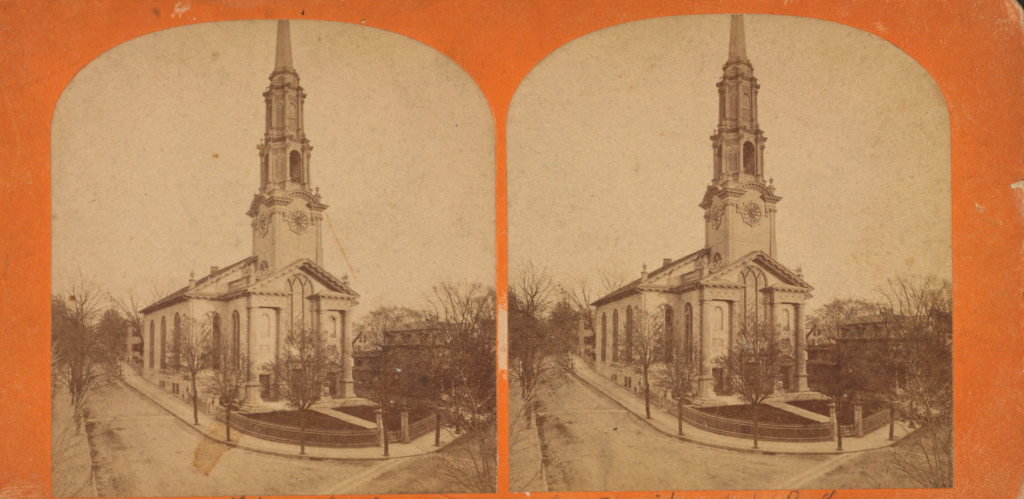
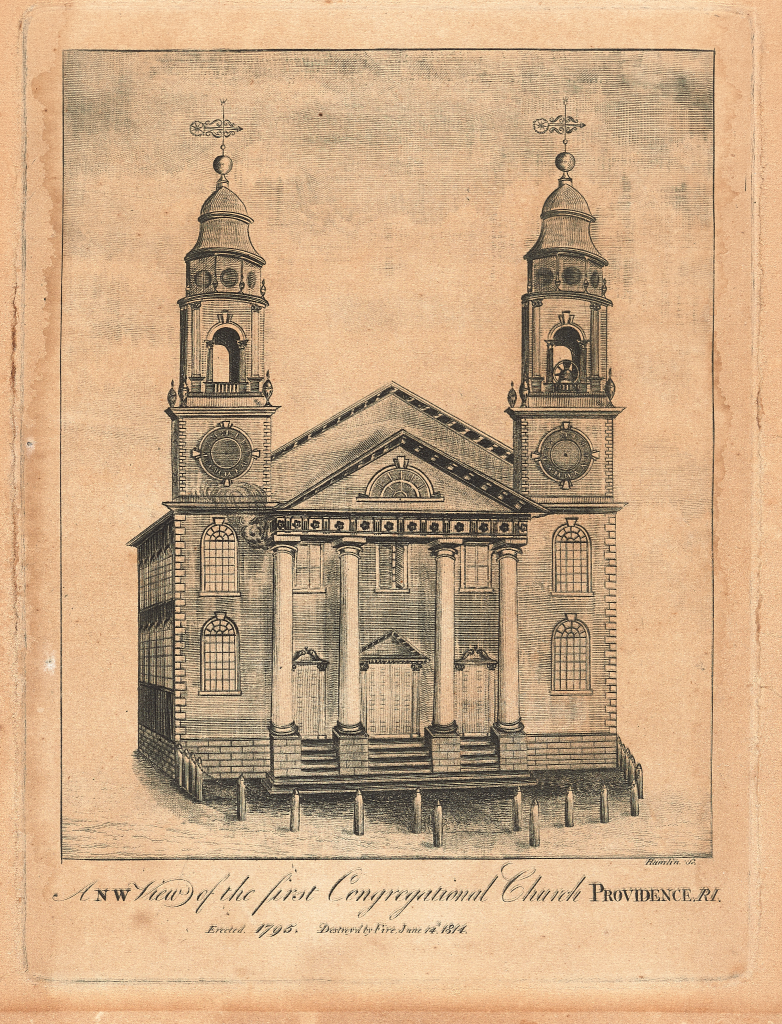
Situated across the street from the Hope Club, a private social club on College Hill, and outfitted with the biggest bell ever cast by Paul Revere & Sons, the First Unitarian Church looks like an imposing historical institution. It is that, but it’s not solely focused on the past. These days, the church is also a hive of justice-focused activity, ranging from solidarity work with at-risk immigrants and trans folks to gun safety advocacy and environmental action.
Add to this mix, increasingly, a growing commitment to active antiracism. First Unitarian seeks to become a church for the city, energized by the involvement of everyone who lives here, not simply its mostly white and mostly middle-class current members. And in order for the transition to have integrity, this 305-year-old congregation’s pathway to a more diverse and engaged future needed to begin in a reckoning with its complicated past.
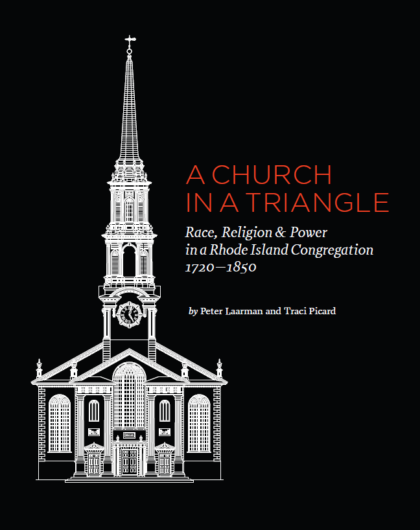
As the church approached its 300th anniversary in 2020 amid the context of the increased nationwide conversation around racial injustice — which included protests following the murder of George Floyd in Minneapolis and the ensuing international support for the Black Lives Matter movement — Senior Minister Liz Lerner Maclay and key lay leaders agreed that it was essential to acknowledge and understand the involvement of early church members in slavery and slavery-related businesses. Preliminary research into this aspect of the church’s history had begun prior to the COVID epidemic, but the work really intensified in early 2022 when the church was able to hire Traci Picard, a Brown-trained public historian, to assist in archival research efforts and write a cumulative report of these findings. That substantial book-length report, titled A Church in a Triangle: Race, Religion & Power in a Rhode Island Congregation,1720-1850, was published by the church in March of this year. The cover, which depicts a striking illustration of the church, was designed by RISD graphic arts professor Ernesto Aparicio.
The team expected to find evidence of early church member involvement in slave trading and domestic enslavement. We found plenty of that, and we decided immediately that we would highlight what we were able to learn about enslaved, indentured, and otherwise abused people in the central section of the book, titled “Say Their Names.” It soon became obvious to us that this book, while focused through the lens of the church, offered an approach to understanding the economic and cultural history of Rhode Island and its capital city in relation to slavery’s early shaping of American capitalism.
It is quite widely known, for example, that this small colony was a rum distilling powerhouse during a time when rum was used as currency to purchase captive people on the coast of Africa. Rum formed the foundation of the Triangular Trade. What is far less well understood is how Providence took the lead in a resurgent slave trade following immediately on the heels of the Revolutionary War, when the sugar economy was waning and the cotton economy was on the rise.
Church members were significantly involved in this “intra-American” trade, as enslaved people were shuttled from Caribbean sugar islands to Savannah, Charleston, and New Orleans before the window closed on slave importation in 1808. Once the cotton gin became commercially viable in 1794, the tens of millions of acres of land stolen from Native tribes were opened to cotton production, prompting the forced removal of nearly one million enslaved African Americans from the Tidewater region to the Deep South.
Church people were deeply involved in these fateful events. John Clark Nightingale, the son of Providence-based rum distiller Joseph Nightingale (builder of the mansion at 357 Benefit Street), went south in 1795 to marry the only daughter of Rhode Island-born Caty Littlefield Greene Miller and thereby gain control of a large Cumberland Island plantation. Caty Miller herself was Eli Whitney’s host at her Savannah River plantation and a primary investor in the firm promoting young Whitney’s invention.
Young Nightingale was among many church people who relocated to the South to take advantage of the cotton boom. Families here that had been heavily invested in slave-produced sugar quickly pivoted to investment in processing slave-picked cotton, as Rhode Island became the cockpit of North America’s industrial revolution during the first half of the 19th century. The many “north-by-south” connections we found in church records, especially the family and business links between Providence and Low Country Georgia, were eye-opening.
It goes without saying that “cotton mill fever,” as it was then called, affected the politics of both church and state. With its most expensive pews owned by many of the state’s leading cotton investors, the church became the center of anti-abolitionist sentiment during the tumultuous 1830s. A liberal theology — Unitarianism — did not translate into a liberal politics.
The church also contributed significantly to the emergence of a racialized caste system during this period. Its elite women founded and operated well-intentioned citywide charities, but these charities also entailed a degree of social control. One of them, the Female Employment Society, only survived the terrible Panic of 1837 by having low-income Providence seamstresses sew thousands of pairs of pants made of “negro cloth” for shipment to Southern plantation owners. When rising anti-Black racism fueled four days of rioting in the Snowtown and Olney’s Lane neighborhoods during the summer of 1831, church member and Brown chancellor Samuel W. Bridgham seized the opportunity to be elected the first mayor of Providence by running on a racist law-and-order platform.
Today’s First Unitarian Church leaders are well aware that publishing a book, however substantial, is only a first step along the antiracism journey. In late May, the church opened its doors to a weekend of education and performance, launching a new exhibit under the rubric “Owning Our History,” which included a two-part immersive experience produced by the multitalented RI actor and writer Rose Weaver called “Haunted by History/Healing from History.”
The church is now in the process of creating place-specific curricular materials focused on the research findings included in A Church in a Triangle, including walking tours, a book club, and curriculum for both adults and children at the fifth-grade level.
To learn more, see the exhibit, or obtain a copy of the book, you may contact the church office: 401-421-7970 or visit firstunitarianprov.org.
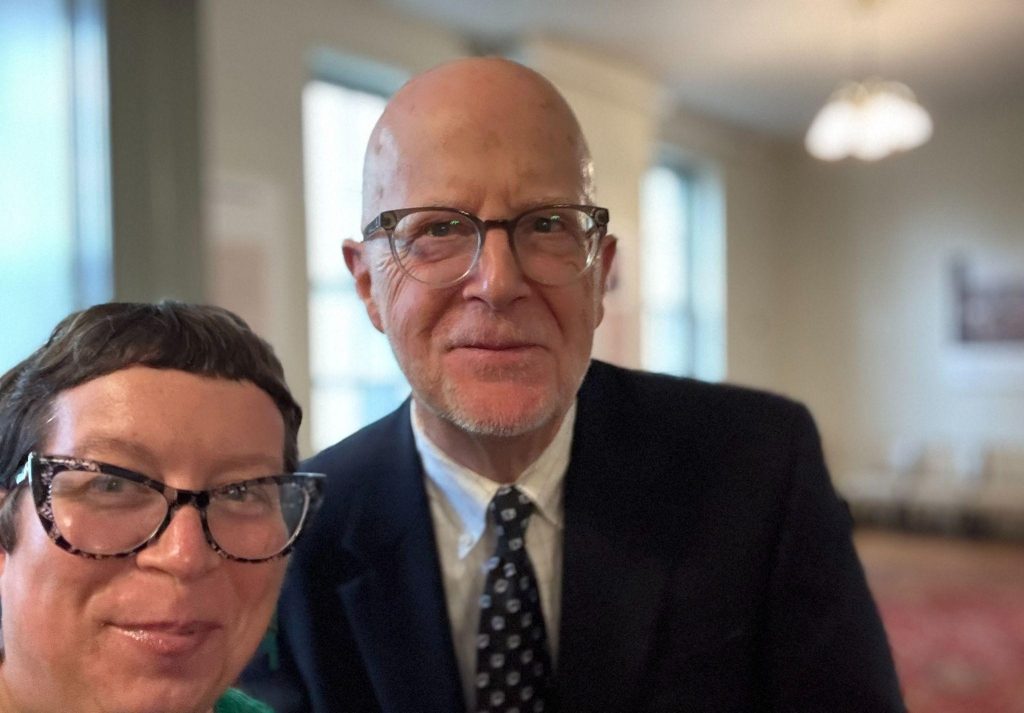
Rev. Peter Laarman moved to Providence from Los Angeles in 2019. A retired minister and lifelong justice activist, he helps coordinate the King & Breaking Silence Project of the National Council of Elders while continuing to write for Religion Dispatches, LA Progressive, and other publications.


Want to comment? Click!