






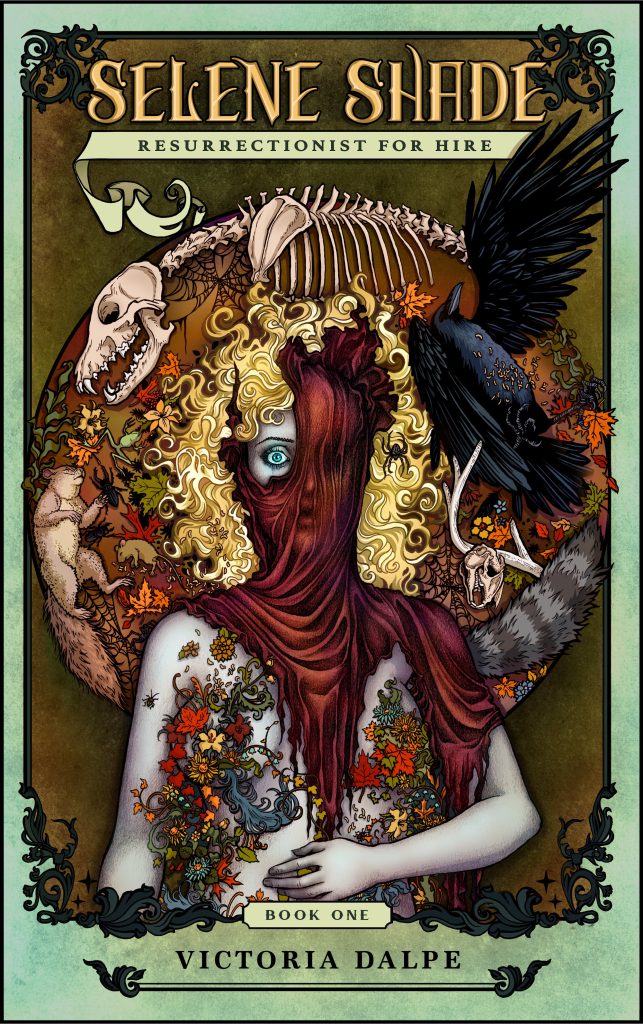
Selene Shade runs a successful small business in Goat Hill, a quirky little city that will strike readers who know Providence as distinctly familiar. Which is good, because Shade’s line of work is distinctly strange. Shade’s a resurrectionist: She raises the dead for a living. Because her job is creepy and her talents hard to explain, she keeps others at a distance, which makes for lonely nights. With this darkly quirky novel, Providence writer Victoria Dalpe explores what it means to live well in nonconformity, to be true to your own weird self while also having a life.
As the novel opens, Selene is tasked with figuring out who or what is behind a rash of brutal murders in Goat Hill. The victims are all female and mostly young. As it turns out, they’re also resurrectionists. Selene is a target; so is her dangerously naïve assistant, Germaine. Little is known about the murderer, an otherworldly and powerful being that shows up in unexpected places, swaying and keening and generally behaving like a restless animal in a zoo enclosure. The being, called the Porta Nigrum, seems to come from another dimension, and its appearance is announced by strange, strong winds and bizarre shadows. It is always looking for an exit.
Selene is great company: funny, self-deprecating, complicated. She’s appealingly vulnerable, having been orphaned at a young age. Horribly, she discovered her resurrectionist powers at her parents’ joint funeral, a trauma she’s never quite managed to integrate or contain psychologically. As the novel begins, she’s also grieving the loss of her beloved teacher and business partner, an older woman named Dot, who also had the special resurrectionist’s gift. In addition to scars and wounds, Selene also has rivals and enemies who make enough trouble to keep her life interesting. Despite her difficult and alienating work, she has created an exciting life for herself. Still, she’s lonely. As a person with a spooky and incomprehensible talent, she finds it hard to get a date.
She is relieved, then, to meet Marlow, a vampire detective who’s also a real sweetheart, the sort of guy who quotes Poe from the high-end sofa in his beautifully refurbished loft apartment. Marlow is an all-around improbable character — smart, literate, incredibly handsome, and from all appearances, rich. Instead of portraying him more realistically (realism is not the point here) Dalpe has fun with this unlikely love interest, who gives her the opportunity to wink at the reader. On her first visit to Marlow’s place, Selene is overawed. “It looks like a magazine showroom in here,” Selene tells him. He replies teasingly, “Well, thank you. When not working I am often home, alone. Reading interior design magazines.”
Dalpe’s worldbuilding is wonderful, richly detailed without being overwhelming. The novel is set in a place and time that’s generally not too different from the here and now. (Goat Hill seems very familiar and surely must be named for the writers’ association that runs teen programs at School One.) There are differences, such as the widespread acceptance of paranormal activity in everyday life, and of people like Selene and Marlow, who have special talents in this area. Police investigations routinely involve experts in the supernatural, and university curricula include paranormal studies, courses like “preternatural bio” in which the biology and anatomy behind a resurrectionist’s talent are explor
As a reader I’m not usually attracted to fantasy. When characters don’t have to struggle with recognizable realities, it’s hard for me as a reader to make sense of what their struggles reveal about them personally, as opposed to what their struggles reveal about their world. In other words, the focus in fantasy is usually squarely on the fantastic world and its mechanics, leaving less space for character development. Instead the characters are cartoonish, and indeed the characters in Selene Shade are drawn in broad strokes. But they are fun — enjoyable — and they do have one problem that’s utterly realistic. Even in a world where unusual and even monstrous talents are normalised, people like Selene still feel like outsiders. In a tender moment that won my heart, Marlow raises a glass to Selene, saying: “Here’s to the lonely road of monsters.”
A playful writer, Dalpe is willing to risk a false note or cheap joke. Some character names, like Peter Partridge, are excessively twee; others, like Dorothea Wraith, are simply too on-the-nose. And while Dalpe’s straightforward prose style keeps the story moving, readers bothered by misplaced modifiers and pronouns with ambiguous referents may find the book tough going despite its propulsive plot. These quibbles aside, I had a hard time closing the covers on Selene Shade and her friends. Dalpe’s storytelling kept me reading late into the night. A sequel is scheduled for publication this fall, just in time for spooky season. I’ll keep the light on.
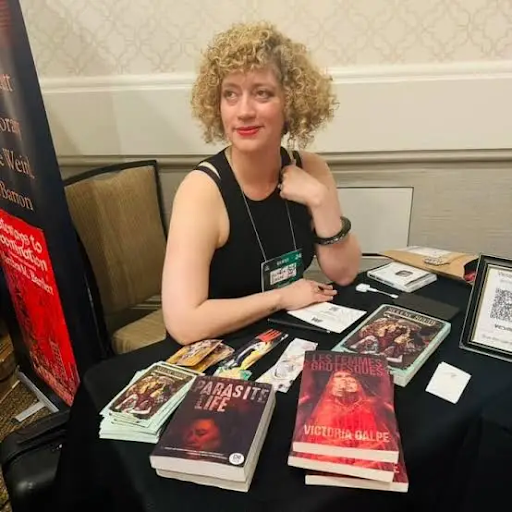
Victoria Dalpe is a Providence-based horror writer and painter. Her short fiction has appeared in over forty-five anthologies. Her previous books include a short story collection, Les Femmes Grotesques and the gothic horror novel Parasite Life. She is a member of the HWA and the New England Horror Writers.
Diane Josefowicz’s writing has appeared in the Boston Globe, Dame Magazine, LA Review of Books, and Conjunctions. Her next book, Guardians & Saints: Stories, is forthcoming in October from Cornerstone Press, and her second novel, The Great Houses of Pill Hill (Little Place of Departed Spirits) will be published by Soho Press in 2026. Sign up for her newsletter, “What’s That Noise?” at www.dianejosefowicz.com. She lives in Providence.


Want to comment? Click!