



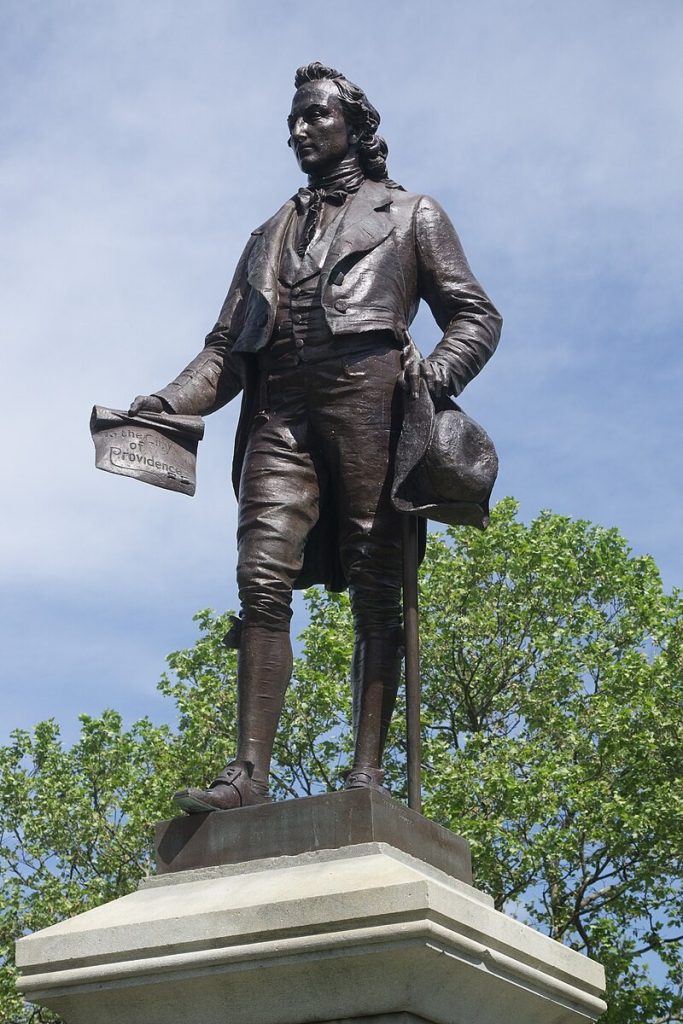
In the early days of the American Republic, Ebenezer Knight Dexter enjoyed a successful career in Rhode Island mercantile and land trade, enough to become one of Providence’s greatest philanthropists after he died in 1824. He left two impressive properties, one on the East Side of Providence and one in the West End. Dexter declared his East Side property to be dedicated to the poor and nothing else, ever. His West End property was to be a military Training Ground, with no buildings for entertainment, nor public executions, ever. Maintaining the certitude of his will for two hundred years has proven difficult. Dexter’s love for Providence is entangled even today with unresolved issues, in both the East Side and West End of the city.
On the East Side
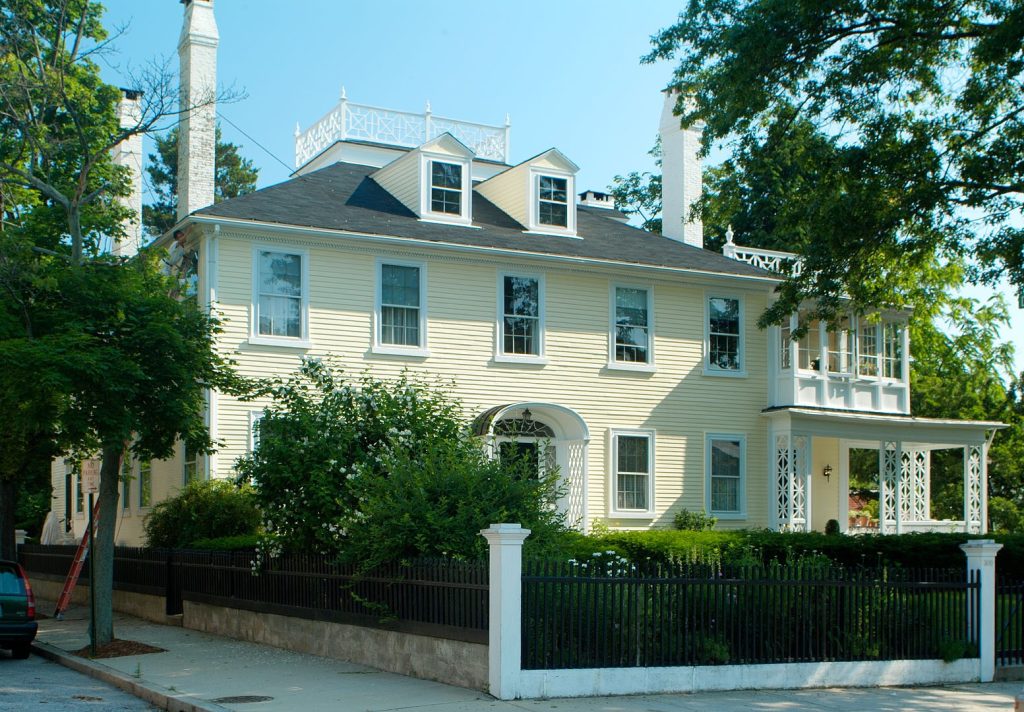
Dexter’s home still stands at 300 Angell Street. His farm, marked off by the stone wall proscribed in his will, provided for poor freemen of Providence for over a century. An almshouse was built and maintained until 1957 when the last inmate left. Dexter had no children, so when it no longer served the poor, more than a hundred heirs approached the court in 1949 to return the property to them. They figured that, since the city could no longer follow Dexter’s will which specified the land could never be sold, it should be returned to the family. The court fight lasted nearly a decade until the RI Supreme Court finally allowed the city to sell the land provided the money was used to support the poor.
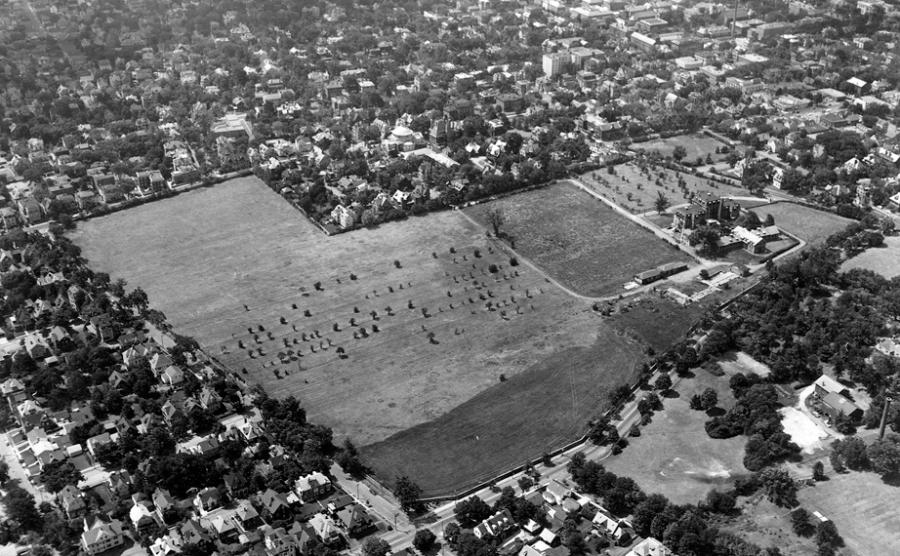
Brown University submitted the highest bid by far, just over a million dollars for Dexter’s farm. Today Brown’s athletic fields and multiple facilities occupy the space. Not without irony, history has thus seen property dedicated to the poor for two hundred years now in the hands of an elite institution. Had the city taken a lower bid that allowed residential development, it would today be collecting taxes on $150 million worth of real estate.
The settlement of Dexter’s East Side donation set up multiple conflicts. The money paid by Brown went to the city, but governance remained in the Commission set up by Dexter’s will. The will specified that a bell should be rung four times at fifteen-minute intervals every year, calling all “freemen” to a meeting. A quorum of at least forty would then elect six Commissioners who would choose a Chair to oversee his donation to the poor. The City eliminated the bell ringing and moved the election of Commissioners to a biennial event.
Dexter Donation Shenanigans
After a lull, a series of struggles for control of the Commission began. In 1965, Mayor Joseph Doorley saw the Dexter investment, according to the Providence Journal, as “idle funds.” Interest was accumulating and Doorley proposed a use. Although Dexter’s money was not to support existing programs for the poor, Doorley argued that the federal distribution of surplus food qualified as “new” since Providence was not participating, arguing “it lacked facilities and staff to handle distributions.” Doorley claimed that an annual expense of $50,000–$60,000 could be covered nicely by the Dexter money. At one meeting a Commissioner argued that the fund was created to give relief to the poor, not the taxpayers. Doorley’s attempt to use the fund kicked off another two decades of conflict over how to dispense the Dexter money, who might be eligible to receive the money, who could dispense it, and who could stop it.
The Dexter Donation funds proved attractive to other mayors. Mayor Buddy Cianci wanted to buy coats for the poor one winter. The Chair of the Commission said there would not be a meeting until spring to entertain his request. Buddy then discovered when the election of Commissioners was scheduled. He showed up with over a hundred city workers and elected a more favorable group. When Buddy got his coats from The Outlet (a now defunct department store), he gave them out at City Hall.
Ray Rickman served two terms on the Dexter Donation Commission in the 80s. Getting onto the Commission, he explained, involved turning out supporters at the open election meeting described in Dexter’s will. Since the meetings were not widely publicized, the key to influencing the Commission was gathering enough Providence “freemen” to vote—the political jockeying of getting enough voters to show up often produced surprises. Rickman, who is Black, surprised the “old guard” Commissioners when he was elected; Rickman, himself, was subsequently outmaneuvered by Mayor Joseph Paolino who called city employees to the election, which was coincidentally held each year in City Hall.
The city treasurer Stephen Napolitano joined the conflict in the 1980s by halting certain distributions that he thought did not contribute to “the amelioration of the poor.” For several years, allegations of grants violating Dexter’s will flew back and forth. After a battle over the chairmanship of the Commission, the sitting mayor automatically became Chair. Cianci was the first to attend meetings and run them himself, not by proxy.
Yet another battle was fought over voter eligibility in the election of Dexter Donation Commissioners. Dexter specified that a minimum of forty “freemen” of Providence was needed to hold the election. In the 80s, the city argued that “freemen” meant citizens, people eligible to vote in other elections. When he was Chair, Rickman argued that Dexter did not use, nor imply, that terminology. He claimed that the Commission was established with its own power; it could determine who could elect its Commission who would then appoint the Chair. Rickman read Dexter as saying one need only be a Providence resident. The question of voter eligibility was being raised at a time when Providence saw an influx of new immigrants, Asian and Hispanic. Practice wavered back and forth over elections (as recent as 2016 any resident of Providence could vote in this election), but both points were eventually lost. Today, the Commission Chair is automatically the current mayor, and only registered voters can elect Commissioners.
The 2016 Dexter election raised controversy over the voting process. Local WPRI described the Commission election that year as “a political coup” that Mayor Jorge Elorza had survived. As Chair of the Commission, Elorza came to the election with a slate of five Commissioners. A coalition assembled by Ana Quezada and Luis Estrada submitted an alternative slate. As usual, the election was held in City Hall, where the mayor and his slate prevailed. Even though the opposing slate brought out twice as many people to vote as in the previous year, fewer than 300 votes were cast out of the population of Providence. Election results historically have turned on the fact that most voters in Providence are not aware of the election they can vote in, and the fact that voting takes place in the confines of City Hall, any mayor’s “home turf.”
In the West End
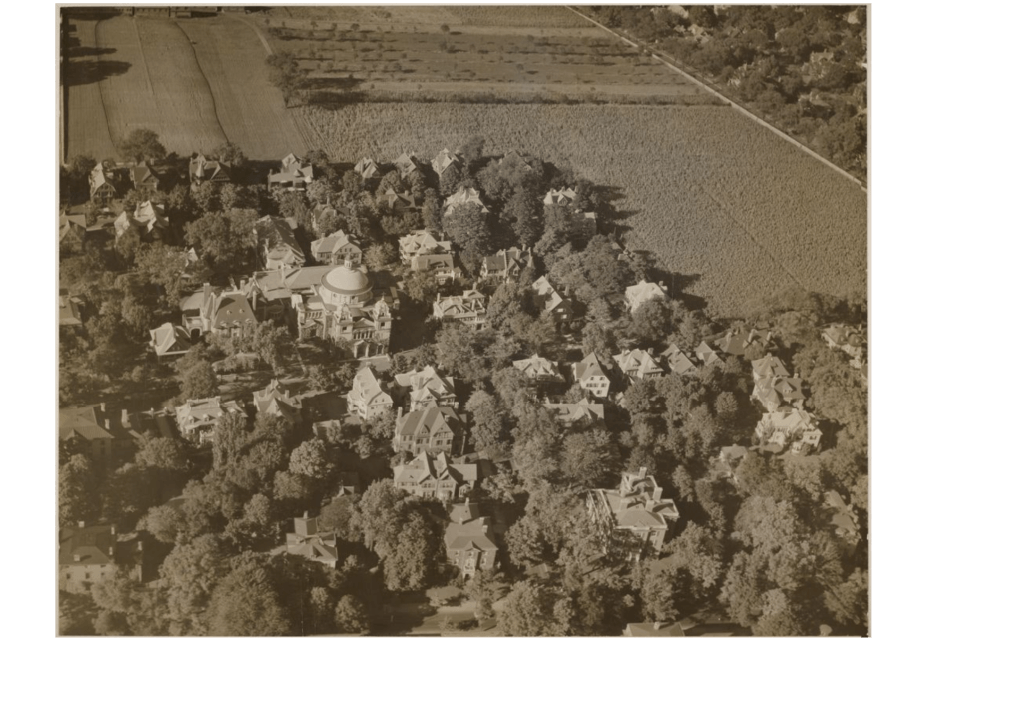
Meanwhile, by the mid-twentieth century, on the other side of town, Dexter’s second legacy, the nine-acre Dexter Training Ground, adjacent to the Cranston Street Armory, had drifted into neglect from the city and the economy. A Providence Journal article in 1978 described the Training Ground as “a seedy looking lot . . .[strewn with] beer cans, broken glass, and litter.” By 1983, the West Broadway Neighborhood Association (WBNA) was organized to advocate for homeowners and the changing neighborhood. The Victorian homes in the neighborhood and especially those that lined two sides of the Training Ground, on Dexter and Parade Streets, many neglected at the time, became critical to reviving interest in the historical heritage of Providence as represented in the West End. Dexter’s Training Field is now Dexter Park, a valuable greenspace amid a broadly expanded revitalization of homes and businesses.
The fly in this ointment is the massive Cranston Street Armory, erected in 1907, replacing a smaller armory adjacent to Dexter’s donation of a training field. Dexter’s field was first used for military purposes in 1841 when government troops were readied to do battle with Thomas Dorr, who was rebelling against the state’s slow recognition that citizens without property should enjoy the right to vote. Troops mustered there at the time of the Civil War, and again during World War I. It housed the National Guard until 1996. Since then, the Armory has made the Providence Preservation Society’s (PPS) endangered properties list almost every year the list has existed. Plans for re-use have come to little, and it has sat empty for most of three decades. (See The PVD Eye’s article on the Armory)
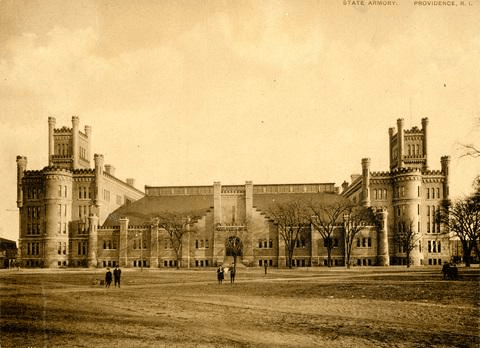
Change has outpaced Dexter’s firm intentions for both his asylum and training field. Unlike his East Side property, however, few were fighting over the environs of Dexter Park at the time the farm became such a prize for the university. The training field, nearly a hundred years after Dexter, lay in the shadow of a monstrous facility. Part of a national trend to build massive, fortress-like armories, Rhode Island’s armory was situated in a neighborhood of immigrants who worked the industrial jobs of a strong economy. The armories were designed to quell labor unrest, and the fact that Providence did not have major unrest, according to Taylor Polites, local educator and writer, “did not mean it had no anxiety.” The architecture of armories across the country conveyed massive strength, often topped with castle-like towers. Providence avoided significant labor violence, allowing the city to write the Armory “an alternate history.” Rather than defining the spaces as military only, the grand central event space of the Armory was likely filled with thousands of visitors for civic events. Within a year of its opening, the largest building in the city, according to Polites, hosted “the biggest trade dinner in America,” seating twenty-five hundred in the main hall. As recently as 2015, the Armory hosted the inauguration of Mayor Jorge Elorza.
The Cranston Street Armory is owned by the state whose most recent plan for redevelopment was widely supported in the Armory neighborhood. Scout Ltd, signed a contract in 2023 to “create office, retail, and event space” for between $50 and $70 million. After an ethics investigation into behavior in Philadelphia by state officials meeting with Scout, followed by an outside consultant’s reassessment of the numbers in the project, Governor McKee canceled Scout’s contract. Scout workers were setting up the huge open event space in the Armory to accommodate viewing of the World Cup when the deal fell apart.
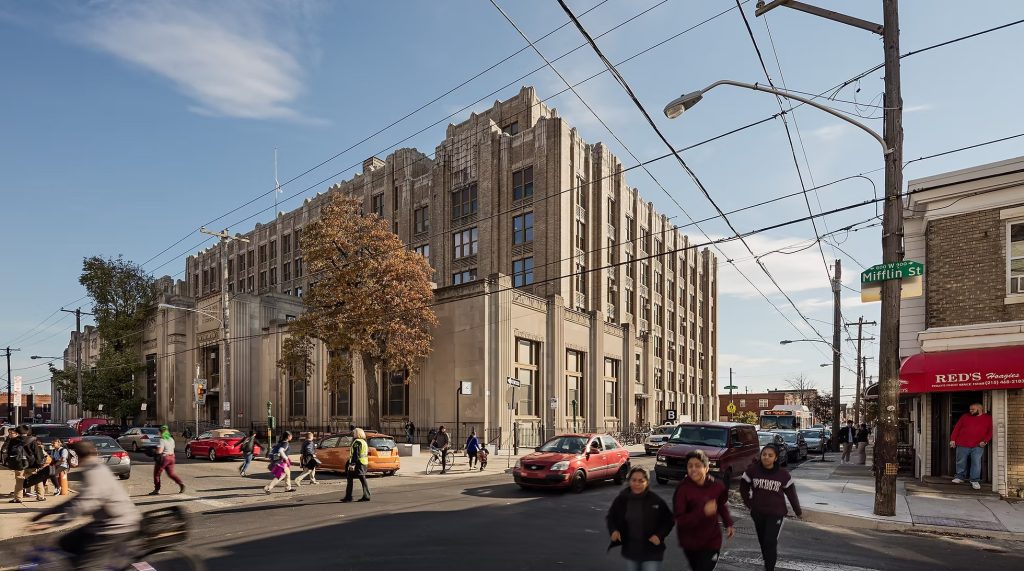
Scout’s proposal rested in part on the work it had done redeveloping a large abandoned school in Philadelphia, the Bok. There Scout created “a hub for makers, entrepreneurs, and. . . more than 200 businesses including musicians, glassblowers, nonprofits, photography studios, community playspace, a contemporary realist art school, an award-winning rooftop bar, and more.” Providence neighbors of the Armory had been hoping for a similar development.
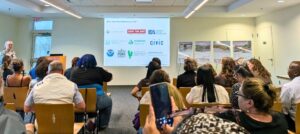
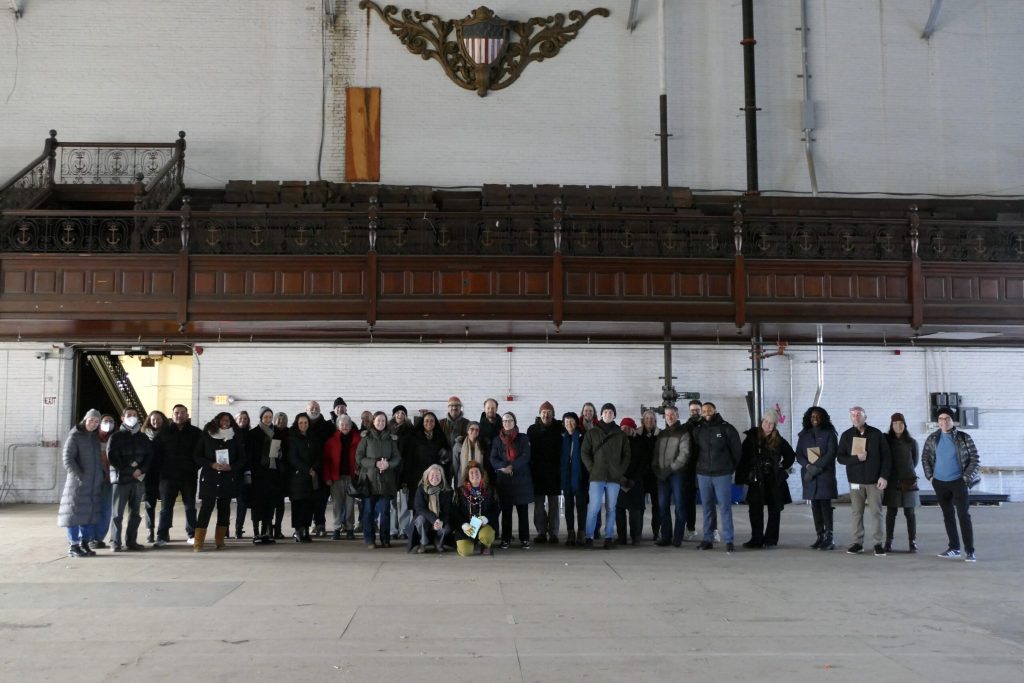
Since then, nothing. The City of Providence would like to own the Armory but not without supporting state funds. No level of government seems actively considering plans for the Armory. Instead, from the ground up, Marisa Brown, Executive Director of the Providence Preservation Society, and Siobhan Callahan, Executive Director of the West Broadway Neighborhood Association, have sparked considerable interest in the Armory’s future. PPS hosted a tour last month, led by Taylor M. Polites, for forty-five interested observers. Most participants, even those long-time Providence residents, had never seen the inside the Armory. The historically significant structure has long been on the radar of PPS, who supported the Scout plan.
Other cities currently struggle with what to do with their armories. Joining the Armory tour in Providence was Sandra Lobo, Executive Director of the Northwest Bronx Community and Clergy Coalition, who was the guest speaker for the annual meeting of PPS. She outlined her decades of lobbying and demonstrating on behalf of the Kingsbridge Armory in the Bronx, “said to be the largest armory in the world. . . more than three times the size of the Cranston Street Armory and . . .vacant for just as long.” After the tour, Lobo shared what she has learned from three decades of advocacy: a commitment to community organizing as a means to legal assurance that any development of the Bronx Armory will directly benefit the neighborhood. Kingsbridge is still seeking the right developer. A lively discussion between Lobo, preservationists, and others from the tour, followed in the WNBA quarters on Westminster Street.
Dexter wrote his will for a future he trusted but could not have predicted. The legacy fund today from his East Side farm comes to approximately $8 million, with the Board of Commissioners accepting and disbursing $200,000–$400,000 annually, having reviewed and selected winning proposals from a formal application process.
Dexter’s farm has served Brown well with “athletic grounds, with a skating rink, aquatic center, tennis and squash courts, gymnasium fitness, both competitive and practice fields for football, baseball, lacrosse, and . . . the school’s massive ‘facilities’ operation and central heating plant.” But his West End Training Ground, a central green space for several of Providence’s diverse neighborhoods, awaits the redevelopment of the nearby Armory to complement and energize Dexter’s gift economically. Inertia has been frustrating and costly; although the state has made needed repairs on the Armory over the years, a recent budget has made cuts in the millions needed just to maintain it. Polites began the Armory tour by noting that it is the time “to restart the conversation” because “it doesn’t have a clear future right now.”
Sandra Lobo’s ongoing fight for the Kingsbridge Armory helped restart the conversation in Providence with those who gathered after the tour. West End residents, activists, and preservationists look to a better future for the Armory and Dexter’s legacy, one that might serve the West End and the entire city as fully as his East Side farm serves both Brown University and the poor of the city.
Roseanne Camacho is a retired educator who came to Providence from the South for graduate school. She has a Ph.D. in American Civilization from Brown University, having taught students from eighth grade to graduate school. She is active in the Friends of Knight Memorial Library, the Community Library of Providence, and lives in Elmwood.
Editor’s Note: The Providence Eye republished this article on July 2, 2025. Sadly, Roseanne passed away in April of this year. We miss her dearly, and are proud to reshare her article with our readers. You can read more about her life in her obituary here and a note in memoriam by fellow Board member Carole Saltz here.


Want to comment? Click!