





Editor’s Note: After the recent resignation of Ward 2 Councilwoman Helen Anthony, a special election is scheduled for Tuesday, December 2. Primary elections will take place on November 4. In advance of the election, the Eye is publishing op-eds from candidates. You can read Matt McDermott’s essay from last week here.
The health of our public schools is one of the most urgent and consequential issues facing Providence – for the future of our children, the future of our democracy, and the future of our municipal finances. We need city leaders who have deep experience with school systems, proven ability to bring people together, and real respect for and ability to collaborate with the diverse communities in our city.
I’m running for the City Council in Ward 2 with decades of hands-on experience with Providence schools as a parent, a parent organization leader, and a national education advocate. My experience with Providence schools runs deep. My family moved to Providence in 2004, the year before our oldest son started kindergarten. We chose Providence in part because we wanted our children to attend public school. My three sons attended Dr. Martin Luther King, Jr. Elementary, Nathan Bishop Middle, and Classical High Schools. They made friends, learned, and joined teams and clubs with children representing an incredible range of ethnicities, national origins, and economic backgrounds. My kids learned alongside students from different neighborhoods and nations, and their worldview expanded. As they built relationships with people from across the city, they gained skills that set them up for success in life.
Like many parents, I spent hours volunteering and organizing with other families to make our schools better. I led the MLK, Bishop, and Classical parent organizations. I represented parents on a superintendent selection committee and other district-level groups. For 19 years, I worked with other families to advocate for our schools, and we saw that we were stronger together. We improved the city’s response to removing graffiti from school buildings – parents from a dozen schools together made the difference. Together we addressed the reliability of transportation, poor building conditions, and adequate time for recess. I was there not just for my own kids, but for the more than 20,000 kids in Providence’s public school classrooms.
At the same time I held a job in national school policy with the Coalition of Essential Schools (CES), a national network of hundreds of schools committed to equity, rigor, and engagement. I traveled across the nation visiting schools and documenting assessment, governance, professional development, and other practices that create the conditions for powerful teaching and learning. I saw how difficult this work is, requiring committed leadership, the right balance of support and accountability, and trust in young people, educators, and families. And I learned that progress does not happen without family and community voices demanding better for their kids.
When the city moved to close Nathan Bishop Middle School in 2006, I joined a group organizing to fight back. We didn’t just save Bishop – we helped reinvent it. Following the city’s commitment to rebuild Bishop, and the hard work of securing state funding, I joined Bishop’s district-level school design committee. Educators and community members studied best practices for strong neighborhood middle schools. When Bishop reopened in 2009, we pushed the district to allow Nathan Bishop to reopen gradually, adding a grade a year so teachers and students could build a strong school culture. We didn’t win every fight, but we stood up, and our neighborhood school is better today because of that advocacy.
Challenges continued, fueled both by the recession and national policies such as high stakes standardized testing which encouraged top-down management that made actual improvement at the school level much more difficult. In 2011, after several years of reduced school funding, Providence faced a dramatic fiscal crisis. The city laid off every teacher in every school, announced the closure of five schools, and proposed that seven other schools undergo major changes. The city didn’t include the people who were most directly affected in any of these decisions – students and their families.
After attending several community meetings which announced school closures and blocked open discussion, we had seen enough. Parents from across the city organized our own meeting with city leaders to insist that families from every affected neighborhood could be part of the conversation. We ensured that city leadership heard how their choices affected families. We didn’t stop the school closures, but we demonstrated that families care about our schools and that they can demand to be heard. Sadly, this period eroded trust among parents, the district, and the city.
The Rhode Island Department of Education’s 2019 district takeover has even further constrained community input. There is little transparency about curriculum, budgeting, school construction or school closures. Gilbert Stuart Middle School in South Providence is being demolished without input from community members. It’s a very different story from the fight to save Nathan Bishop.
It’s likely that the Providence Public Schools will return to the city’s control in 2026. Unfortunately, the state takeover, like most across the country, hasn’t resulted in improved achievement. And mistrust persists among families for the system that is supposed to shape their children’s futures.
The good news is that return to local control offers the opportunity to reimagine governance and strengthen the connection between the community, our school board, the city council, the mayor’s office, district leaders, and teachers. We have some direction with the Mayor’s April 2025 school transition plan and the school board’s summer 2025 community listening sessions. But we need to create real channels for leadership among teachers, parents, and students. Our city’s financial challenges should not prevent us from championing the voices of those most directly impacted by our schools. In fact, the collective energy of our neighborhoods is the only resource that will remain as budgets come and go.
I hope that the City Council can take up its responsibility to our schools and to championing the voices of our neighborhood families. The success of our schools is fundamental to our democracy, to the health of our city, and our collective future.
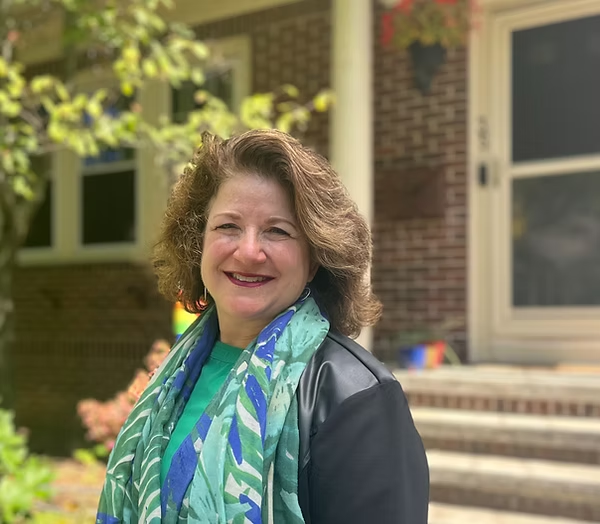
Jill Davidson is running as a Democrat for the open Ward 2 seat on the Providence City Council. She has lived in Providence for more than 20 years and works as an accomplished nonprofit leader and strategist dedicated to advancing equity, education, and environmental sustainability.


Want to comment? Click!