




Providence issued more than 50,000 tickets for overnight parking violations in 2025, the most the City has delivered in the past five years.
City residents without driveways or provided parking lots are gambling over whether to buy an expensive overnight parking pass or risk a ticket with Providence’s irregular parking enforcement. As housing density increases without expanded public transit options, the issue of parking continues to compound.
Providence’s current overnight parking permit program was implemented in 2012 under Mayor Angel Tavares, overturning a ban on street parking between 1AM and 7AM that dated back to 1928.
“The overnight parking program made it easier for residents of properties without off-street parking to legally park near their residence,” said Providence spokesperson Josh Estrella. “The hours were changed to recognize the early and late closing hours of many businesses in the city whose employees used on-street parking while at work.”
After a series of pilot programs that began in 2007, the City adopted the current permit process with promises that the change would protect green space from being paved over for parking, offer an affordable alternative to private lots, and — according to the Providence Journal at the time — bring the city revenue to brave its “Category-5 hurricane” financial crisis.
“To the extent we want our city to be more inviting and to be an area where population growth is encouraged, this was a move in the right direction,” said Scott Wolf, executive director of GrowSmart RI. “I certainly think the current system is better than the old one. I’m not sure the current system is everything it could be, and we probably should be revisiting what the cost is to purchase a permit.”
Comparing the Cost of Parking Permits Here to Other Cities
Providence’s overnight parking permits cost $100 per year for cars registered in the city, and $200 annually for those registered elsewhere, in order to park a car on the street between two and five in the morning. According to a Boston University study from 2022, Providence’s permits are some of the most expensive in the country. The average cost of an overnight parking permit for cars registered in over 100 other similar cities is $41, and nearly a third of cities in the study distribute overnight parking permits for free. Only 8% of the cities in the study charged $100 or more for permits.
“Providence charges more than double the average cost of residential parking permits, for vehicles registered both in and outside the city,” according to the undergraduate student authors participating in BU’s Initiative on Cities. “This finding is most shocking when paired with the fact that the Providence poverty rate is also twice the national average.”
The study recommends Providence lower the overnight parking program’s enrollment fee and discount permits for lower-income residents. Providence issued 5,392 on-street overnight parking passes in 2025 and has seen a steady increase in passes each year since 2021’s level of 1,660. That’s at least $539,200 in parking pass revenue last year, but the City brought in more revenue from fines for parking violations.
Sporadic Enforcement Leaves Residents Rolling the Dice
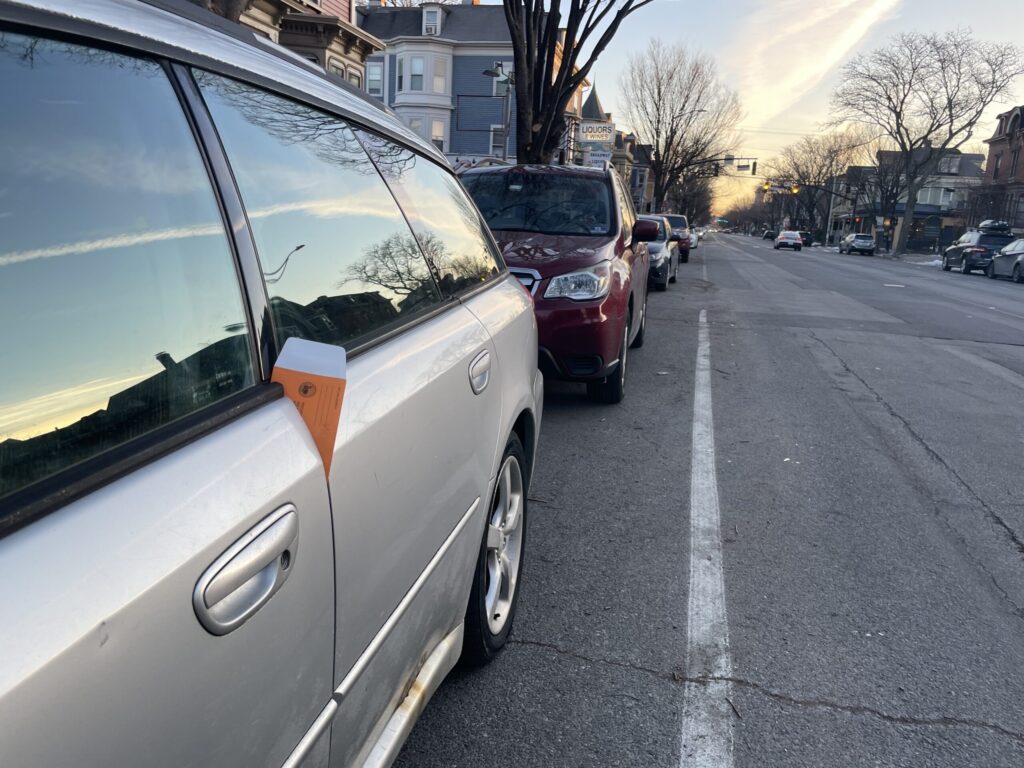
The city employs 25 non-sworn officers to monitor parking rules, and six of those officers are assigned to night shifts. Officers scan license plates using handheld devices connected to the city’s online permitting system, OpenGov, and issue a ticket that costs around $40 after fees.
“The parking was bad before the snow, and now it’s even worse,” said Jack, a postal worker who lives in another town but delivers mail in Olneyville. Jack’s route goes through parts of 02909, where he said lots of residents receive tickets and even boots on their cars. “If you’re asking me, I would get the pass… If they get me seven days in one week, forty times seven, it’s $280 in one week.”
Providence issued 51,845 overnight parking tickets in 2025, up from the 27,276 issued in 2020. Ticketing numbers vary from year to year, with the second highest annual total in the last five years being 46,913 overnight parking tickets in 2021.
“Regular enforcement creates clear expectations for all residents that permits are required to park on-street overnight,” said Estrella.
Providence officials said staffing changes, equipment issues, and weather can influence how many tickets the City gives out, but officers focus on ticketing in places where residents complain the most.
“Enforcement priority is given to areas with recent complaints of overnight parking violations,” said Providence Police spokesperson Kristy DosReis in an email. Providence’s website lists maps that specify where overnight parking is allowed in the city. “A Traffic Sergeant reviews complaints submitted through PVD311 and online reporting systems and assigns a list of streets for monitoring based on those complaints.”
As overnight enforcement officers address the sporadic reports of parking violations, some Providence residents are left guessing whether a permit is necessary on any given night. Annie Mun rents an apartment in Federal Hill and parks in an off-street lot provided by her building’s property management. Two weeks ago, her childhood friend was hit with a ticket despite visiting Providence for less than 24 hours.
“It seems to be fairly random when they choose to enforce it,” said Mun, an administrative assistant at a local law firm. The city issued 2,263 guest passes last year for $25 each, but guest passes are only available to those who already have city-issued parking permits. Without a street permit, Mun couldn’t provide a city guest pass. “You’re forced to gamble it or have to dig to find proper information.”
Although Wolf acknowledges this enforcement method may not be perfect, he said it is unrealistic for the City to police every street every night for parking violations.
“It’s probably not the fairest way, but I want to give the City administration a little bit of an acknowledgement that there are budget constraints,” said Wolf. “We have to provide a little bit of grace for policy that isn’t ideal, but that may be a defensible, practical response to limited resources.”
According to Providence Municipal Court officials, the city received $1,525,302 from overnight parking fines in 2025, but the total haul could tally up to $3,046,341 with the potential for any penalties, fees, or court costs. The numbers are subject to changes if the judge in a case reduces a fine amount or an individual is on a payment plan.
According to Mayor Smiley’s 2026 budget, the City projects to take in around $14.7 million dollars in total fines and fees—a $1.7 million increase from fiscal year 2025. It’s a small portion of the city’s total operating cost of $624 million dollars, but it could help Providence navigate another budget storm after settling with the state over chronically underfunding Providence Public Schools.
But parking policy will likely play an even larger role in Providence’s other crisis: housing.
How Parking Shapes Housing, and Vice Versa
The Boston University researchers found the majority of housing stock in Providence outside of downtown includes off-street parking, a likely result of the ban on overnight street parking in the city for over eight decades. However, off-street spots are occupying land in a city desperately looking to build more units and slow down skyrocketing housing costs.
“Space in our city is at a premium, and mandatory parking minimums have already led to the creation of overbuilt parking lots throughout the city, stifling development and stunting housing production,” said Dylan Giles, an advocate with the Providence Streets Coalition. Giles suspects this past fall’s cuts to Rhode Island’s public transportation are also increasing traffic in the city, if not forcing more city residents to purchase cars. “Riders report having to drive, or take expensive Ubers now, for trips previously made by bus.”
People in Providence may be forced to pay the high price of parking or ride a reduced public transportation system if Providence officials like the Mayor and City Council continue to encourage high density housing.
According to the City, parking permits are more commonly used in denser neighborhoods, and the city’s comprehensive plan aims to remove mandatory parking spaces wherever possible. GrowSmart RI’s Wolf said fair parking policy encourages housing development and should support a robust transportation system.
“In order to effectively address our housing crisis, we need to have more location efficient, dense housing production, and part of the way you achieve that is through parking reform and reducing minimum parking requirements,” said Wolf, who also hopes this year’s race for governor highlights the need to restore and expand RIPTA funding. “To the extent we make progress on either of these objectives, it may help us make progress on the other one.”
Editor’s Note: For detailed information to obtain parking permits and overnight passes, click here.
Eric Halvarson is a multimedia journalist with years of experience in digital media publishing. Originally from Cranston, he’s always up for an adventure and reporting on this city gives him a chance to explore all of storied Providence. Outside of work, Eric is gardening, reading science-fiction, playing volleyball, dancing and holding onto a sense of wonder.


Want to comment? Click!